What Is a Backflow Prevention Assembly and Why Is It Required
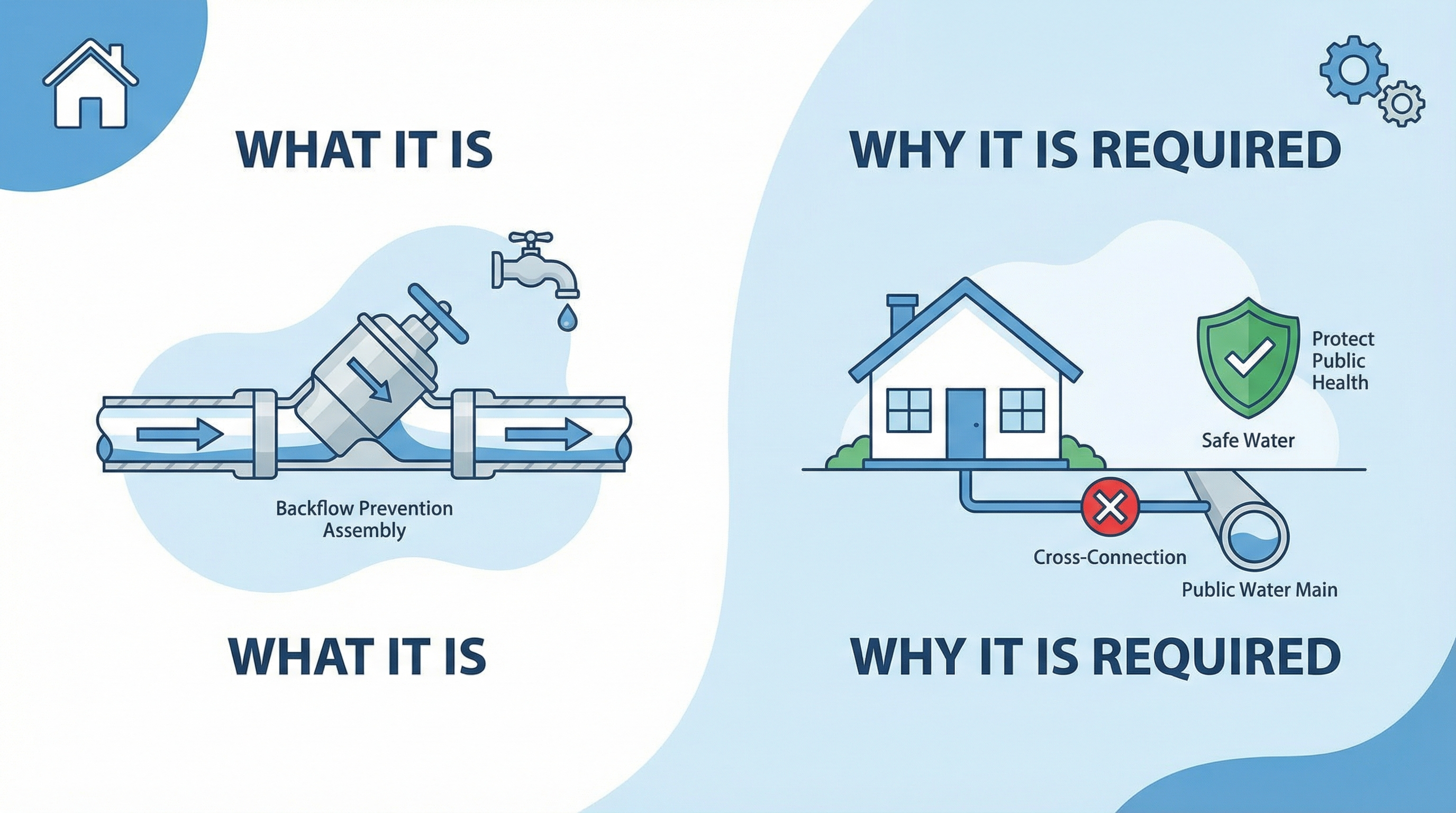
If you're a property owner who's been told you need a backflow prevention assembly — or you've received a testing notice for one you didn't know you had — you probably have some basic questions. What is this thing? What does it do? And why is it my responsibility?
This guide covers the fundamentals.
 Backflow prevention assemblies are installed at the connection between your property's plumbing and the public water supply.
What Is a Backflow Prevention Assembly?
A backflow prevention assembly is a mechanical device installed on a water supply line that prevents water from flowing in the wrong direction — specifically, from flowing backward from your property into the public drinking water system.
Think of it as a one-way gate. Water flows from the utility's distribution system into your property. The backflow prevention assembly ensures it can never flow back the other direction, even if conditions change (like a sudden drop in supply pressure or an increase in pressure on your side).
The word "assembly" is important. It distinguishes these devices from simpler, non-testable backflow preventers (like a vacuum breaker on a faucet). An assembly has test ports that allow a certified professional to verify it's working correctly using specialized pressure testing equipment. This testability is what makes assemblies the standard for protecting public water systems.
How Does Backflow Happen?
Backflow occurs through two mechanisms:
Back-Siphonage
When pressure in the public water main drops below the pressure in your building's plumbing, it creates a siphon effect — like drinking through a straw. Water (and any contaminants) get pulled backward from your property into the public supply.
This can happen during:
- Water main breaks
- Firefighting operations that draw heavy demand from the main
- Pump failures at the treatment plant
- High-demand periods in the distribution system
Back-Pressure
When the pressure in your building's plumbing exceeds the pressure in the public main, water gets pushed backward. This can occur with:
- Booster pumps in your building
- Thermal expansion in water heaters or boilers
- Elevated storage tanks on your property
- Chemical injection systems that create pressure
Both mechanisms are real, documented, and have caused contamination events. The Centers for Disease Control and Prevention (CDC) tracks backflow-related disease outbreaks as part of its waterborne disease surveillance.
Why Is It Required?
The requirement for backflow prevention assemblies comes from multiple levels:
Federal Level
The Safe Drinking Water Act (SDWA) requires public water systems to protect drinking water quality throughout their distribution systems. While the SDWA doesn't specifically name backflow prevention, it establishes the authority that states and utilities use to require it.
State Level
Every state has adopted cross-connection control regulations or guidelines, typically administered by the state's drinking water program or health department. These regulations require water utilities to maintain cross-connection control programs, which include requiring backflow prevention assemblies.
Local Level
Your city or water district has a cross-connection control ordinance that specifies:
- Which properties need backflow prevention
- What type of device is required based on the hazard level
- How often the device must be tested
- What happens if you don't comply
For a deeper look at how these programs work, read our guide on what a cross-connection control program is.
Types of Backflow Prevention Assemblies
There are several types, each designed for different hazard levels and installation scenarios:
Reduced Pressure Zone (RPZ) Assembly
The gold standard. An RPZ has two independent check valves and a hydraulically operated relief valve between them. If both check valves fail, the relief valve opens and dumps water to the ground rather than allowing contamination into the supply.
Used for: High-hazard connections (chemical storage, medical facilities, commercial/industrial processes, irrigation with chemical injection)
How it works: Water enters through the first check valve, passes through a reduced pressure zone (monitored by the relief valve), and exits through the second check valve. Any failure triggers the relief valve.
 An RPZ assembly provides the highest level of backflow protection with its dual check valves and relief valve.
Double Check Valve Assembly (DCVA)
Two independent check valves in series, with test ports between them. Simpler than an RPZ because there's no relief valve.
Used for: Low-to-moderate hazard connections (commercial irrigation without chemicals, standard commercial properties)
Pressure Vacuum Breaker (PVB)
A spring-loaded check valve and an air inlet valve. When supply pressure drops, the air inlet opens and breaks the vacuum that could cause back-siphonage.
Used for: Above-ground irrigation systems, residential sprinklers, and other applications where only back-siphonage protection is needed
Limitation: Only protects against back-siphonage, not back-pressure. Must be installed above the highest downstream outlet.
Spill-Resistant Vacuum Breaker (SVB)
Similar to a PVB but designed not to discharge water during normal operation. The air inlet is sealed until a pressure differential triggers it.
Used for: Similar applications as PVB, particularly where spilling water during normal operation is undesirable
What Your Assembly Costs
Backflow prevention assemblies represent a real investment:
| Component | Typical Cost |
|---|---|
| RPZ assembly (3/4" - 1" residential) | $300 - $800 |
| RPZ assembly (2" - 4" commercial) | $1,500 - $5,000 |
| DCVA (3/4" - 1" residential) | $200 - $500 |
| PVB (3/4" - 1" residential) | $100 - $300 |
| Professional installation | $200 - $800 |
| Annual testing | $75 - $250 |
The device itself plus installation is a one-time cost. The annual testing is the ongoing expense. For most residential property owners, the total annual maintenance cost is $75-$250 for the test plus occasional repair costs.
Your Responsibilities as a Property Owner
Once a backflow prevention assembly is installed on your property, you're responsible for:
- Annual testing by a certified backflow tester
- Timely repair or replacement when the device fails its test
- Protecting the device from physical damage, freezing, and vandalism
- Providing access for testing and utility inspections
- Responding to notices from your water utility about compliance
The utility owns the public side of the water system. Everything on your side of the meter — including the backflow prevention assembly — is yours to maintain.
For details on what annual testing involves, read understanding your backflow test report.
Common Questions
"Can I choose not to have one?" No. If your utility's cross-connection survey determines your property needs one, it's required by local ordinance. Operating without one can result in water service disconnection.
"How long does it last?" With proper maintenance, a quality backflow prevention assembly can last 15-25 years. Internal components (rubber seals, springs) may need replacement every 5-10 years through a process called a rebuild.
"Who installs it?" A licensed plumber installs the device. The specific type and size are determined by your utility or a certified cross-connection control surveyor.
"Does it affect my water pressure?" All backflow devices create some pressure drop — typically 5-12 psi for residential devices. This is rarely noticeable in normal household use.
The Bottom Line
A backflow prevention assembly is your property's contribution to keeping the public drinking water supply safe. It's a mechanical device that requires professional installation and annual testing, and it's required by law when your property has cross-connections that could contaminate the water supply.
It's not glamorous infrastructure, but it's essential. If you need to schedule your annual test, find a certified backflow tester in your state. If you've received a test notice and aren't sure what to do next, read our complete guide on what happens after you get a backflow test notice.
Sources
This article references guidance and regulations from authoritative sources including:
- U.S. Environmental Protection Agency (EPA) - Safe Drinking Water Act — Federal authority for drinking water quality protection
- American Water Works Association (AWWA) - Manual M14: Backflow Prevention and Cross-Connection Control — Comprehensive technical reference for backflow prevention devices
- USC Foundation for Cross-Connection Control and Hydraulic Research - Manual of Cross-Connection Control — Device specifications, testing procedures, and installation standards
- Centers for Disease Control and Prevention (CDC) - Cross-Connection Control and Backflow Prevention — Public health rationale and contamination event documentation
- American Society of Sanitary Engineering (ASSE) - Backflow Prevention Device Standards — Manufacturing and performance standards for backflow assemblies
Last updated: March 10, 2026