What Is a Cross-Connection Control Program and Why Your City Has One
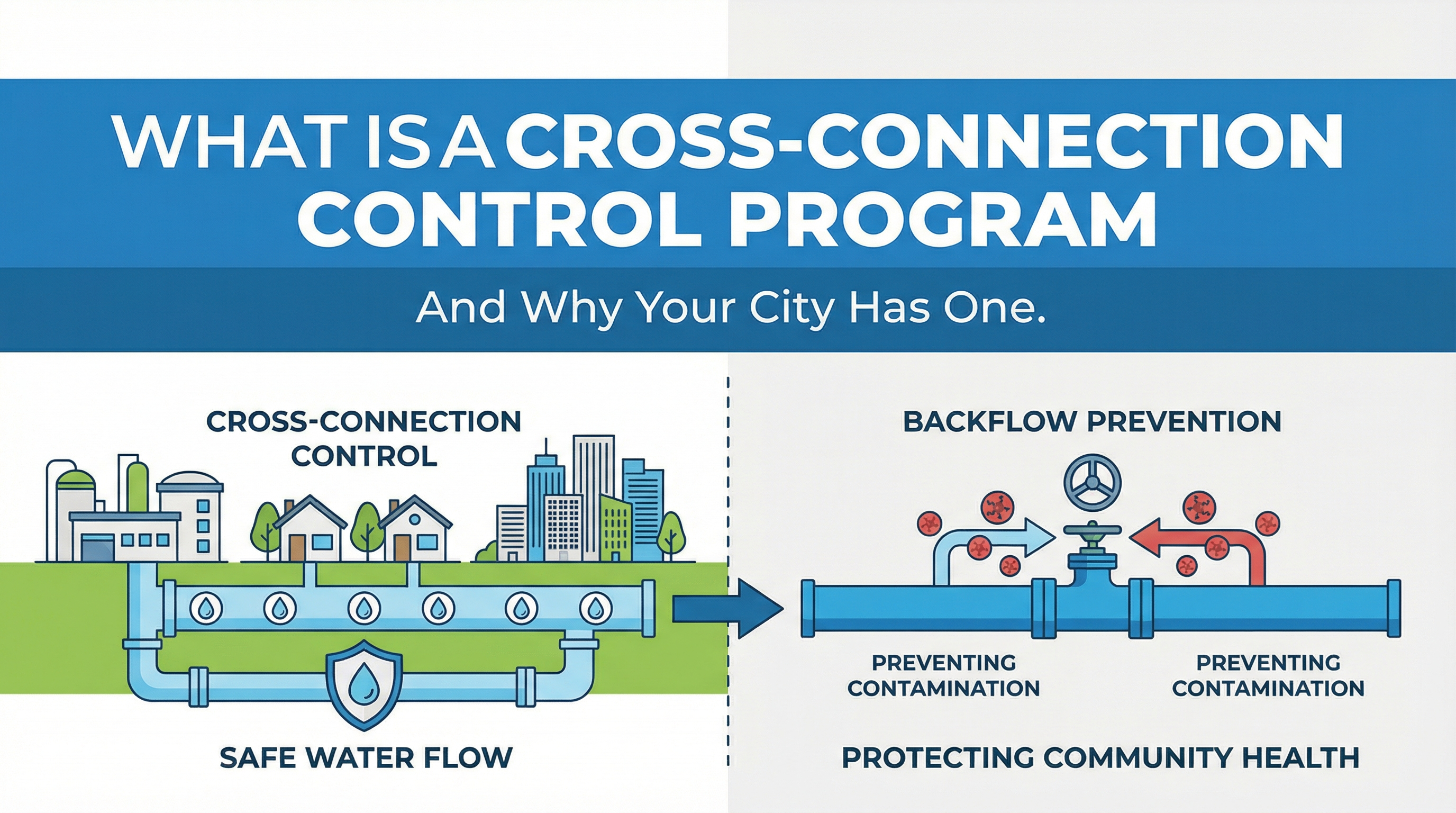
If you've received a backflow test notice from your water utility, you've encountered your city's cross-connection control program — even if you didn't know that's what it was called. These programs are the reason you have a backflow prevention device on your property, and they're the reason that device needs to be tested every year.
But what exactly is a cross-connection control program, and why does every public water system in America have one? Here's the story.
 Cross-connection control programs protect the integrity of public drinking water from the treatment plant all the way to your tap.
What Is a Cross-Connection?
A cross-connection is any physical link between a potable (drinkable) water supply and a source of contamination or pollution. In simpler terms, it's any point where clean water and dirty water could potentially mix.
Cross-connections exist in virtually every building. Some common examples:
- A garden hose lying in a puddle of pesticide — if water pressure drops, that contaminated water could get sucked back into your home's plumbing
- An irrigation system connected to fertilizer injectors — a pressure drop could pull chemical-laden water backward into the drinking supply
- A boiler connected to the domestic water system — boiler treatment chemicals could backflow into potable water
- A swimming pool with an automatic fill valve — pool chemicals could flow backward during a pressure event
- A commercial dishwasher or industrial process connected to the water supply — chemicals, detergents, or biological contaminants could reach drinking water
The key insight: cross-connections are normal. They're part of how modern plumbing works. The risk isn't that they exist — it's that they exist without proper protection.
What Is Backflow?
Backflow is the actual reverse flow of water through a cross-connection. It happens through two mechanisms:
Back-siphonage: When pressure in the supply drops below the pressure at the cross-connection point, creating a vacuum that sucks contaminated water backward. This can happen during water main breaks, firefighting operations, or periods of high demand.
Back-pressure: When the pressure on the customer side exceeds the supply pressure, pushing contaminated water backward into the distribution system. This is common with booster pumps, elevated tanks, and pressurized systems.
Both mechanisms are well-documented and occur regularly in water distribution systems. The American Water Works Association estimates that backflow events contribute to a significant portion of waterborne disease outbreaks in the United States.
What Is a Cross-Connection Control Program?
A cross-connection control program is a systematic approach by a water utility to:
- Identify all cross-connections within their distribution system
- Assess the hazard level of each cross-connection
- Require appropriate protection (backflow prevention devices) based on the hazard level
- Ensure ongoing compliance through annual testing and enforcement
- Respond to backflow events when they occur
These programs are run by your local water utility — the entity that treats and delivers drinking water to your property. They typically have a dedicated cross-connection control department or specialist who manages the program.
Why Every City Has One
The answer starts with federal law. The Safe Drinking Water Act (SDWA), first passed in 1974 and amended multiple times since, requires all public water systems to deliver safe drinking water to their customers. The EPA's regulations under the SDWA establish minimum standards for water quality, treatment, and distribution.
While the SDWA doesn't explicitly mandate cross-connection control programs by name, it does require water systems to protect the quality of water throughout their distribution systems. State drinking water agencies — the entities that implement the SDWA at the state level — have universally interpreted this to include cross-connection control.
 Your water meter marks the boundary between the utility's responsibility and yours — and it's often where your backflow preventer is installed.
As a result, every state has cross-connection control requirements, though the specifics vary. Some states have detailed regulations; others provide guidelines that utilities adapt to their local needs. The practical outcome is the same: every public water system must have a program.
How the Program Affects You
As a property owner, your city's cross-connection control program affects you in several ways:
Survey and Assessment
The utility may conduct a cross-connection survey of your property to identify potential hazards. For residential properties, this is often done at the time of new construction or when a new water service connection is established. For commercial properties, surveys may be conducted periodically.
Based on the survey, the utility determines what level of protection your property needs:
- Residential with standard plumbing: May require a dual check valve or no device at all (depending on local rules)
- Residential with irrigation, pool, or other hazards: Typically requires a PVB (Pressure Vacuum Breaker) or DCVA (Double Check Valve Assembly)
- Commercial or industrial: Typically requires a DCVA or RPZ (Reduced Pressure Zone) depending on the hazard level
- High-hazard connections: Requires an RPZ assembly — the highest level of protection
Device Installation
Once the utility determines what protection you need, you're required to install the appropriate backflow prevention device at your expense. The utility specifies the type and size of device, and the installation must be done by a licensed plumber in accordance with local plumbing codes.
Annual Testing
After installation, the device must be tested annually by a certified backflow tester. The utility tracks testing schedules and sends notices when your test is due. This is the part most property owners are familiar with — it's why you get that letter in the mail every year.
For a walkthrough of the testing process, see our guide on what happens after you get a backflow test notice.
Enforcement
If you don't comply with testing requirements, the utility has enforcement tools ranging from reminder letters to fines to water service disconnection. The specifics depend on your local ordinance, but the authority to enforce is universal.
For details on enforcement timelines, read about what happens if you ignore a backflow test notice.
Hazard Levels: Why Different Properties Get Different Devices
Cross-connection control programs categorize hazards into levels, which determine the required protection:
Low Hazard (Pollutant)
Contaminants that would make water aesthetically undesirable (taste, odor, appearance) but not necessarily dangerous. Examples: food-grade substances, dyes, non-toxic chemicals.
Typical protection: DCVA or PVB
High Hazard (Health Hazard)
Contaminants that could cause illness, injury, or death. Examples: sewage, pesticides, industrial chemicals, medical waste, boiler treatment chemicals.
Typical protection: RPZ assembly
The distinction matters because RPZ assemblies provide a higher level of protection (they have a relief valve that dumps water rather than allowing contamination) but they're also more expensive to install, maintain, and test.
What the Program Tracks
Your utility's cross-connection control program maintains records on:
- Every property with a backflow prevention device
- The type, size, and location of each device
- The installation date
- Annual test results and dates
- Compliance status (current, overdue, non-compliant)
- Enforcement actions taken
- Repair and replacement history
Many utilities are modernizing these tracking systems with online portals where property owners can view their compliance status, download test reports, and even receive electronic reminders.
The Real-World Impact
Cross-connection control programs prevent contamination events. When programs are well-run and compliance rates are high, the public water supply stays safe. When compliance lapses, real contamination events occur.
The CDC tracks waterborne disease outbreaks associated with backflow and cross-connection failures. Documented incidents include:
- Ethylene glycol (antifreeze) entering a drinking water system through an unprotected boiler connection
- Pesticides backflowing through an irrigation system cross-connection
- Sewage contamination from a back-siphonage event during a water main break
- Chemical contamination from an industrial process that backflowed during a pressure loss
These aren't hypothetical scenarios — they're documented events that cross-connection control programs are specifically designed to prevent.
How to Work With Your City's Program
The best approach as a property owner:
- Know your utility's cross-connection control department. Find their phone number and website. This is your primary contact for backflow questions.
- Respond to notices promptly. Whether it's a testing notice, a survey request, or a compliance reminder, responding quickly keeps you in good standing.
- Maintain your device. Annual testing isn't just about compliance — it's about making sure your device actually works.
- Report problems. If you notice your backflow device leaking, damaged, or behaving unusually, report it to your utility and schedule a repair.
- Check for utility programs. Some utilities offer testing coordination, preferred tester lists, or even subsidized testing for low-income property owners.
You can check whether your utility has a specific program listed on our Programs by Utility page.
The Bottom Line
Cross-connection control programs exist because drinking water safety depends on protecting the distribution system from the millions of potential contamination points connected to it. Your backflow prevention device and annual testing requirement are your small part of that system.
It's not glamorous. It's not exciting. But it works — and your compliance plays a real role in keeping your community's drinking water safe.
If you're due for your annual test, find a certified backflow tester near you. For a deeper understanding of the testing process, start with our guide on understanding your backflow test report.
Sources
This article references guidance and regulations from authoritative sources including:
- U.S. Environmental Protection Agency (EPA) - Safe Drinking Water Act Overview — Federal legislation requiring public water systems to maintain drinking water quality
- American Water Works Association (AWWA) - Manual M14: Backflow Prevention and Cross-Connection Control — Comprehensive guidance for designing and managing cross-connection control programs
- USC Foundation for Cross-Connection Control and Hydraulic Research - Manual of Cross-Connection Control — Technical manual for utility cross-connection control program administration
- Centers for Disease Control and Prevention (CDC) - Cross-Connection Control and Backflow Prevention — Documentation of backflow-related contamination events and public health impact
- American Society of Sanitary Engineering (ASSE) - Professional Standards — Standards for backflow prevention device testing and tester certification
Last updated: March 2, 2026