What Happens After You Get a Backflow Test Notice from Your Water Utility
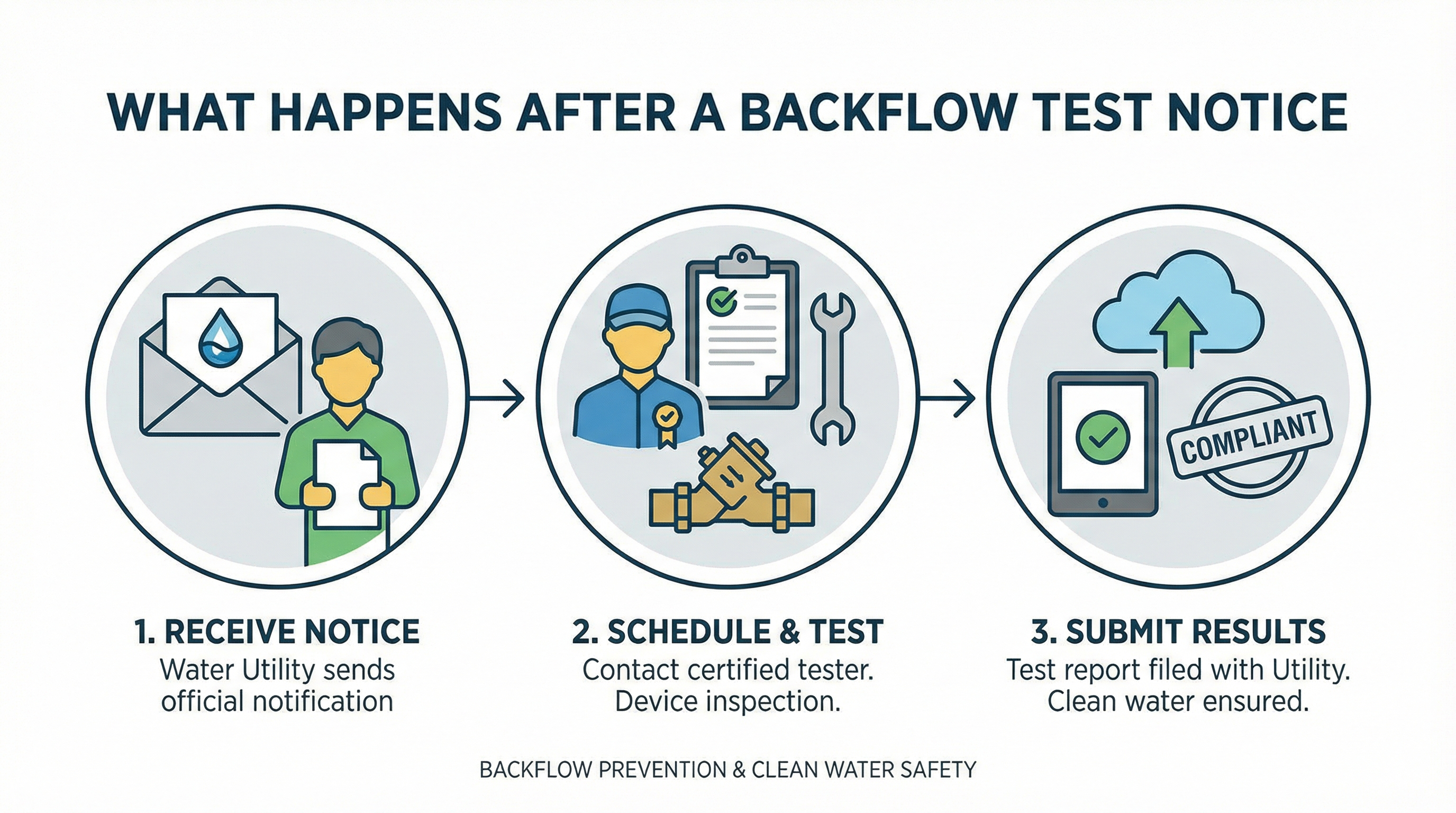
If you've just pulled a letter from your water utility out of the mailbox telling you that your backflow prevention assembly needs to be tested, you're probably wondering what it actually means — and whether you can ignore it.
The short answer: no, you can't ignore it. But the good news is that handling a backflow test notice is straightforward once you understand the process. This guide walks you through what happens after you receive that notice, step by step.

What Is a Backflow Test Notice?
A backflow test notice is an official communication from your local water utility or water district informing you that a backflow prevention device on your property is due for its required test. This notice is part of your utility's cross-connection control program — a program that every public water system in the United States is required to maintain under the federal Safe Drinking Water Act.
Backflow prevention devices are mechanical assemblies installed on your water service line to prevent contaminated water from flowing backward into the public drinking water supply. Because they contain internal components like check valves, springs, and seals that wear out over time, most jurisdictions require them to be tested annually by a certified professional.
Your utility tracks which properties have backflow preventers and when each device is due for testing. When your test date approaches, they send you a notice.
What the Notice Typically Includes
While the exact format varies by utility, most backflow test notices include:
- Your property address and account number
- The type of backflow device on your property (RPZ, DCVA, PVB, etc.)
- The compliance deadline — the date by which your test must be completed and results submitted
- Instructions for submitting test results — usually a form the tester fills out and sends to the utility
- Contact information for your utility's cross-connection control department
- Consequences of non-compliance — what happens if you miss the deadline
Some utilities also include a list of certified testers in your area, though not all do.
Step 1: Don't Panic — But Don't Ignore It
The most important thing to understand is that a backflow test notice is not a violation notice. It's a routine compliance reminder. Your utility sends these to every property owner with a backflow device, typically once a year.
That said, the notice has a real deadline attached to it. Ignoring it doesn't make it go away — it escalates the situation. More on that below.
If you've never received one of these before, it likely means either a backflow device was recently installed on your property (perhaps during a renovation or new construction), or your utility recently updated its cross-connection control records and identified your property.
Step 2: Understand Your Deadline
Most utilities give property owners 30 to 60 days from the date of the notice to complete their backflow test and submit the results. Some utilities are more generous with 90-day windows, while others give as little as 15 to 30 days.
The deadline is printed on the notice. Circle it, put it in your calendar, set a reminder — whatever works for you. This is the date that matters.
If you're a property manager or landlord with multiple properties, each property may have its own deadline. It's worth setting up a compliance calendar to track all of them. Many property managers find it helpful to schedule all their backflow tests during the same period each year to streamline the process.
If you need more time, many utilities will grant a deadline extension if you contact them before the deadline passes and provide a reasonable explanation (such as difficulty scheduling a tester during peak season). The key word is before — calling after the deadline has passed is a very different conversation.
Step 3: Find a Certified Backflow Tester
This is where most property owners get stuck. You can't test your backflow device yourself — it must be done by a professional who holds a valid backflow testing certification.
The certification requirements vary by state, but most states require testers to be certified through programs recognized by the American Society of Sanitary Engineering (ASSE) or equivalent state-level programs. Your tester needs to have calibrated test equipment (a differential pressure gauge kit) and current certification credentials.
Here's how to find one:
- Check your notice — some utilities include a list of approved testers
- Call your utility's cross-connection control department — they usually maintain a list
- Browse our directory — find certified backflow testers in your state with real ratings and contact information
- Ask your plumber — but verify they hold specific backflow certification, not just a plumbing license (there's an important difference between a certified backflow tester and a general plumber)
 A certified tester uses specialized gauge equipment to verify your backflow preventer is working correctly.
What to Expect Cost-Wise
Backflow testing typically costs between $75 and $250 for a standard residential device, depending on your location and the type of device. RPZ assemblies generally cost more to test than simpler devices like PVBs. If you have multiple devices, many testers offer a discount for testing them all in one visit.
Step 4: Schedule the Test
Once you've identified a tester, schedule the appointment well ahead of your deadline. During peak compliance season (typically spring and early summer, when most utilities send out their notices), certified testers can get booked up quickly.
When scheduling, make sure:
- The tester can access the device — clear away any landscaping, stored items, or debris around the preventer
- Someone is available to provide access if the device is behind a locked gate or inside a utility room
- You know where the device is — it's usually near the water meter or where the service line enters your property
The test itself typically takes 15 to 30 minutes. The tester will connect their gauge kit to the test ports on your device and run a series of pressure checks to verify that each internal component (check valves, relief valve) is holding properly.
Step 5: The Tester Submits Results
After completing the test, your tester will fill out a backflow test report (sometimes called a test and maintenance report). This form includes:
- Device type, size, manufacturer, and serial number
- Test date and gauge readings for each component
- Pass or fail determination
- Tester's name, certification number, and signature
In most jurisdictions, the tester is responsible for submitting the report directly to your water utility. Some utilities accept digital submissions, while others still require paper forms mailed or faxed. A few utilities require the property owner to submit the form themselves — your notice will specify who is responsible.
Keep a copy for your records. This is your proof of compliance if any questions come up later.
What If Your Device Fails the Test?
A failed test doesn't mean you're in immediate trouble, but it does mean your device isn't protecting the water supply as intended and needs repair or replacement.
Here's the typical process after a failed test:
- Your tester will explain what failed — usually a specific check valve or the relief valve
- Repairs are made — either by the same tester (if they're also a certified repair technician) or by a licensed plumber
- A retest is performed after repairs to confirm the device now passes
- The passing retest report is submitted to your utility
Most utilities understand that repairs take time and won't penalize you for a failed initial test as long as you complete repairs and submit a passing retest within a reasonable timeframe (usually 30 days from the failed test).
For a detailed look at the repair-vs-replace decision, check out our guide on what to do when your backflow preventer fails its annual test.
What Happens If You Don't Comply
This is where it gets serious. If you miss your deadline without scheduling a test or contacting your utility, the consequences typically follow a progression:
First: Additional Notices
Most utilities will send a second notice or reminder letter if your deadline passes without a test report on file. Some send multiple follow-ups over 30 to 90 days.
Next: Fines or Penalties
Many utilities have the authority to impose administrative fees or fines for non-compliance. These vary widely — anywhere from $25 to $500 or more depending on the jurisdiction. Some utilities charge escalating daily fees for each day past the deadline.
Finally: Water Service Shutoff
As a last resort, most utilities reserve the right to disconnect your water service if you remain non-compliant after repeated notices. This is the nuclear option and utilities generally don't want to use it, but they have the legal authority to do so under their cross-connection control ordinance.
The progression from first notice to shutoff typically takes several months, giving property owners plenty of time to comply. But it's far easier and cheaper to just schedule the test than to deal with escalating enforcement actions.
Tips for Staying on Top of Compliance
Once you've handled your first backflow test notice, the process gets much simpler in subsequent years. Here are some practical tips:
- Set an annual reminder a month before your typical notice date so you can schedule proactively
- Build a relationship with a tester — many will send you reminders and can schedule recurring annual visits
- Keep records organized — store your test reports with other property documents
- If you're a landlord, include backflow compliance in your property management checklist and annual budget
- Check if your utility has an online portal where you can view your compliance status and upcoming deadlines
For more tips on organizing compliance across multiple properties, visit our Learning Center for property management resources.
The Bottom Line
A backflow test notice is routine, not alarming. Thousands of property owners receive them every year, and the vast majority handle them without any issues. The process is simple:
- Read the notice and note your deadline
- Find a certified tester — search your area here
- Schedule the test before the deadline
- Make sure results are submitted to your utility
- Keep a copy for your records
The entire process, from receiving the notice to being fully compliant, typically takes less than an hour of your time (plus the 15-30 minutes for the actual test). It's a small investment that keeps your water safe and your property in good standing with your utility.
If you're not sure where to start, browse backflow testers by state or check out our guide to common backflow prevention mistakes to make sure you're covered.
Sources
This article references guidance and regulations from authoritative sources including:
- U.S. Environmental Protection Agency (EPA) - Safe Drinking Water Act Overview — Federal legislation requiring public water systems to maintain cross-connection control programs
- American Water Works Association (AWWA) - Manual M14: Backflow Prevention and Cross-Connection Control — Industry-standard manual for utilities managing backflow prevention programs
- USC Foundation for Cross-Connection Control and Hydraulic Research - Manual of Cross-Connection Control — Technical reference used by water utilities across the U.S. for cross-connection control program administration
- American Society of Sanitary Engineering (ASSE) - Professional Qualifications Standards — Standards for backflow prevention assembly tester certification (ASSE 5110)
- Centers for Disease Control and Prevention (CDC) - Cross-Connection Control and Backflow Prevention — Public health guidance on protecting drinking water from backflow contamination
Last updated: March 25, 2026