How to Schedule Backflow Testing for Multiple Properties
How to Schedule Backflow Testing for Multiple Properties
If you manage more than one property, backflow testing stops being a simple annual reminder and starts looking like an operations system. One address might have a domestic assembly and an irrigation device. Another might have a fire-line detector check. A third might be in a different city with a different utility, a different tester pool, and a different report process.
That is why the real challenge is not just booking a tester. It is building a repeatable way to track assemblies, due dates, access needs, and paperwork across the whole portfolio.
The public-health reason behind all of this is straightforward. EPA says the Safe Drinking Water Act protects public drinking water, and local cross-connection control programs use backflow prevention and testing to keep contaminated water from reversing into the supply. If you want the broader background first, start with why backflow testing is required.
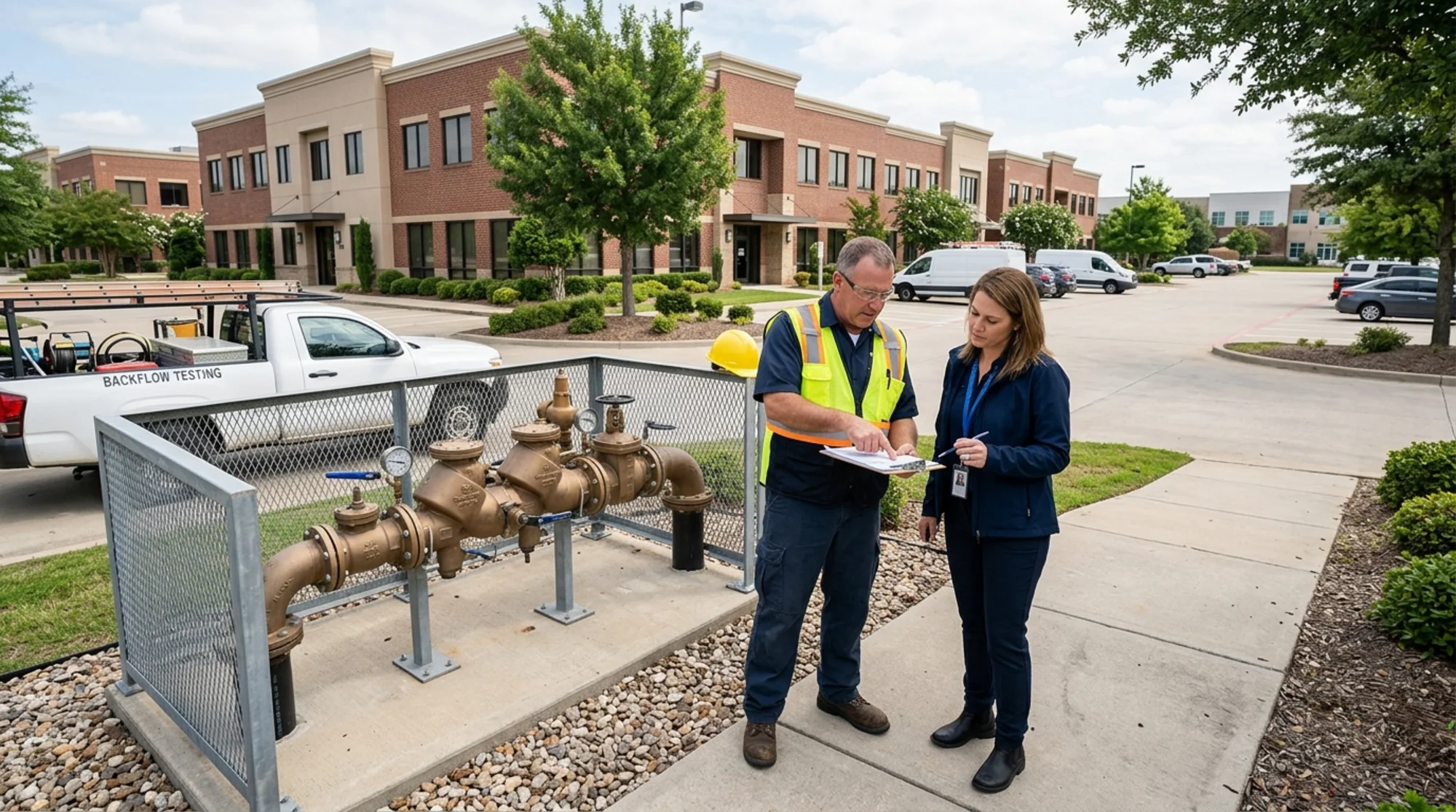
A property manager and certified backflow tester reviewing a route sheet and site schedule beside a commercial backflow assembly outside a multi-building property, natural daylight, no logos or text
Start with an assembly register, not a calendar invite
The biggest multi-property mistake is trying to schedule testing before you have a clean inventory of what actually needs to be tested.
For each property, keep a simple register with:
- property name and address,
- utility or water program name,
- assembly location,
- assembly type,
- serial number,
- last passing test date,
- next due date,
- whether the line is domestic, irrigation, or fire protection,
- site-access notes,
- and who is responsible for receiving the final report.
This matters because utilities usually track assemblies by property, account, or assembly record, not by your internal portfolio name. Seattle Public Utilities makes clear that the owner is responsible for making sure assemblies are tested on time, even if a tester handles the field work and report submission. Philadelphia’s Water Department publishes formal test-and-maintenance records and separate technician resources, which is another reminder that documentation is part of compliance, not an afterthought.
If your records are incomplete, pull from old reports, utility notices, and installation permits before you worry about route optimization. A messy calendar sitting on top of bad inventory just creates faster confusion.
Group properties by jurisdiction before you group them by geography
It is tempting to batch sites only by driving distance. That helps, but it should be your second sorting rule, not your first.
The first sorting rule should be jurisdiction. A five-property route only works cleanly when the same tester can legally test all of those assemblies and submit reports the way each utility expects.
Washington is a good example. Seattle says all backflow assemblies must be tested by a State of Washington Certified Backflow Assembly Tester, and the Washington Department of Health publishes BAT duties, field test report content rules, certification verification, and a public tester list. Texas uses a different structure. TCEQ says anyone who tests or repairs the installation or operation of backflow prevention assemblies must hold a TCEQ-issued license, with extra limits around fire-line work.
That means a good portfolio schedule usually starts with buckets like:
- same city and same utility,
- same state but different utilities,
- and different states with different credential rules.
Only after that should you build the actual route for the technician or vendor. If you are coordinating sites in different markets, it helps to review local pages like Austin, Charlotte, and Philadelphia alongside utility-specific guides such as Austin Water and the Philadelphia Water Department.
 A certified backflow tester connecting a differential pressure gauge to an outdoor assembly while a clipboard shows multiple scheduled property stops and utility notes, natural lighting, no text overlay
Standardize your vendor screening before the first appointment gets booked
Once you know which jurisdictions you are dealing with, decide whether one vendor can cover the batch or whether you need different testers by market.
For multi-property work, the screening questions should be a little stricter than they are for a single house or one-off commercial site:
- What credential do you hold for each jurisdiction in my portfolio?
- Can you test domestic, irrigation, and fire-line assemblies where applicable?
- Do you submit reports directly to the utility, and how do you confirm submission?
- Can you handle failed-assembly repair and retest, or only the initial test?
- Can you schedule multiple properties in one route window?
- What access information do you need ahead of time?
Seattle specifically says owners can contact several certified testers to find one that fits pricing and scheduling needs. That is useful for portfolios because you are not just buying a pass/fail test. You are buying reliability around route planning, paperwork, and retests.
If you need a deeper screening checklist, our guide on how to choose a qualified backflow tester is a good companion.
Treat report handling like a separate workflow
A lot of property managers think the job is done when the technician leaves the site. That is exactly where multi-property compliance starts to break.
Seattle says testers submit reports directly and advises owners to make sure they receive documentation confirming that the results were submitted. Washington DOH publishes minimum field-test report content requirements, which tells you that utilities care about the completeness of the paperwork, not just the appointment happening. Philadelphia makes this even more visible by publishing its official test-and-maintenance record form and technician lists.
In practical terms, your workflow should include two different checkpoints:
Field completion
The assembly was tested, the result is known, and any failure was documented.
Compliance completion
The utility-acceptable report was submitted, you have a copy, and your register shows the new passing date or active repair follow-up.
For a portfolio, that means someone on your side should review every visit packet for:
- test result,
- tester name and credential,
- calibration or required documentation where applicable,
- submission confirmation,
- failed assemblies needing repair,
- and the next due date.
If you skip that review step, a portfolio can look fully scheduled while several properties are still technically out of compliance.
Build a 60-30-7 scheduling rhythm
The easiest multi-property testing system is boring on purpose.
A practical cadence looks like this:
60 days out
- Review properties coming due.
- Confirm which ones can be batched by jurisdiction and route.
- Update access notes, tenant contacts, and assembly inventory.
- Request quotes or route windows from qualified testers.
30 days out
- Lock the appointment dates.
- Send site-access instructions.
- Confirm who needs to be on site for gates, mechanical rooms, or tenant suites.
- Reconfirm whether any property has open repair issues from the prior cycle.
7 days out
- Reconfirm the route.
- Send reminder notices internally.
- Make sure every assembly area is accessible.
- Prepare the last report or utility notice in case the tester needs context.
This cadence matters because failed assemblies, tenant-access problems, and reschedules are much harder to absorb when every site is booked at the deadline. If one property fails, you want room for repair and retest before the utility starts escalating. For a broader view of what missed follow-through can cause, see what happens after you get a backflow test notice.
 A property operations manager reviewing completed backflow test reports, a compliance calendar, and a map of multiple sites on a desk, natural indoor lighting, no logos or text
Plan for failures and partial completions in advance
This is the part that saves the most stress.
Not every route day ends with every property fully closed out. Assemblies fail. Tenants block access. A fire-line tester may need different authorization. A utility may reject a report because required details are missing.
So your register should support at least four statuses:
- scheduled
- tested, awaiting report confirmation
- failed, repair/retest needed
- complete
That small distinction makes a big difference. It stops a manager from looking at a calendar and assuming everything turned green just because all visits happened.
It also helps to pre-decide who handles each exception:
- Who approves repair quotes?
- Who speaks with the utility if a due date is close?
- Who coordinates tenant or site access for the retest?
- Who updates the central register after the repair passes?
If you manage a mix of commercial and association properties, our articles on backflow testing requirements for commercial properties and backflow prevention for HOAs and condo associations add more context.
A simple operating rule for portfolio managers
The simplest rule is this: schedule by program, track by assembly, and close out by report.
That keeps the workflow aligned with how utilities actually operate. Utilities care whether the specific protected connection was tested correctly and whether acceptable paperwork reached the program. They do not care that you had a busy week or that twelve other properties were on the same service route.
For quick baseline answers, the FAQs page is useful. If you are ready to line up service, start by finding a certified backflow tester near you.
Bottom line
Scheduling backflow testing for multiple properties is less about one perfect calendar and more about building a system that survives real-world friction. Get your assembly inventory clean, batch by jurisdiction before geography, use testers whose credentials match the market, and treat submission tracking as part of the job.
Do that, and annual testing turns into a manageable recurring workflow instead of a scramble driven by notices and missed paperwork.
Sources
This article references guidance and regulations from authoritative sources including:
- U.S. Environmental Protection Agency - Overview of the Safe Drinking Water Act
- Seattle Public Utilities - Backflow Assembly Testing
- Washington State Department of Health - Cross-Connection Control and Backflow Prevention
- Philadelphia Water Department - Cross-Connection & Backflow Compliance
- Texas Commission on Environmental Quality - Backflow Prevention Assembly Tester Information and Requirements
- Centers for Disease Control and Prevention - Preventing Drinking Water-Related Illnesses
- American Water Works Association - Cross-Connection Control / Backflow Prevention Resources
Last updated: April 30, 2026