How Backflow Preventers Are Tested: The Step-by-Step Process
How Backflow Preventers Are Tested: The Step-by-Step Process
If you own property with a backflow preventer installed, you probably know that it needs to be tested every year. But what actually happens during that test? What is the tester looking for, and what do the results mean for you?
This article walks through the backflow testing process in plain English — from the moment a certified tester arrives to the final report that gets submitted to your water utility. Whether you have a small residential connection or manage a commercial property, understanding the process can help you prepare, avoid surprises, and stay in compliance.
To understand more about why this testing exists in the first place, see our guide on why backflow testing is required.
What a Backflow Test Is Actually Checking
A backflow preventer is a mechanical assembly installed on your water line to stop water from flowing backward into the public supply. That reverse flow — called backflow — can pull contaminants like fertilizer, chemicals, or stagnant water into the drinking water system. The EPA's cross-connection control guidance identifies backflow as a real distribution-system risk that can contaminate drinking water if not properly controlled.
Inside the assembly, internal components like check valves and relief valves do the heavy lifting. Over time, these parts can wear out, collect debris, or lose the spring tension they need to seal properly. A backflow test uses calibrated pressure gauges to verify that each of those internal components is still working as designed.
The test doesn't just confirm the device is present — it confirms that it's actually protecting the water supply right now. As Seattle Public Utilities notes, annual testing is the only way to ensure assemblies are functioning properly.
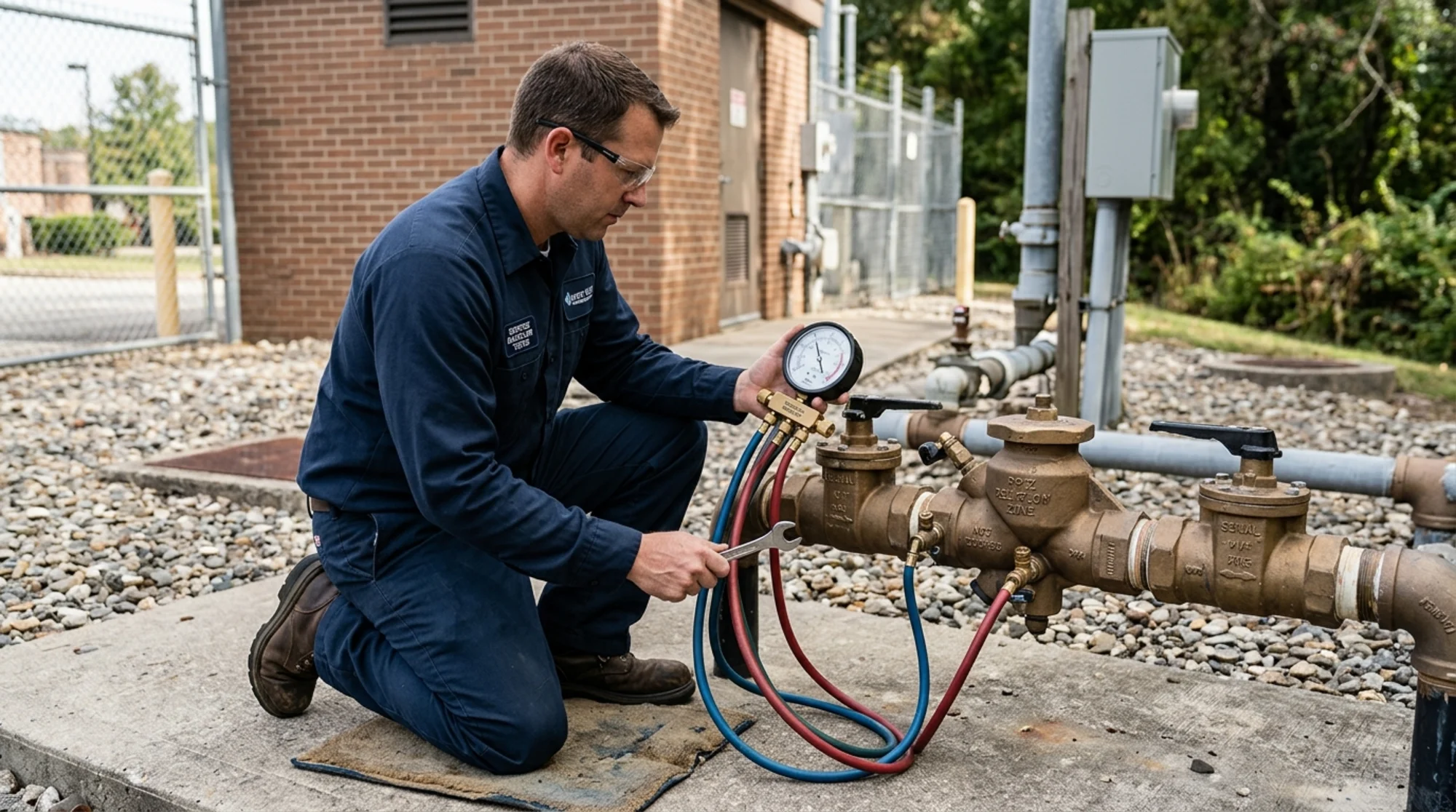 Certified backflow tester kneeling beside an outdoor RPZ assembly with differential pressure gauges connected to the test cocks
Common Types of Testable Assemblies
Not every backflow preventer is the same, and the test procedure varies depending on the type of assembly you have. The most common testable assemblies include:
- Reduced Pressure Zone assembly (RPZ) — Often required for higher-hazard connections. RPZs have two check valves and a relief valve that opens to discharge water if pressure drops. These are common on commercial properties and irrigation lines.
- Double Check Valve Assembly (DCVA) — Uses two independently operating check valves. Frequently installed on fire sprinkler connections and lower-hazard commercial lines.
- Pressure Vacuum Breaker (PVB) — A simpler assembly often used on irrigation systems. It includes a check valve and an air inlet that opens if water pressure drops.
Each assembly type has its own specific test procedure, and the tester follows standardized steps for whichever device you have. If you're unsure which type is installed on your property, your tester can identify it on arrival. For guidance on whether your assembly matches your property's needs, take a look at what size backflow preventer your property needs.
What Happens Before the Test
Good preparation makes the appointment go smoothly. Here's what you can do ahead of time:
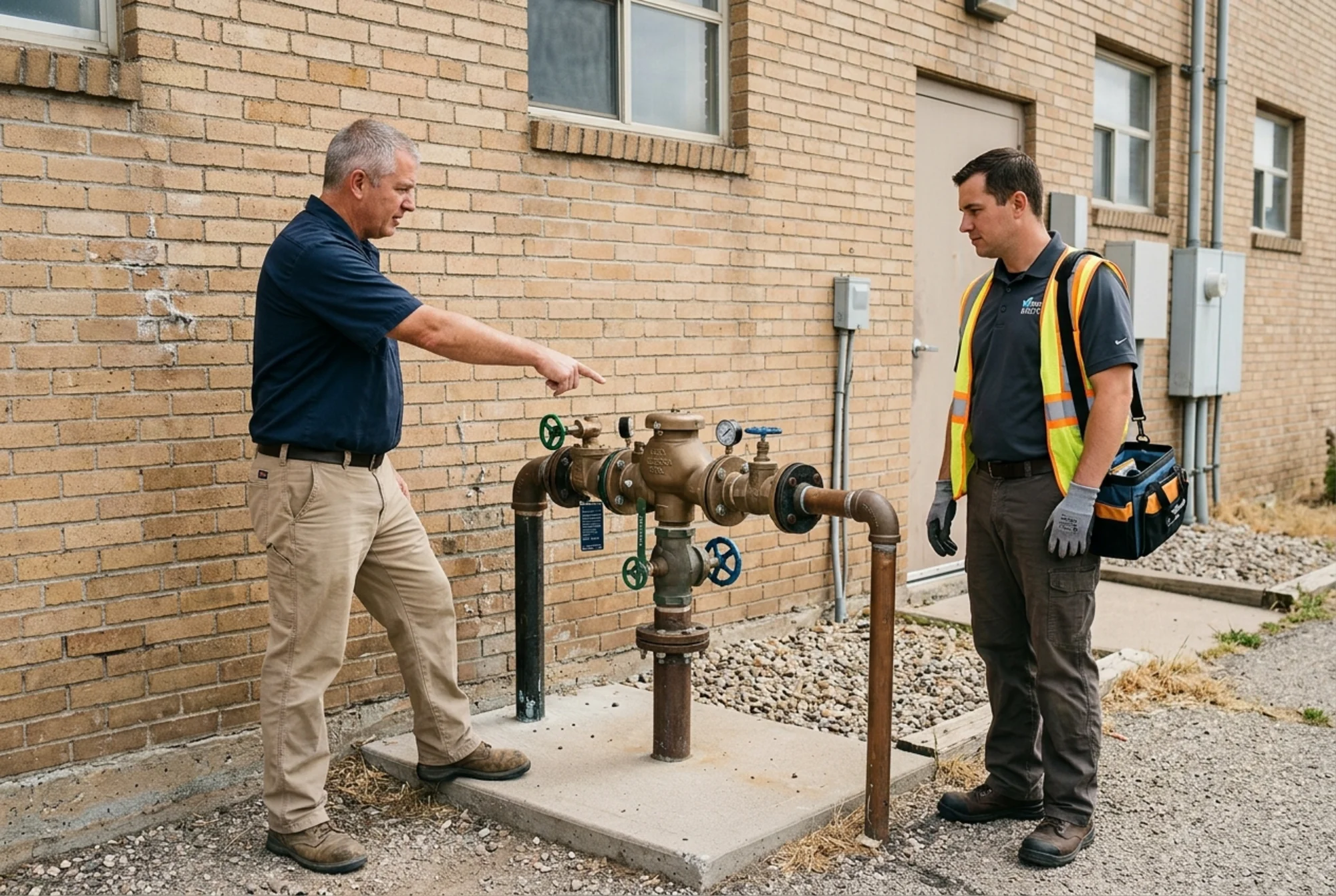
- Know where your assembly is. Most backflow preventers are installed near the water meter or where the service line enters the property. If your device is behind a locked gate, in a vault, or inside a mechanical room, make sure the tester can access it.
- Clear the area. Remove anything stored around the device — boxes, landscaping debris, garden hoses. The tester needs room to work and connect gauges.
- Plan for a brief water interruption. The test requires temporarily shutting off water flow through the assembly, usually for just a few minutes. You won't be without water for long, but it's worth knowing in advance.
- Have your previous test report handy if you can. This isn't always required, but it can be helpful context for the tester.
If you manage a commercial property, you may want to review backflow testing requirements for commercial properties to make sure you're fully prepared.
Property owner pointing out an outdoor backflow preventer assembly to a tester near the side of a building
The Testing Process: Step by Step
Here's what a typical backflow test looks like from the property owner's perspective. Keep in mind that exact procedures vary by assembly type, local program requirements, and the specific test kit being used.
1. Identify and Inspect the Assembly
The tester starts by identifying the make, model, serial number, and size of the assembly. They'll also do a visual inspection — checking for leaks, corrosion, physical damage, or anything that might affect the test.
2. Shut Off Water Flow
The tester closes the downstream shutoff valve first, then the upstream valve, to isolate the assembly. This temporarily stops water flow through the device so the internal components can be tested under controlled conditions.
3. Connect the Test Gauges
Using a calibrated differential pressure gauge kit, the tester connects hoses to the test cocks on the assembly. These small ports are built into the device specifically for testing. The gauge measures pressure differences across the internal valves.
4. Test Each Internal Component
This is the core of the process. The tester systematically checks each valve and component inside the assembly by manipulating the test cocks and reading the gauge:
- Check valves are tested to confirm they hold against backpressure and don't allow water to pass in the wrong direction.
- The relief valve (on RPZ assemblies) is tested to confirm it opens when it should — providing a critical safety discharge if the check valves ever fail.
To learn more about how these internal parts work, see our article on understanding backflow preventer check valve and relief valve components.
5. Record the Results
The tester records the pressure readings from each stage of the test on a standardized field test report. Each reading is compared against the performance standards for that assembly type. A passing result means all components held within acceptable parameters.
6. Restore Water Service
Once the test is complete, the tester reopens the shutoff valves and restores normal water flow. The whole process usually takes about 15 to 30 minutes for a single assembly.
7. Submit the Report
The tester completes the test report — including property information, assembly details, test readings, and a pass or fail result — and submits it to your local water utility or cross-connection control program. In most jurisdictions, this submission is required. Washington state, for example, requires testing by state-certified backflow assembly testers and expects reports submitted according to state administrative code requirements. Oregon maintains a similar program that certifies individuals who protect public water systems from backflow hazards.
What Happens If the Assembly Fails
A failed test means one or more internal components didn't perform within acceptable standards. This is not unusual — parts wear out over time, and that's exactly why annual testing exists.
If the assembly fails, the typical next steps are:
- Repair: The tester (or a qualified repair technician) opens the assembly, replaces the worn components — such as rubber seals, springs, or disc assemblies — and reassembles the device.
- Retest: After the repair, the assembly must be retested to confirm it now passes. The retest follows the same procedure.
- Updated report: A new passing report is submitted to the utility. Some programs require both the failed and passing reports.
Most repairs can be done on the spot during the same visit if the tester carries common replacement parts. In some cases, a follow-up visit is needed.
 Close-up of a tester's hands writing results on a backflow test report form clipped to a clipboard
Why Test Results and Submission Matter
Your backflow test report isn't just paperwork — it's the documentation your water utility relies on to confirm your property's connection isn't putting the public water supply at risk. The EPA's Safe Drinking Water Act establishes the framework that protects the nation's public drinking water, and local cross-connection control programs are how utilities enforce that protection at the property level.
If your report isn't submitted on time, or if a failed assembly goes unrepaired, your utility may issue notices, fines, or in some cases discontinue water service. If you want to understand local market context or find testing help, you can browse providers in Austin or Charlotte, and you can learn more about Austin's local requirements on our Austin Water backflow testing program page.
Assembly Type and Size Still Matter
Annual testing confirms that your assembly is working, but it's also worth making sure the right assembly is installed in the first place. The type and size of your backflow preventer should match both the hazard level of your connection and your property's flow requirements. If your property use has changed — you've added irrigation, expanded a commercial kitchen, or modified your fire suppression system — it's worth asking your tester whether your current assembly still fits.
Find a Certified Tester Near You
Backflow testing must be performed by a certified tester — someone trained, tested, and approved by your state or local authority. You can't do it yourself, and your utility won't accept results from someone who isn't certified.
Ready to schedule your annual test? Find a certified backflow tester near you by searching your city or browsing by state on FindBackflowTesters.com. You can also visit our FAQs page for answers to common questions about testing, compliance, and what to expect.
Sources
This article references guidance and regulations from authoritative sources including:
- U.S. Environmental Protection Agency - Safe Drinking Water Act Overview
- EPA Cross-Connection Control Fact Sheet - Distribution System Toolbox: Cross-Connection Control
- Washington State Department of Health - Cross-Connection Control and Backflow Prevention
- Seattle Public Utilities - Backflow Assembly Testing
- Oregon Health Authority - Cross Connection and Backflow Prevention Program
- American Water Works Association - Cross-Connection Control and Backflow Prevention Resources
- Centers for Disease Control and Prevention - Drinking Water Overview
Last updated: April 20, 2026