Understanding Backflow Preventer Check Valve and Relief Valve Components
Understanding Backflow Preventer Check Valve and Relief Valve Components
If you own or manage a property with a backflow prevention assembly, you have probably heard terms like "check valve" and "relief valve" during an annual test. Maybe a tester mentioned that a check valve was not holding, or you noticed water dripping from a valve on the assembly and were not sure whether that was normal.
These are internal components that do specific jobs inside your backflow preventer. Understanding what they do, and what it means when something goes wrong, can help you make better decisions about maintenance, repairs, and why backflow testing is required in the first place.
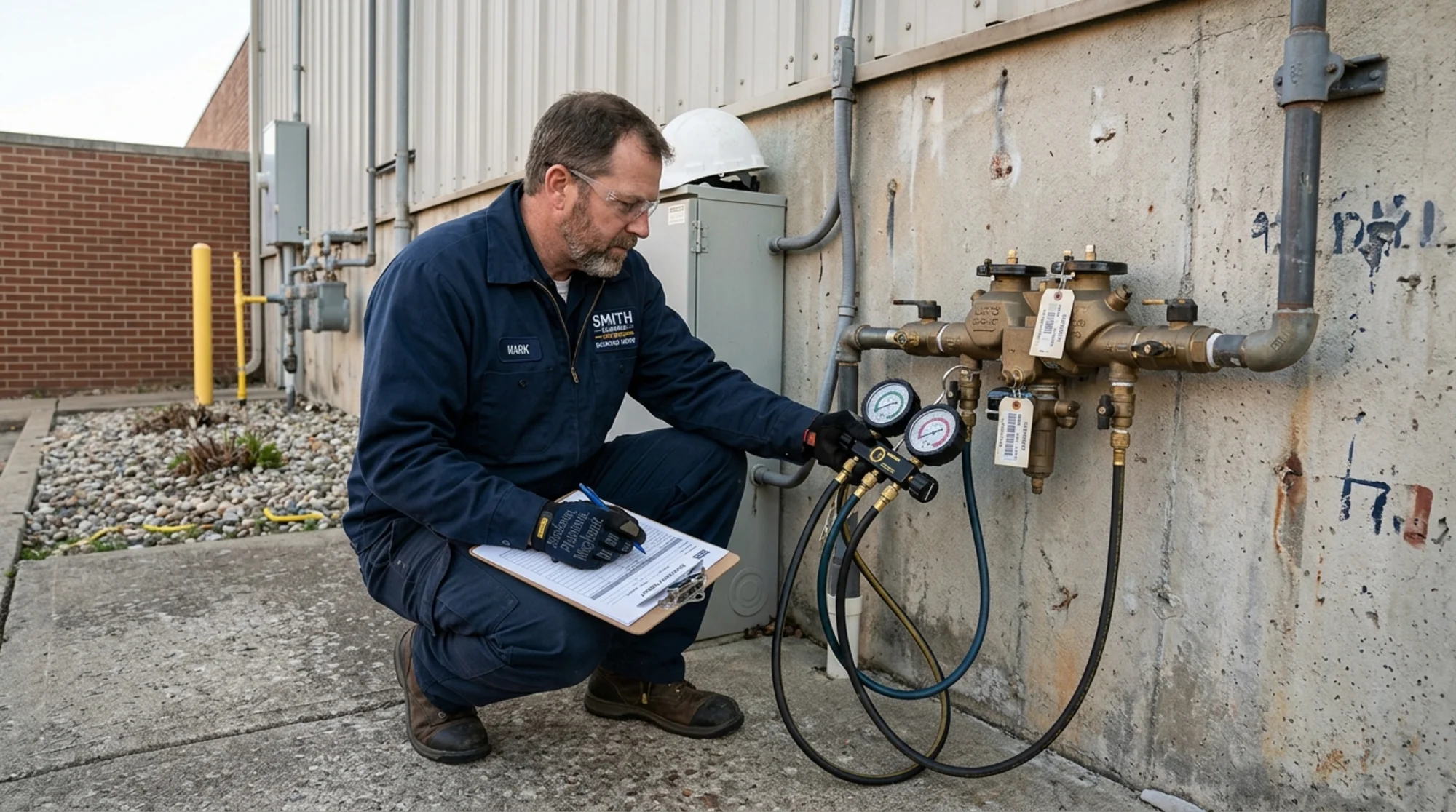 A certified backflow tester crouched beside an RPZ assembly mounted on an outdoor wall, with test gauges attached and a clipboard in hand
What Is a Check Valve and What Does It Do?
A check valve is a one-way valve. Its job is simple: let water flow in one direction and block it from flowing backward.
Think of it like a swinging door that only opens one way. When water pressure pushes from the supply side, the valve opens and water passes through. If pressure drops on the supply side, or increases on the downstream side, the valve snaps shut and prevents water from reversing course.
Check valves are not unique to one type of backflow preventer. They are internal components used across multiple assembly types, including:
- Reduced Pressure Zone (RPZ) assemblies, which use two check valves plus a relief valve
- Double Check Valve Assemblies (DCVA), which use two check valves with no relief valve
- Pressure Vacuum Breakers (PVB) and other approved devices that incorporate check mechanisms
The reason most testable assemblies use two check valves rather than one is redundancy. If the first check valve fails, the second one is still there to block backflow. Annual testing confirms that both checks are sealing properly under pressure.
What Is a Relief Valve and Which Assemblies Have One?
Not every backflow assembly has a relief valve. This is an important distinction.
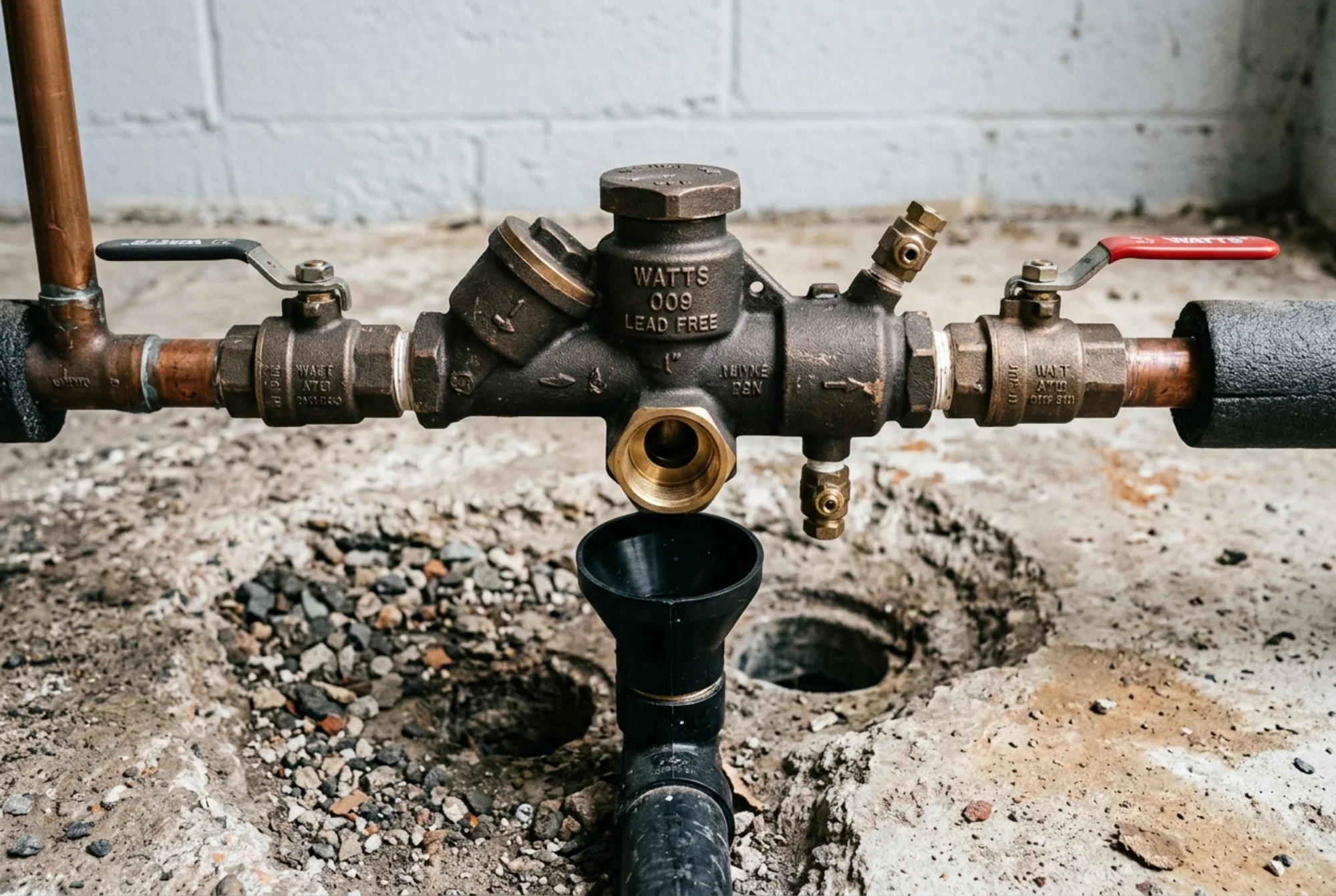
A relief valve is a fail-safe component found specifically in RPZ assemblies, also called reduced pressure principle assemblies. It sits in a zone between the two check valves, and its purpose is to open and discharge water to the outside if pressure conditions indicate that backflow could occur and the check valves are not fully containing it.
In plain terms, the relief valve is a safety release. If the internal checks are compromised and contaminated water might reach the supply line, the relief valve dumps that water out of the assembly rather than allowing it to flow back into the drinking water system. It prioritizes protecting the water supply, even if that means spilling water onto the ground.
A DCVA, by contrast, relies solely on its two check valves and does not include a relief valve. This is one reason RPZ assemblies are generally required for higher-hazard connections, because the relief valve adds an extra layer of protection that a DCVA does not provide.
The type of assembly your property needs depends on the assessed hazard level and the requirements of your local cross-connection control program, not personal preference. If you are unsure which assembly your property requires, your local water utility or a certified tester in your area can help clarify. Property owners in Austin can check the Austin Water backflow testing program for local guidance, and those in Charlotte can contact their water provider directly.
Close-up of an RPZ backflow preventer assembly installed on a pipe near ground level, showing the relief valve opening at the bottom of the unit between two shutoff valves
How These Parts Show Up in Common Assemblies
For property owners, the simplest way to think about these components is by assembly type:
- DCVA: two check valves, no relief valve. Common where the hazard is lower and local rules allow that level of protection.
- RPZ: two check valves plus a relief valve. Common where the hazard is higher and the program requires a stronger fail-safe response.
- Other devices: some approved devices use different mechanisms or are designed for narrower applications, which is one reason assembly selection should always be confirmed through the local utility or code process.
That distinction matters when you are reading a test report or talking with a plumber. If someone says the relief valve is discharging, they are talking about an RPZ. If someone says a check is failing, that could apply to an RPZ or a DCVA. If you are still sorting out what is installed on your property, our related guide on what size backflow preventer your property needs helps explain why assembly type and application have to line up.
What to Do If a Check Valve Fails During Testing
During an annual backflow test, a certified tester uses differential pressure gauges to verify that each check valve is holding properly. If a check valve does not hold at the required differential, the tester will report it as a failure.
A failed check does not necessarily mean the entire assembly needs to be replaced. In many cases, the check valve has an internal rubber disc or spring that has worn out, and a qualified repair technician can rebuild or replace the check valve component inside the assembly.
Here is what you should know as a property owner:
- A failed test result will typically be reported to your water utility. Most cross-connection control programs require both the test result and any subsequent repair documentation.
- Repairs should be performed by someone qualified to work on backflow assemblies. After repair, the assembly must be retested to confirm it now passes.
- Do not ignore a failed test. Your water utility may follow up, and an unresolved failure can result in compliance issues or, in some jurisdictions, service interruption.
If you have questions about what a test result means, our FAQs page covers common scenarios.
What to Do If Your RPZ Assembly Is Discharging Water
Seeing water drip or flow from the bottom of an RPZ assembly can be alarming, but it is important to understand what it means before reacting.
A small amount of intermittent discharge during pressure fluctuations can be normal for RPZ assemblies. The relief valve is designed to open when the pressure in the zone between the two checks drops to a certain point relative to the supply pressure. Brief discharge during sudden pressure changes, such as a water main break, a fire hydrant being flushed, or heavy irrigation demand, does not always indicate a problem.
However, continuous or heavy discharge from an RPZ relief opening should be evaluated by a certified tester, not capped or ignored. Blocking the relief valve defeats the purpose of the assembly and can create a serious public health risk. If the relief valve is discharging constantly, it often means one or both check valves have failed and the relief valve is doing exactly what it was designed to do, keeping potentially contaminated water out of the supply.
The correct response is:
- Do not cap, plug, or pipe the relief valve to a closed drain. The relief opening must be able to discharge freely to atmosphere.
- Contact a certified backflow assembly tester to diagnose the cause of the discharge.
- Have repairs made if needed, followed by a retest to confirm the assembly is functioning correctly.
Property owners should not assume that visible water discharge means the same thing on every type of device. A DCVA does not have a relief valve, so water appearing around a DCVA typically indicates a different issue, such as a leak at a fitting or test cock. If you manage commercial properties, staying on top of these differences is especially important given the higher hazard classifications often involved.
 A property manager standing near a mechanical room door, speaking with a uniformed plumbing technician who is holding a backflow test kit
Finding a Qualified Tester
Whether you need a routine annual test, a retest after repairs, or help understanding what type of assembly your property requires, working with a certified backflow assembly tester is the right starting point. Cross-connection control programs at the state and local level, from Washington State to Oregon to Texas, all emphasize the role of certified testers in keeping these systems functioning properly and protecting the public water supply.
Find a certified backflow tester near you or browse by state to connect with a qualified professional in your area.
Sources
This article references guidance and regulations from authoritative sources including:
- U.S. Environmental Protection Agency - Safe Drinking Water Act Overview
- EPA Cross-Connection Control Fact Sheet - Distribution System Toolbox: Cross-Connection Control
- Washington State Department of Health - Cross-Connection Control and Backflow Prevention
- Seattle Public Utilities - Backflow Assembly Testing
- Oregon Health Authority - Cross Connection and Backflow Prevention Program
- American Water Works Association - Cross-Connection Control and Backflow Prevention Resources
- Centers for Disease Control and Prevention - Drinking Water Overview
Last updated: April 20, 2026