7 Common Backflow Prevention Mistakes Homeowners Make (And How to Avoid Them)
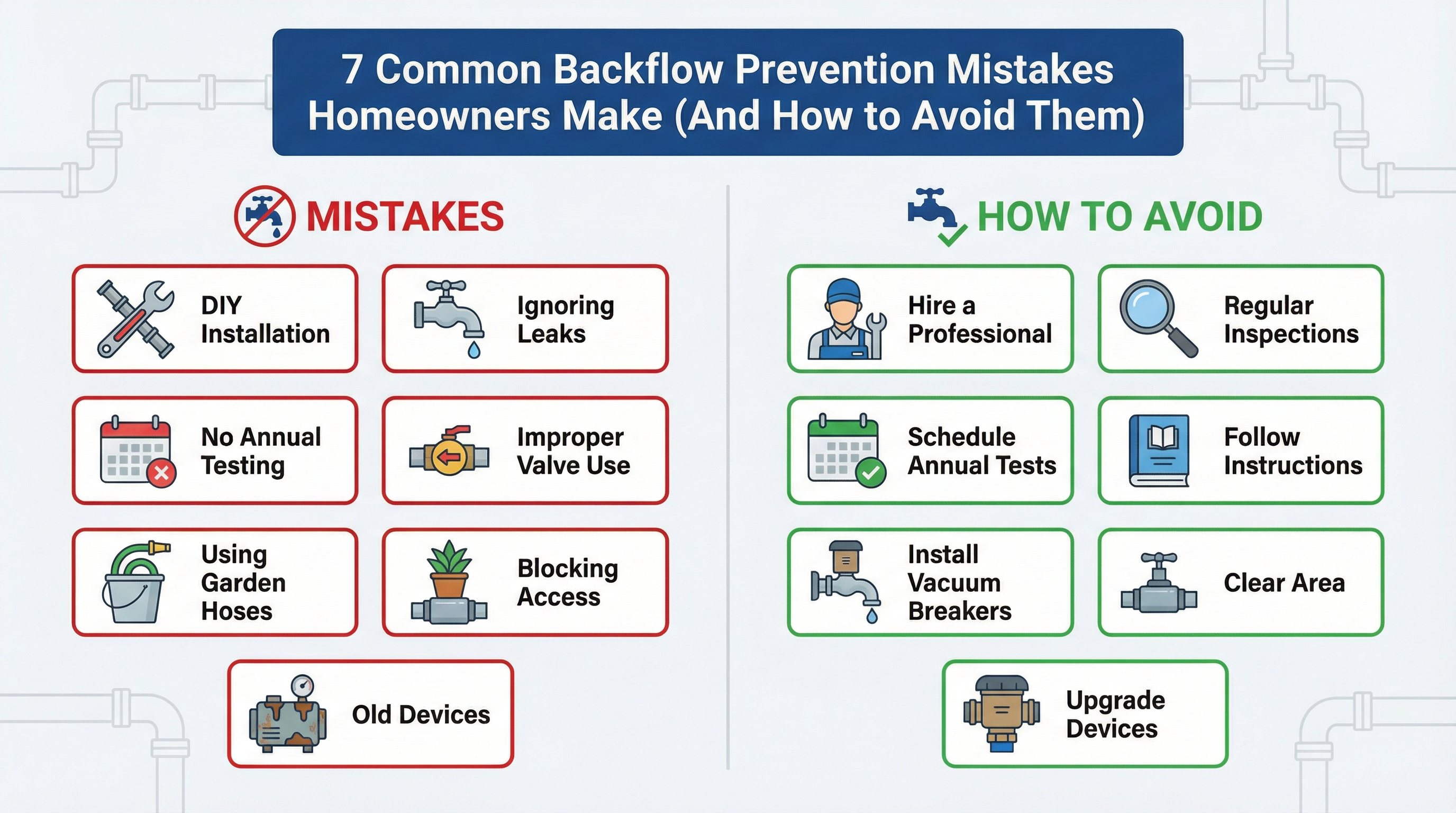
Most homeowners don't give backflow prevention a second thought — until a compliance notice shows up in the mailbox or a failed test puts their water service at risk. The truth is, backflow prevention isn't complicated, but there are a handful of mistakes that come up again and again. Some are simple oversights. Others can lead to fines, failed inspections, or even contaminated drinking water.
Whether you're a first-time homeowner who just discovered you have a backflow preventer, or you've been managing one for years, this guide covers the most common mistakes and how to avoid them.
 A properly installed backflow preventer protects your home's water supply from contamination.
1. Ignoring the Annual Testing Requirement
This is by far the most common mistake. Many homeowners don't realize that most municipalities require backflow prevention devices to be tested every year by a certified tester. It's not a suggestion — it's a legal requirement enforced by your local water utility.
When you skip your annual test, your water utility may send warning letters, impose fines, or in some cases, shut off your water service entirely. The testing requirement exists because backflow preventers are mechanical devices with internal seals, springs, and check valves that can wear out or fail silently over time.
How to avoid it: Mark your calendar for your annual test well before the deadline. Most water utilities send a reminder notice 30-60 days before your test is due. If you're not sure when yours is due, call your local water authority or check their website. You can also find a certified tester in your area through our directory.
For a detailed breakdown of what annual testing involves and what it costs, check out our Annual Backflow Testing Requirements guide.
2. Hiring an Unqualified Tester
Not every plumber is qualified to test backflow prevention devices. In most states, backflow testers must hold a specific certification — separate from their plumbing license — that demonstrates they've been trained on proper testing procedures and know how to use differential pressure gauge test kits.
Hiring someone without the proper certification means the test results won't be accepted by your water utility, which means you've paid for nothing and you're still out of compliance.
How to avoid it: Always ask to see a tester's backflow certification before hiring them. Most states require testers to carry a card or certificate issued by a recognized certifying body such as the American Society of Sanitary Engineering (ASSE) or a state-specific program. Your water utility typically maintains a list of approved testers in your area.
We've written a detailed comparison to help you understand the difference: Certified Backflow Tester vs. Licensed Plumber.
 Make sure your tester holds specific backflow certification — a general plumbing license isn't always enough.
3. Not Knowing Where Your Backflow Preventer Is Located
It sounds basic, but a surprising number of homeowners have no idea where their backflow prevention device is physically installed. This creates problems when it's time for testing (the tester needs access), when maintenance is needed, or when freezing weather threatens to damage the device.
Backflow preventers are typically installed at the point where your water service line enters your property. On residential properties, you'll commonly find them near the water meter, along an exterior wall, or in a below-grade vault or pit.
How to avoid it: Take 10 minutes to locate your device. If you can't find it, your water utility can usually tell you where it should be based on your property records. Once you find it, make sure the area around it stays clear and accessible — overgrown landscaping is one of the top reasons testers can't complete an inspection on the first visit.
4. Skipping Winterization in Cold Climates
Backflow prevention devices contain water-filled chambers and internal components that are vulnerable to freezing. When water freezes inside the device, it expands and can crack the body, damage internal seals, or break check valve assemblies. A freeze-damaged backflow preventer won't just fail its next test — it may not prevent backflow at all, which is the entire point of having one.
This mistake is especially common with reduced pressure zone (RPZ) assemblies, which have a relief valve that stays partially open during normal operation. Water sitting in the relief valve area is particularly susceptible to freeze damage.
How to avoid it: If you live in an area where temperatures drop below freezing:
- Insulate the device with an approved backflow preventer cover or insulation bag (available at most plumbing supply stores for $30-$80)
- Drain the device before the first hard freeze if your local code allows it and you have a shut-off valve upstream
- Never wrap it in plastic alone — plastic traps moisture and can actually accelerate freeze damage
- Check it in spring for visible cracks, leaks, or damage before your annual test
For more on seasonal care, browse our Learning Center for device-specific maintenance guides.
5. Attempting DIY Repairs on a Failed Device
When a backflow preventer fails its annual test, some homeowners try to fix it themselves to save money. While the impulse is understandable, this is a mistake for several reasons.
First, most jurisdictions require that repairs on backflow prevention devices be performed by a licensed plumber or certified repair technician. DIY repairs typically won't satisfy your water utility's compliance requirements.
Second, backflow preventers are precision assemblies. The internal components — check valves, relief valves, springs, and seats — need to be reassembled to exact specifications. Incorrect repair can make the device appear functional while actually failing to prevent backflow, creating a hidden public health risk.
How to avoid it: If your device fails its annual test, get a quote from a certified professional for repair vs. replacement. Minor issues like worn rubber seals or fouled check valves are typically inexpensive to fix ($50-$150 for parts and labor). For a full breakdown of when to repair versus replace, see our guide on Repair vs. Replace: What to Do When Your Backflow Preventer Fails.
 Professional repair ensures your device meets exact specifications required by your water utility.
6. Ignoring Cross-Connections on Your Property
A backflow preventer at your water meter protects the public water supply from your property. But many homeowners don't realize they may have additional cross-connections within their property that also need protection.
Common residential cross-connections include:
- Irrigation systems — especially those connected to chemical fertilizer injectors
- Swimming pools and hot tubs with automatic fill valves
- Boilers and radiant heating systems that connect to the domestic water supply
- Garden hose connections (called hose bibbs) — a garden hose submerged in a pool or lying in fertilizer runoff is a textbook cross-connection
- Utility sinks with threaded faucets that can connect to hoses
Each of these represents a point where contaminated water could flow backward into your home's drinking water system if pressure conditions change.
How to avoid it: Install hose bibb vacuum breakers on all outdoor faucets ($3-$8 each at any hardware store). Make sure your irrigation system has its own backflow preventer (required by code in most areas). If you have a pool, hot tub, or boiler, ask your plumber whether additional protection is needed.
Your local water utility's cross-connection control program can provide specific guidance for your area. Many utilities offer free inspections. Check if your utility has a program listed on our Programs by Utility page.
7. Not Keeping Records of Tests and Repairs
Your water utility maintains records of your backflow test results, but you should keep your own copies too. Having organized records helps you:
- Track device performance over time — a device that barely passes each year may be approaching end of life
- Prove compliance if there's ever a dispute with your water utility
- Provide documentation to buyers if you sell your property (many home inspectors ask about backflow compliance)
- Identify patterns — if the same component fails repeatedly, it may be more cost-effective to replace the entire assembly
How to avoid it: After each annual test, ask your tester for a copy of the test report. Keep it with your other home maintenance records. The report should include the device type, serial number, test date, gauge readings, pass/fail result, and the tester's certification number.
The Bottom Line
Backflow prevention doesn't have to be stressful or expensive. Most of these mistakes come down to awareness — once you know what your device is, where it is, and what it needs, staying compliant is straightforward.
The key takeaways:
- Test annually — it's required, not optional
- Hire certified testers — verify credentials before booking
- Know your device location — and keep it accessible
- Winterize in cold climates — freeze damage is preventable
- Leave repairs to professionals — DIY fixes won't pass inspection
- Address all cross-connections — not just the one at the meter
- Keep records — they protect you long-term
If you're overdue for a test or not sure where to start, browse our state directory to find certified backflow testers near you. And for a full cost breakdown, check out our Backflow Testing Cost Guide 2026.
Sources
This article references guidance and regulations from authoritative sources including:
- U.S. Environmental Protection Agency (EPA) - Safe Drinking Water Act Overview — Federal framework requiring water systems to maintain cross-connection control programs
- American Water Works Association (AWWA) - Manual M14: Backflow Prevention and Cross-Connection Control — Industry standard reference for backflow prevention best practices
- USC Foundation for Cross-Connection Control and Hydraulic Research - Manual of Cross-Connection Control — Comprehensive technical manual used by water utilities nationwide
- Centers for Disease Control and Prevention (CDC) - Drinking Water: Cross-Connection Control — Public health guidance on preventing waterborne contamination through cross-connections
- American Society of Sanitary Engineering (ASSE) - Backflow Prevention Device Standards — Professional standards for backflow preventer testing, repair, and certification
Last updated: March 25, 2026