ROI of Proactive Backflow Maintenance vs Reactive Repairs
If you own or manage property with a backflow prevention assembly, you have probably had the same internal debate at least once: do you stay ahead of testing and small fixes, or wait until something forces your hand. The phrase "proactive backflow maintenance vs reactive repairs" sounds like a finance question, but in practice it is mostly an operations and compliance question. The return on proactive work shows up as fewer surprises, cleaner records, and less scrambling before deadlines, not as a single neat percentage on a spreadsheet.
This article is a practical, non-alarmist walk through how to think about that tradeoff. It is not legal, engineering, or insurance advice. Assembly type, hazard classification, local rules, and required maintenance vary by property and by utility, so always confirm specifics with your water provider and a certified tester.
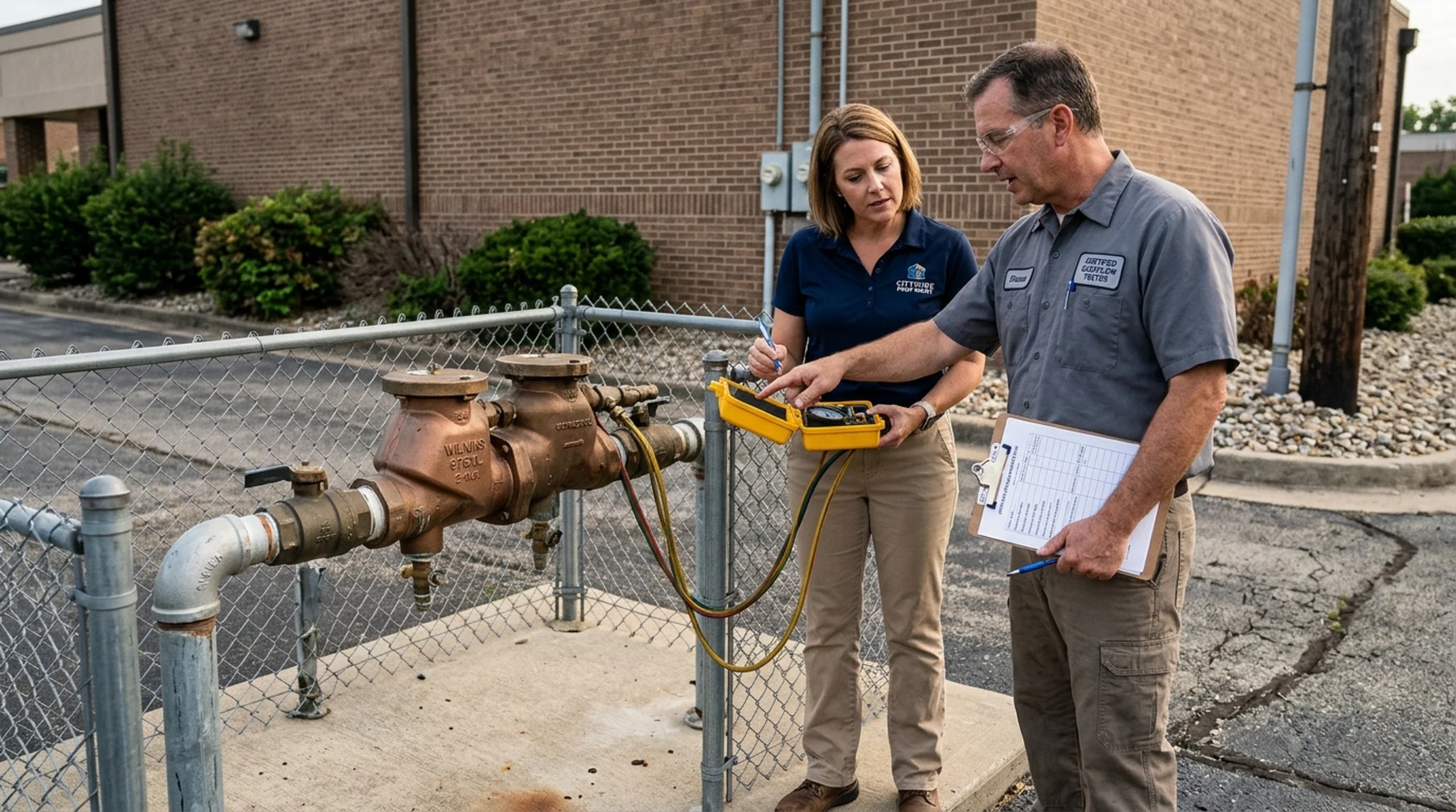
Property manager and certified backflow tester inspecting an outdoor commercial backflow assembly and discussing a maintenance checklist
What "ROI" really means for backflow compliance
For most properties, return on investment in this context is not a number you calculate once. It is a pattern you build over time. Backflow prevention exists because non-potable water with hazardous substances can compromise the public drinking water supply, which is why utilities require certain properties to install, test, and maintain assemblies in the first place. The Safe Drinking Water Act, originally passed in 1974, set the framework for protecting public drinking water, and the EPA, states, and water systems still work together to make sure those standards are met.
So when we talk about ROI here, we mean qualitative outcomes:
- Avoided emergency dispatches and rush fees
- Fewer repeat visits because issues are caught early
- Less downtime for tenants, residents, or operations
- Fewer missed deadlines and fewer notices from the utility
- Cleaner documentation when the utility, an inspector, or a buyer asks
- Easier annual budgeting instead of unplanned line items
- Reduced risk of water damage and reduced compliance risk
None of these are guaranteed by being proactive, and none of them are easy to put a dollar sign on without making things up. But they are real, and they compound. If you want a deeper compliance primer to share with stakeholders, why backflow testing is required is a good starting point.
Why reactive repairs usually cost more operationally
Reactive work is not always more expensive on a single invoice. Sometimes the part is the same part, and the labor is the same labor. The cost difference shows up around the work, not in it.
Reactive repairs typically happen under one of these conditions:
- The annual test failed and there is now a deadline to correct it.
- There is visible discharge, a wet spot, or a tenant complaint.
- The utility has already sent a notice.
- Something has been disconnected or shut off and operations are affected.
In each of those scenarios, you are buying time as much as you are buying parts. You are scheduling around a tester's existing calendar, not yours. You may be paying for diagnostic visits that proactive cadence would have caught during a routine test. And you may be repeating work, because the underlying issue, such as debris, freezing, drainage, or a worn check, was never addressed before it caused the failure.
Utilities take this seriously because the public health stakes are real. Seattle Public Utilities, for example, states that annual testing by a State of Washington Certified Backflow Assembly Tester is the only way to ensure assemblies are functioning properly, and that owners are responsible for on-time testing. Their system will not even accept a test report unless the tester's certification and calibration documents are on file, and non-compliance can lead to charges and possible water-service termination. New York City's DEP makes a similar point in its FAQ: testing is required every 12 months by a certified tester, and failing to perform that annual test could result in fines or water-service disconnection. Properties with multiple water service lines may need a device on each line, which multiplies both the proactive and reactive workload.
Once you are in reactive mode, you are also a worse customer to yourself. You have less leverage to shop testers, less time to compare repair-versus-replace tradeoffs, and less ability to bundle work with other property tasks. If you have ever read finding emergency backflow testing when your deadline is tomorrow, you already know how narrow that window can feel.
Where proactive maintenance creates practical returns
Proactive work is unglamorous. It is mostly calendar discipline plus a few small habits.
Documentation that travels with the property. When test reports, calibration certificates, and repair notes live in one place, every future test gets easier, every ownership change gets cleaner, and every utility inquiry gets answered faster. Washington's DOH cross-connection program, for instance, governs tester duties and the minimum content of field test reports by rule, and publishes a sample field test report along with BAT certification verification. That structure rewards property owners who keep their own records aligned with what the state and utility expect.
On-time annual testing. This is the floor, not the ceiling. The CDC's drinking water guidance reminds the public that utilities are required to meet safe drinking water standards and that customers should contact their water utility or health department with concerns. Annual testing is a key part of how that standard holds up at the property level. For more on how this is monitored, see how utilities track backflow test compliance.
Quick response to failed tests. A failed test is information, not a verdict. Reading common reasons backflow tests fail before the next test is a small proactive step that reduces surprise.
Watching the surroundings. The Portland Water Bureau notes that a properly functioning RPBA may periodically release small amounts of water and should be installed where discharge will not cause water damage, and that if it is clogged or not functioning properly it may discharge a large volume of water. Drainage and clearance around the assembly are quietly some of the highest-leverage items on a maintenance checklist.
 Close-up documentation scene with test report, calibration certificate, repair notes, and compliance calendar beside a backflow assembly
What a simple proactive program looks like
You do not need a sophisticated system. For most small commercial, multi-family, and HOA-managed properties, a workable proactive program looks like this:
- A single calendar with the annual test date, the utility's deadline, and a reminder set well before either.
- A folder, digital or physical, with the latest test report, prior reports, repair invoices, and the assembly's make, model, and serial number.
- A short note on the assembly's location, service size, and the hazard level determination from your utility, since these factors influence which assembly is required. Portland Water Bureau, for example, explains that location, service size, and hazard level determine which assembly is used on commercial properties, and that DCVAs are commonly used where hazards do not pose a health risk while RPBAs may be used on low- or high-hazard connections.
- A practice of preparing the site before the tester arrives, so the visit is efficient. How to prepare your property for a backflow test covers the basics.
- A budgeting habit that treats annual testing as a known line item, not a surprise. See how to budget for annual backflow testing as a property manager.
Cadence beyond the required annual test depends on the property. Some assemblies in harsh environments, with heavy debris, with freeze risk, or with frequent prior failures benefit from interim visual checks. Others do not. This is a conversation to have with your tester and, where relevant, your utility's cross-connection program. Philadelphia's Water Department, for example, publishes its cross connection control regulations, lists approved assemblies, requires certified technicians, and provides official test and maintenance forms along with FAQs. Programs like Austin Water's backflow testing program and the Philadelphia Water Department backflow testing program are good examples of how local rules shape practical cadence.
For city and state context, see Austin, TX, Philadelphia, PA, and Seattle, WA. Commercial operators may also want to review backflow testing requirements for commercial properties.
When repair becomes replacement instead
Proactive maintenance does not stop at testing and small fixes. Sometimes a repair stops being the right answer. Recurring failures on the same component, parts that are no longer easily sourced, an assembly that does not match the current hazard classification, or damage from freezing or impact can all push the conversation toward replacement. The Washington DOH approach is useful here as a reference: assemblies on the USC-approved assemblies list are acceptable for protection of the public water system, which is one of the inputs into a sound replacement decision.
This is its own decision and deserves its own analysis. Replace a backflow preventer vs repair walks through the tradeoffs in more depth.
 Realistic mechanical-room or service-entrance scene with a property owner reviewing drainage and clearance around an RPZ assembly with a certified tester
Bottom line
Proactive backflow maintenance is rarely the cheaper invoice in any single month. It is the cheaper operating posture across years, because it converts a category of unpredictable, deadline-driven work into a category of routine, scheduled work. Reactive repairs do not just cost a repair. They cost the surrounding scramble: rush scheduling, repeated visits, missed deadlines, and the cognitive load of dealing with a utility notice while running a property.
If you are starting from scratch, the simplest first step is the calendar. The second is the folder. The third is reading the FAQs and getting on the same page with your tester before the next deadline arrives, not after.
Sources
This article references guidance and regulations from authoritative sources including:
- U.S. Environmental Protection Agency (EPA) - Overview of the Safe Drinking Water Act
- Centers for Disease Control and Prevention (CDC) - Preventing Drinking Water-Related Illnesses
- Seattle Public Utilities - Backflow Assembly Testing
- Philadelphia Water Department - Cross-Connection & Backflow Compliance
- Portland Water Bureau - How to choose and install a backflow prevention assembly
- New York City Department of Environmental Protection - Backflow Prevention Frequently Asked Questions
- Washington State Department of Health - Cross-Connection Control and Backflow Prevention
- American Water Works Association (AWWA) - Cross-Connection Control and Backflow Prevention resources
Last updated: May 5, 2026