Backflow Testing Requirements for Medical and Dental Offices
Backflow Testing Requirements for Medical and Dental Offices
If you manage a medical office, dental practice, urgent care site, or small healthcare clinic, backflow testing usually lands in the same category as fire inspections, water-heater maintenance, and other compliance tasks that are easy to ignore until a notice arrives. The tricky part is that there is no single national rulebook that says every medical or dental office must follow one identical backflow standard.
What is consistent is the public-health goal behind these programs. The EPA says the Safe Drinking Water Act protects public health by regulating the nation’s public drinking water supply. Local utilities and state drinking-water programs use cross-connection control and backflow prevention rules to carry that responsibility down to individual properties.
For office owners and managers, the practical question is not just whether a backflow preventer exists somewhere on the property. It is whether your office has been classified in a way that requires a particular assembly, whether annual testing is required, and whether your reports are being handled the way your water utility expects.
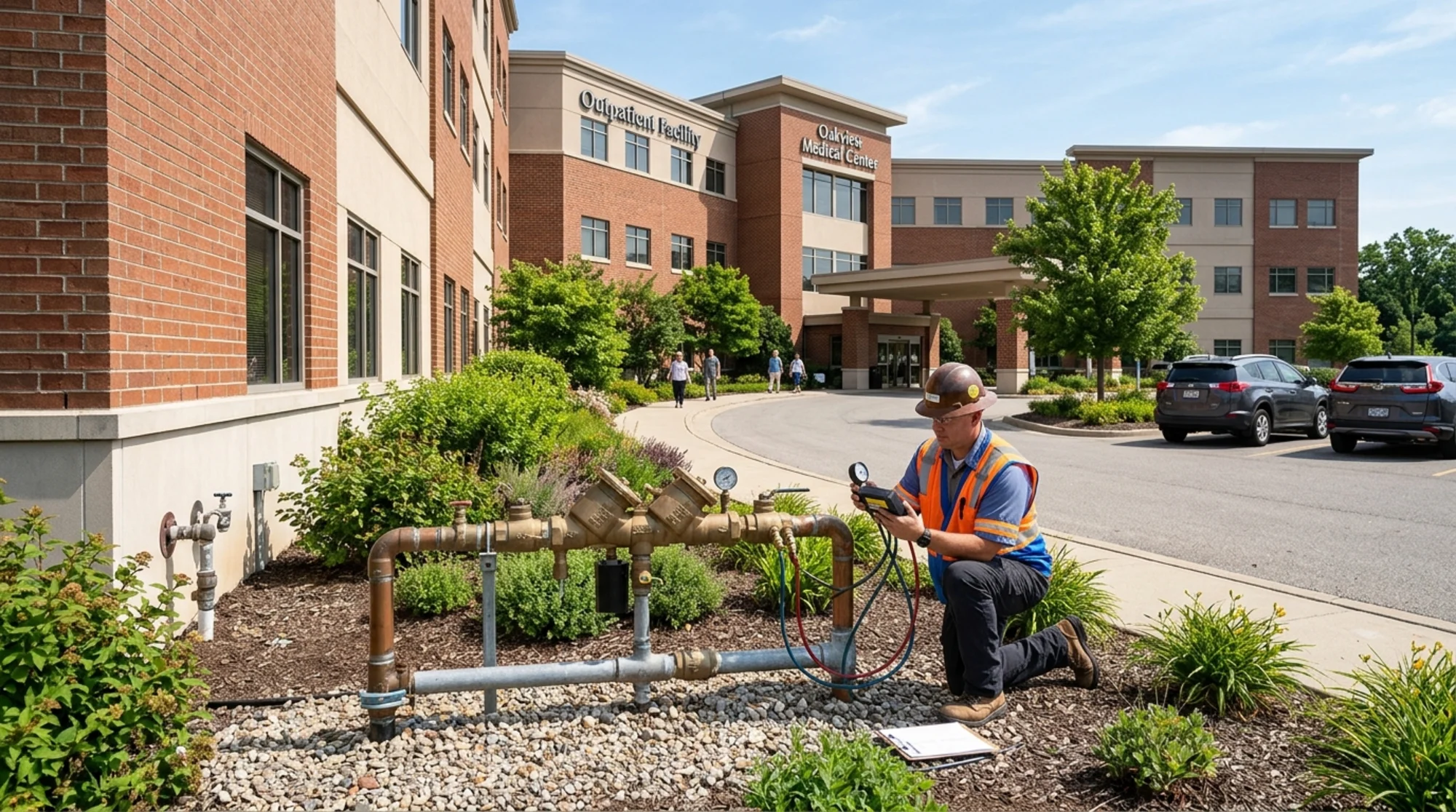
Wide realistic photo of a medical office building or outpatient clinic with an exterior reduced pressure backflow assembly being inspected by a certified tester, natural daylight, no logos or text overlay
There is no single national medical-office rule, but some utility programs clearly treat healthcare uses as higher hazard
This is the first thing to understand. Backflow requirements usually depend on hazard classification and the way the property is actually used, not just the business label on the front door.
Philadelphia’s Cross-Connection Control Manual is one of the clearest official utility examples we found. In its occupancy table, it specifically lists “Clinic / Doctor’s Office / Urgent Care” and “Hospital” among examples tied to high-hazard backflow concern. The same manual also states that a facility with a high hazard potential must have an approved reduced pressure assembly (RP) or an approved air gap.
That matters because it shows how at least one major utility thinks about medical occupancies. The requirement is not framed as a casual plumbing preference. It is tied directly to hazard level and protection of the public water system.
Dental offices are where owners should be a little more careful about assumptions. We did not find one single national or universal official rule that says every dental office in the country is automatically handled the exact same way as every medical office. In practice, many programs evaluate the actual plumbing hazards, water-using equipment, and local cross-connection rules rather than relying only on the word “dental.”
So the safest takeaway is this: do not assume your office is exempt just because nobody has flagged it yet, and do not assume the same rule applies everywhere. Your utility or local program may evaluate a physician office, urgent care site, or dental practice differently depending on the hazard and the service configuration.
If you are still getting the basics in place, our Learning Center guide on why backflow testing is required is a useful foundation.
What this usually means in practice for clinics and office managers
When a utility treats a property as a meaningful cross-connection risk, it usually wants protection at the service connection or another approved control point, plus a repeatable compliance process.
That often means some combination of the following:
- an approved testable backflow assembly,
- a specific assembly type based on hazard level,
- installation records or permits,
- annual testing by a qualified tester,
- and a formal report submitted to the utility or cross-connection control office.
Philadelphia’s public backflow program page reinforces that structure. It publishes approved-assembly information, technician resources, installation forms, and the official backflow test and maintenance record. That is a strong sign that medical-office compliance is not just about installing a device once and forgetting it.
For a small office, this can feel overbuilt. But utilities are trying to protect the public water supply, not just one tenant suite. If your office has already been placed in a program, the right move is to treat that as an active compliance requirement.
 Realistic close-up photo of a certified backflow tester connecting gauges to an RP assembly outside a clinic or professional office building, accessible service area, natural lighting, no brand names
Annual testing is a common requirement, and the tester usually needs the right credential
Once an approved testable assembly is installed, annual testing is a very common next step.
Seattle Public Utilities says directly that backflow prevention assemblies must be tested every year and that annual testing is the only way to ensure they are functioning properly. It also says testing must be performed by a State of Washington Certified Backflow Assembly Tester and warns that missed testing can lead to non-compliance charges and possibly water-service termination.
Washington’s Department of Health adds more structure around that process. It publishes Backflow Assembly Tester duties, field test report content requirements, certification verification resources, and public lists that help utilities and owners confirm whether a tester is properly recognized.
Texas shows the same idea through a different regulatory path. The Texas Commission on Environmental Quality says people who test or repair backflow prevention assemblies must hold the required BPAT license. That is useful because it reminds owners that “backflow tester” is not just a generic marketing phrase. In many places, it is a credentialed role.
For medical and dental offices, the real lesson is simple: if your utility requires a test, use a tester who clearly meets your state or local program’s rules. A rejected report is not just paperwork frustration. It can leave you still out of compliance after you already paid for the visit.
If you need help choosing a provider, our related guide on how to choose a qualified backflow tester goes deeper on the credential and calibration side.
What dental offices should do if the rules are not obvious
Dental practices are a good example of why owners should ask direct questions instead of guessing.
Even when a utility does not publish a dental-office-specific page, that does not mean the office has no backflow obligations. It may simply mean the utility evaluates the property through its broader cross-connection control program rather than by publishing industry-specific guidance.
A smart approach for a dental office is to confirm all of the following:
- Does the property already have a testable backflow assembly on the domestic service, irrigation line, or another connection?
- Has the utility classified the office as a hazard that requires annual testing or a particular assembly type?
- Who is responsible for submitting the report, the tester or the office?
- If the office is in a leased suite, is the assembly shared with the building or dedicated to the tenant space?
- If the office is remodeling or adding equipment, does the utility need to review anything before work is finalized?
That fourth question matters more than many practice owners realize. In a small professional building, the testable assembly may protect the whole building rather than one tenant. In that case, the landlord, property manager, or HOA may control the compliance process. But if your suite has a dedicated protected line, the obligation may land more directly on the practice.
If you want broader owner-level orientation, our FAQs and city pages such as Austin, Texas and Charlotte, North Carolina are good next stops.
Records, deadlines, and report handling matter almost as much as the device itself
One of the easiest ways for a medical or dental office to create problems is to focus only on the test appointment and forget the documentation trail.
Seattle says owners are still responsible for making sure testing happens on time. Philadelphia publishes formal test and maintenance records as part of its program. Washington publishes field-report content requirements. All three examples point to the same reality: compliance is not complete until the utility has what it needs.
That means an office manager should keep a simple record with:
- assembly location,
- assembly type,
- serial number,
- last passing test date,
- next due date,
- tester name and credential,
- and a saved copy of the submitted report.
This becomes especially important when the office changes managers, changes landlords, or changes vendors. Backflow compliance problems often show up after a transition, not because the assembly suddenly failed, but because nobody knows who was supposed to handle the paperwork.
If your office operates inside a larger commercial property, our post on how utilities track backflow test compliance explains the utility side of that recordkeeping in plain English.
 Documentary-style realistic photo of a healthcare office manager reviewing a backflow test report and compliance binder beside plumbing records in a clean office setting, no text overlay
A practical checklist for medical and dental offices
Use this list before your next deadline sneaks up on you:
- Confirm whether your property is already in a utility backflow program.
- Find out which assembly is on file and where it is located.
- Ask whether the property has been classified as high hazard or otherwise requires a specific assembly type.
- Use a tester whose credential matches your local program requirements.
- Ask whether the tester submits the report or whether your office must do it.
- Keep a copy of every passing and failed report.
- If the assembly fails, track the repair and re-test deadline immediately.
- If you are moving into a new suite or remodeling, ask the utility or property manager whether anything needs review before work is signed off.
For local-program context, it can also help to review the Philadelphia Water Department backflow testing program and the Austin Water backflow testing program.
Bottom line
Backflow testing requirements for medical and dental offices are usually driven by hazard classification, local utility rules, and the specific way the property is plumbed, not by one universal national checklist.
What we can say confidently from the official sources is that some utility programs clearly treat clinics, doctor’s offices, urgent care sites, and hospitals as higher-hazard occupancies, and that once a testable assembly is required, annual testing by a properly qualified tester is a common expectation.
For dental offices, the safest approach is not to assume the answer is yes or no without checking. Confirm the assembly, confirm the program, confirm who handles reporting, and keep the paperwork organized.
That is the version of compliance that saves time, prevents missed deadlines, and keeps your office from turning a routine water-safety requirement into an avoidable administrative mess.
If you need help now, start by finding a certified backflow tester near you.
Sources
This article references guidance and regulations from authoritative sources including:
- U.S. Environmental Protection Agency - Safe Drinking Water Act (SDWA)
- American Water Works Association - Cross-Connection Control and Backflow Prevention Resources
- Washington State Department of Health - Cross-Connection Control and Backflow Prevention
- Seattle Public Utilities - Backflow Assembly Testing
- Philadelphia Water Department - Cross-Connection & Backflow Compliance
- Philadelphia Water Department - Cross-Connection Control Manual (PDF)
- Texas Commission on Environmental Quality - Occupational Licenses: Backflow Prevention Assembly Tester (BPAT)
- Centers for Disease Control and Prevention - Preventing Drinking Water-Related Illnesses
Last updated: April 28, 2026