Backflow Testing for Restaurants and Food Service Businesses
Backflow Testing for Restaurants and Food Service Businesses
Restaurants and food-service businesses usually face more backflow scrutiny than a simple office or retail suite. That is not because every restaurant follows one identical rulebook. It is because food-service properties often combine several plumbing conditions that water utilities treat as potential cross-connection hazards, from beverage systems to washdown hoses to chemical-use areas.
At the public-water level, the goal is simple: keep anything non-potable from reversing into the drinking water supply. The EPA’s Safe Drinking Water Act provides the framework for protecting public drinking water, and local cross-connection control programs enforce that protection property by property. If you need the big-picture background, our Learning Center guide on why backflow testing is required is a good starting point.
For restaurant operators, the practical question is not just “Do I have a backflow preventer?” It is:
- what assemblies or devices are on the property,
- whether they are the right ones for your hazard level,
- whether annual testing is required, and
- whether your tester’s report is actually getting to the utility.
Why restaurants often get closer attention
Water utilities care about hazard level, not just business type. But food-service properties often have more ways for contamination to move the wrong direction if pressure changes occur.
An official example comes from the City of Walla Walla’s backflow information page, which lists carbonated water from a restaurant’s soda dispenser entering the water system due to backpressure as a specific backflow incident example. That is exactly the kind of scenario cross-connection control programs are designed to prevent.
That does not mean every restaurant automatically has the same assembly requirement. A small coffee shop, a fast-casual restaurant, a commissary kitchen, and a full-service restaurant with irrigation and fire protection may all be treated differently. Still, restaurants are more likely than many other small businesses to have combinations like:
- beverage or carbonation systems,
- hose-connected cleaning equipment,
- chemical-use or sanitizing areas,
- irrigation around the property,
- boilers or specialty equipment,
- and fire sprinkler connections on larger sites.
That is why restaurant owners should think about backflow testing as part of normal operating compliance, similar to grease traps, hood inspections, or fire-system paperwork.
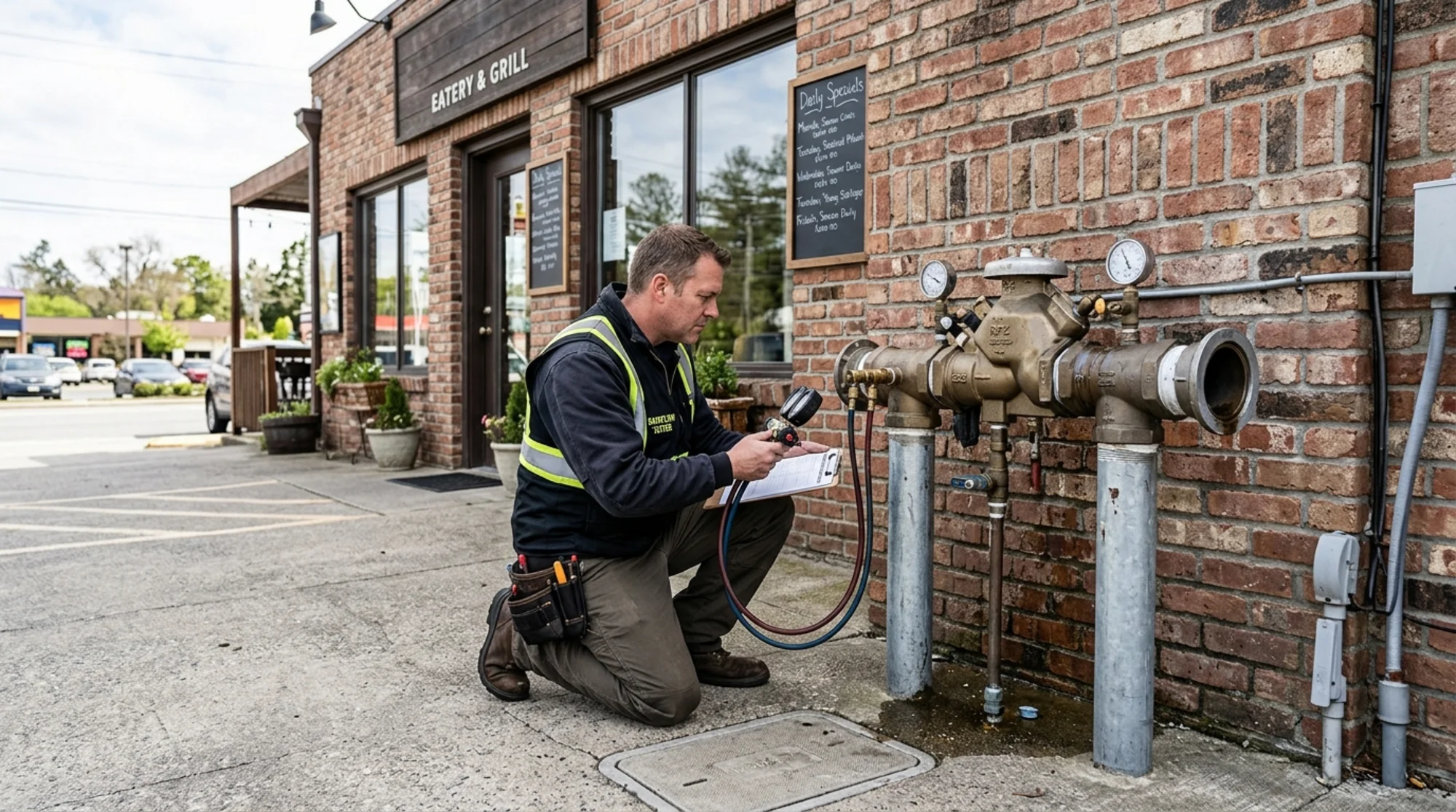
Exterior of a small independent restaurant with a certified backflow tester inspecting an above-ground RPZ assembly near the building water service line, realistic photo, no visible brand names or text
What utilities and testers are actually looking for
On most restaurant properties, the utility’s biggest concern is whether the public water supply is protected at the right points and whether testable assemblies are being maintained correctly.
That usually includes some combination of the following:
1. The main service-line assembly
Many commercial properties, including restaurants, have a testable backflow assembly on the domestic service, irrigation line, fire line, or a combination of those. Depending on local rules and hazard classification, that may be an RPZ, a DCVA, or another approved assembly.
Philadelphia’s Water Department, for example, maintains city-approved assembly lists, certified technician resources, and official backflow test and maintenance forms. That is a good illustration of how seriously larger utilities treat documentation and approved equipment.
2. Cross-connection hazards inside the business
The utility may focus on the premises-isolation assembly, while plumbing and health requirements often deal with point-of-use protections inside the building. In restaurant settings, the high-risk conversation often centers on equipment or connections where potable water could come into contact with carbonated water, chemicals, or other non-potable uses.
The important point is not to guess. If your restaurant is opening, expanding, or remodeling, ask the utility or your qualified backflow professional what level of protection is required for your specific setup.
3. Test reports and recordkeeping
Washington’s Department of Health spells out required field test report content and maintains certification resources for Backflow Assembly Testers. Seattle Public Utilities says annual testing is the only way to ensure assemblies are functioning properly and requires reports to be submitted with the information required under Washington rules.
In plain English, the assembly itself is only half the job. The paperwork matters too.
If you manage a broader site with multiple risks, our guide on backflow testing requirements for commercial properties adds more context.
Common food-service situations that raise backflow questions
Restaurant operators do not need to become cross-connection specialists, but it helps to know where questions usually come from.
Soda and beverage systems
This is the clearest restaurant-specific example in the sources. Walla Walla explicitly warns that carbonated water from a restaurant soda dispenser can backflow into the water system under backpressure conditions.
If your site has carbonation or beverage equipment, do not assume it is a minor detail. It is one of the classic reasons food-service properties draw closer review.
Washdown and hose-connected equipment
Any business that uses hoses for cleanup, mop sinks, or washdown should take cross-connections seriously. Walla Walla also gives the example of lawn chemicals backflowing through a garden hose. The principle is broader than landscaping: a hose-connected setup becomes risky when it can contact contaminants and pressure reverses.
Chemical-use areas
Restaurants rely on sanitizers, detergents, and cleaning chemicals. Whether those are handled through dispensers, sinks, or other plumbing-connected equipment, they are exactly the kind of non-potable materials that make utilities conservative about backflow protection.
Irrigation, boilers, and fire protection on larger sites
A restaurant in a strip center may have a simple domestic assembly, while a stand-alone site may also have irrigation or fire-line assemblies that carry their own testing schedules. This is one reason two restaurants in the same city can have different compliance obligations.
If you are still sorting out what type of assembly is considered testable, our related guide on what is a testable backflow preventer helps explain the difference.
 Restaurant manager speaking with a certified backflow tester in a clean utility area behind a commercial kitchen, with visible piping and a backflow prevention assembly, realistic photo, no logos or text
What the testing process usually looks like for a restaurant
For most food-service businesses, the annual cycle is pretty straightforward:
- The utility tracks an installed testable assembly by address, account, or assembly record.
- A certified tester performs the annual test. In places like Washington, that means a state-certified Backflow Assembly Tester.
- The tester submits the report to the utility or cross-connection control program.
- If the assembly fails, it must be repaired or replaced and re-tested.
Seattle’s guidance is especially clear here. The utility says assemblies must be tested every year, the tester must be state certified, and failure to test can lead to non-compliance charges and possibly water service termination.
That same overall pattern shows up across many programs even when the exact forms and deadlines differ. Philadelphia provides formal test and maintenance records. Oregon’s program emphasizes certification and protection of public water supplies from backflow hazards. Washington provides report-content rules and tester-verification tools.
The practical lesson is simple: do not wait until the last minute. Restaurants already juggle vendor coordination, health inspections, staffing, and service interruptions. Backflow testing is much easier when it is scheduled early and documented clearly.
If you need a prep checklist before the appointment, see how to prepare your property for a backflow test.
What happens if you ignore the requirement
This is where restaurant owners can get themselves into avoidable trouble.
Utilities generally do not start with the harshest penalty, but they do expect follow-through. Seattle says owners are responsible for testing on time and warns that missed testing can lead to non-compliance charges and possible service termination. Philadelphia states plainly that cross-connection regulations exist to protect public health and the integrity of the drinking water supply.
For a restaurant, unresolved backflow issues can snowball into bigger operational problems:
- repeat notices from the utility,
- rush repair costs,
- compliance headaches during opening or remodeling,
- disruption to food-service operations,
- and in the worst case, water-service risk.
That is why it makes sense to treat annual testing as routine compliance, not emergency plumbing.
Best practices for restaurant owners and managers
The easiest way to stay ahead of backflow compliance is to be boring and organized.
Keep a simple assembly record
For each assembly on the property, keep:
- assembly type,
- size,
- location,
- serial number,
- last passing test date,
- next due date,
- and tester contact information.
Ask the right questions during build-out or remodels
If you are opening a new restaurant, replacing beverage equipment, or reworking plumbing, confirm requirements early. Do not assume your plumber, beverage vendor, and utility are all making the same assumptions.
Use a qualified tester who understands commercial sites
Restaurant properties are not the best place for vague answers. Ask whether the tester handles commercial food-service accounts, whether they understand your utility’s report requirements, and whether they can coordinate repair-and-retest work if needed.
Save every report
Keep digital copies of passing and failed reports. If the utility says you are overdue, paperwork is what gets the record fixed.
If you want to compare local markets or start finding vendors, you can browse providers in Austin, Texas and Charlotte, North Carolina, and review utility-specific guidance on our Austin Water program page and Philadelphia Water Department program page. For quick answers to common owner questions, visit our FAQs.
 Close-up of a completed backflow test report on a clipboard beside a commercial backflow prevention assembly serving a food-service business, realistic photo, natural lighting, no text overlay
Bottom line
Restaurants and food-service businesses are more likely than many other small businesses to have the kind of plumbing setup that triggers real backflow compliance obligations. The most obvious restaurant-specific example is the soda dispenser, but the larger issue is broader: if your property has testable assemblies or higher-risk cross-connections, annual testing and good documentation matter.
The safest approach is to confirm what is installed, use a properly qualified tester, keep your reports organized, and treat backflow testing like any other recurring operational requirement.
If you need help now, start by finding a certified backflow tester near you.
Sources
This article references guidance and regulations from authoritative sources including:
- U.S. Environmental Protection Agency - Safe Drinking Water Act (SDWA)
- American Water Works Association - Cross-Connection Control and Backflow Prevention Resources
- City of Walla Walla - Backflow Information
- Philadelphia Water Department - Cross-Connection & Backflow Compliance
- Washington State Department of Health - Cross-Connection Control and Backflow Prevention
- Seattle Public Utilities - Backflow Assembly Testing
- Oregon Health Authority - Cross Connection and Backflow Prevention Program
- Centers for Disease Control and Prevention - About Drinking Water
Last updated: April 20, 2026