How Long Do You Have to Complete a Backflow Test After Receiving a Notice
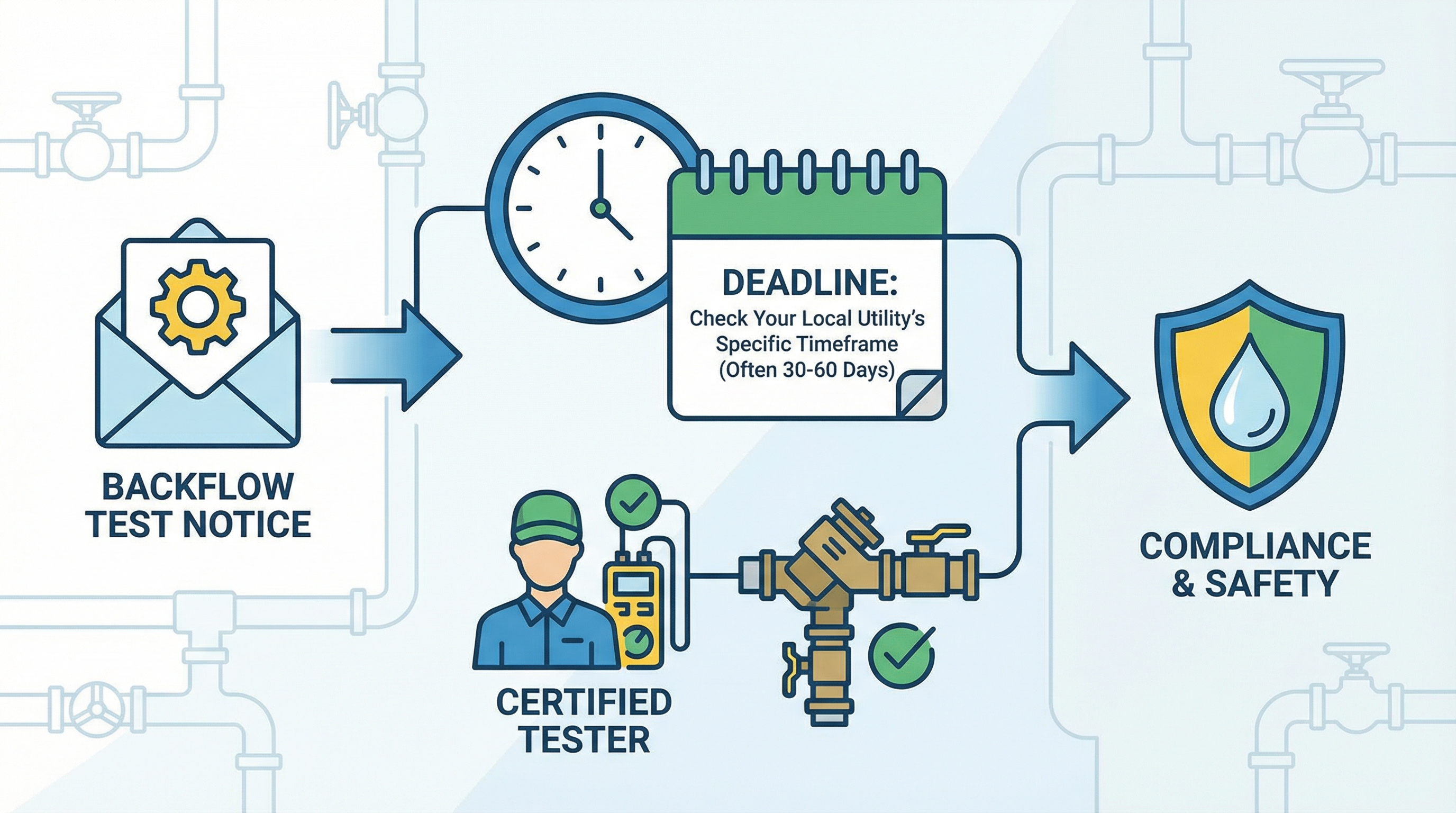
When a backflow test notice arrives from your water utility, the first question most property owners ask is simple: how long do I have?
The answer depends on your specific utility and local ordinances, but understanding the typical timeline — and what options you have if you need more time — can save you from unnecessary stress, fines, or service interruptions.

Typical Deadlines by Utility Type
Backflow test notice deadlines vary significantly across the country. There's no single federal standard that dictates how long property owners get to comply. Instead, each water utility sets its own timeline based on local cross-connection control ordinances.
Here's what you'll typically see:
30-Day Deadlines
Some of the stricter utilities give property owners just 30 days from the date of the notice. This is common in densely populated metropolitan areas where utilities manage large numbers of backflow devices and need tight compliance schedules to keep their programs running efficiently. Cities like Denver, parts of Los Angeles County, and several Texas municipalities use 30-day windows.
60-Day Deadlines
This is the most common timeframe across the United States. A 60-day window gives property owners enough time to receive the notice, find a certified tester, schedule an appointment, and have the results submitted — all without feeling rushed. Most mid-sized utilities and many state-level regulations default to approximately 60 days.
90-Day Deadlines
Some utilities, particularly those in rural areas or those with smaller cross-connection control programs, provide up to 90 days. This extended window acknowledges that certified backflow testers may be less available in certain regions, and scheduling can take longer.
Annual Testing Windows
A growing number of utilities have moved to an annual testing window approach rather than individual notice deadlines. Under this model, all backflow devices in a particular zone or district must be tested within a specific calendar period — often a 3 to 4 month window. You'll receive a notice at the start of the window, and you have until the window closes to complete your test.
Where to Find Your Specific Deadline
Your deadline is printed directly on the notice itself. Look for language like:
- "Testing must be completed by [DATE]"
- "Compliance deadline: [DATE]"
- "You have [X] days from the date of this notice to..."
- "Annual test due within the [MONTH-MONTH] testing period"
If the deadline isn't clear, contact your utility's cross-connection control department directly. The phone number is usually on the notice.
You can also check your water utility's website. Many utilities publish their cross-connection control requirements, including testing timelines, online. Some even have online portals where you can look up your property's compliance status.
Can You Request a Deadline Extension?
Yes — and this is something most property owners don't realize. Many utilities will grant a deadline extension if you ask for one before the original deadline passes.
Common acceptable reasons for an extension include:
- Scheduling difficulty — certified testers in your area are booked out past your deadline
- Recent property purchase — you just bought the property and weren't aware of the backflow device
- Device access issues — construction, landscaping, or other work is temporarily blocking access to the device
- Financial hardship — some utilities have hardship provisions for low-income property owners

The key is to contact your utility before the deadline expires. Calling after the deadline has passed changes the conversation from "I need more time" to "I'm already non-compliant" — and utilities are much less flexible at that point.
Most extensions are granted for an additional 15 to 30 days. Some utilities will grant longer extensions on a case-by-case basis.
What Happens When the Deadline Passes
If your deadline passes without a test report on file, the consequences follow a fairly predictable escalation pattern:
Stage 1: Second Notice (0-30 days past deadline)
Most utilities send a follow-up notice — sometimes called a "final notice" or "second notice" — reminding you that your test is overdue. This letter typically warns of specific consequences if you don't comply within an additional timeframe (usually 15 to 30 days).
Stage 2: Administrative Action (30-90 days past deadline)
If you still haven't complied after the second notice, utilities may take administrative action. This can include:
- Administrative fees ranging from $25 to $250
- Daily non-compliance penalties (some utilities charge $10 to $50 per day)
- Listing your property as non-compliant in their records
- Requiring a backflow survey of your entire property at your expense
Stage 3: Water Service Action (90+ days past deadline)
As a last resort, utilities have the authority to restrict or disconnect water service to non-compliant properties. This is the nuclear option that utilities generally prefer not to use, but virtually every cross-connection control ordinance includes this provision.
The Safe Drinking Water Act gives public water systems both the authority and the obligation to protect drinking water quality. Cross-connection control programs, including backflow testing requirements, are a core part of that mandate.
Tips for Meeting Your Deadline
Here are practical steps to make sure you comply on time:
Act within the first week of receiving the notice. Don't set it aside to deal with later.
Find a certified tester immediately. Browse our state directory to find testers in your area with real ratings and contact information.
Schedule early in the compliance window. During peak testing season (spring and summer), certified testers fill up fast. If you wait until the last two weeks before your deadline, you may not find availability.
Confirm the tester will submit results. In most jurisdictions, the tester submits the report directly to your utility. Confirm this when booking — don't assume.
Follow up with your utility a week after the test to confirm they received the report. Occasional paperwork errors happen, and you don't want to be flagged as non-compliant because of a lost form.
Set a calendar reminder for next year. Annual testing means this happens every year — getting ahead of it makes each subsequent year easier.
Special Situations
New Property Owners
If you recently purchased a property and received a backflow test notice, you may not have even known a backflow device existed on the property. This is more common than you'd think. Contact your utility to explain the situation — they're usually understanding and will work with you on the timeline.
Multiple Devices
Some commercial properties and larger residential properties have multiple backflow prevention devices. Your notice may cover all of them, and the deadline applies to all devices listed. Make sure your tester plans to test all devices in a single visit if possible — it's more efficient and usually costs less per device.
Property Managers
If you manage multiple properties, each may have different testing deadlines. Building a compliance calendar is essential. Many property management firms schedule all their backflow tests during the same period each year to simplify tracking. Our Learning Center has resources for managing compliance across multiple properties.
The Bottom Line
Most property owners have 30 to 90 days to complete a backflow test after receiving a notice, with 60 days being the most common deadline. The single most important thing you can do is act promptly — find a tester, schedule the appointment, and make sure results get submitted.
If you need more time, contact your utility before the deadline. If you're not sure where to find a certified tester, search our directory by state for providers with verified ratings and contact information.
For a complete walkthrough of what happens once you schedule the test, read our guide on what happens after you get a backflow test notice.
Sources
This article references guidance and regulations from authoritative sources including:
- U.S. Environmental Protection Agency (EPA) - Safe Drinking Water Act Overview — Federal framework authorizing water systems to enforce cross-connection control compliance
- American Water Works Association (AWWA) - Cross-Connection Control Manual (M14) — Industry guidance on testing timelines and compliance program administration
- USC Foundation for Cross-Connection Control and Hydraulic Research - Manual of Cross-Connection Control — Technical reference for utility compliance enforcement procedures
- Centers for Disease Control and Prevention (CDC) - Cross-Connection Control and Backflow Prevention — Public health rationale for backflow testing requirements
Last updated: February 20, 2026