Backflow Prevention Requirements for Hotels and Hospitality
Backflow Prevention Requirements for Hotels and Hospitality
Hotels tend to have more complicated water systems than they look like from the curb. Even a limited-service property may have irrigation, a treated boiler, housekeeping sinks, and several floors. Larger hotels add kitchens, laundry, pools, spas, cooling equipment, fountains, and sometimes multiple service lines.
That is why backflow compliance comes up so often in hospitality. Usually the rule is not "hotels must do X." The rule is that hotels often combine several conditions utilities already treat as cross-connection risks.
EPA explains that the Safe Drinking Water Act protects public drinking water, and local cross-connection control programs are one of the practical ways utilities carry out that responsibility. If you want the broader public-health background first, start with why backflow testing is required.
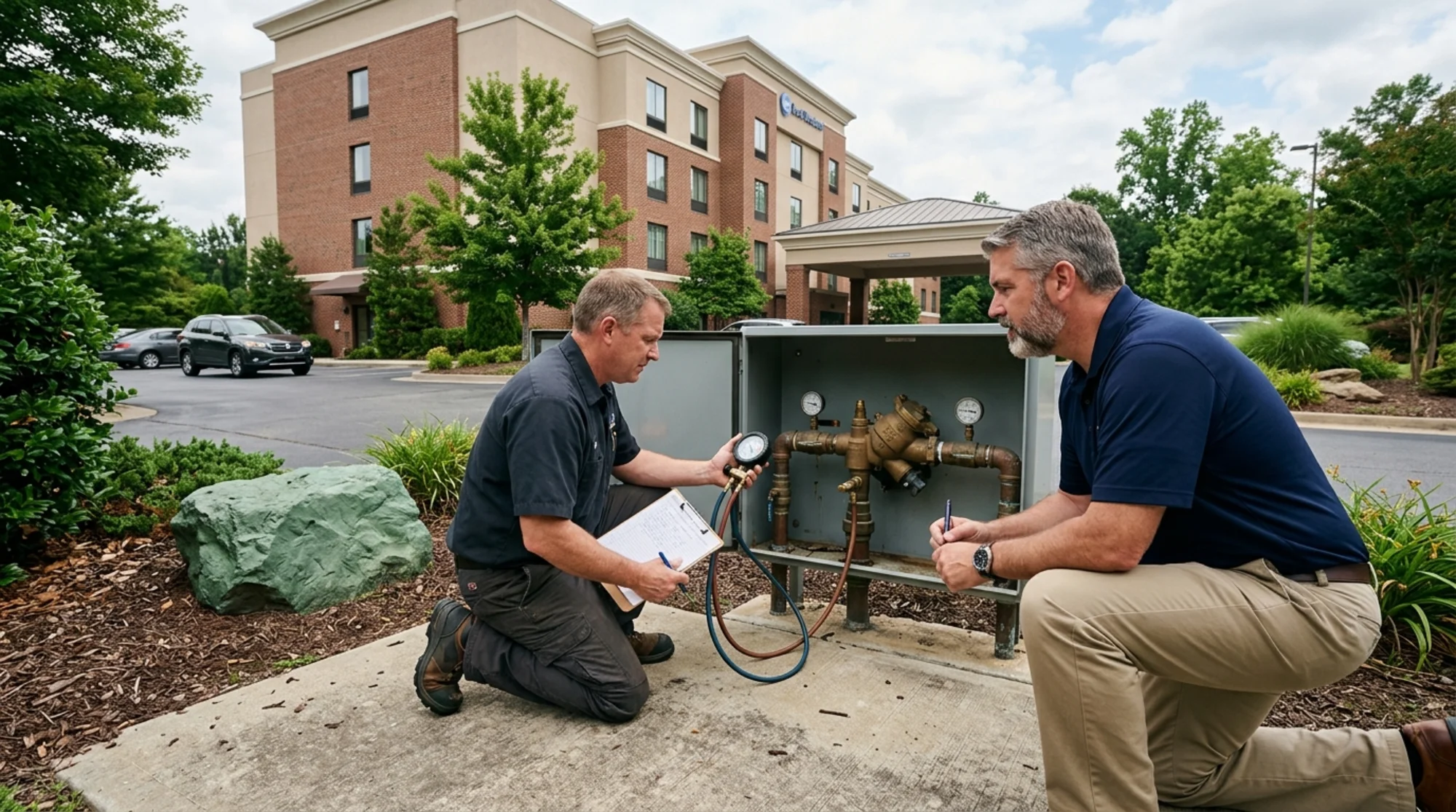
A hotel property manager and certified backflow tester inspecting a reduced pressure backflow assembly near the main water service outside a mid-size hotel, entrance drive and landscaped frontage visible in the background, natural daylight, no logos or text
Hotels are often regulated by system type, not by the word "hotel"
Many utility programs focus on the actual hazards connected to the water system. That means your hotel may trigger requirements because of what is on site, even if a local page does not list "hospitality" in bold letters.
New York City DEP is a useful example because its FAQ lays out the logic very clearly. The city requires backflow prevention devices for properties with swimming pools, multiple water service lines, laundries and dry cleaners, premises with commercial or public kitchens, premises with water cooled equipment or chillers, premises with roof tanks and elevated storage lines, premises with large boilers or chemically treated boilers, and premises that reuse or recycle water. A single hotel can easily check several of those boxes at once.
Seattle Public Utilities says the required protection is determined by hazard. Its page lists commercial laundries and dry cleaners and irrigation systems with chemical addition as example health hazards, and it also notes that buildings exceeding three stories or 30 feet may still require approved backflow protection. Even a fairly ordinary hotel can enter the compliance conversation because of height, irrigation, laundry, or other connected systems.
So the practical question is not just, "Am I a hotel?" It is, "Which systems on my property create a cross-connection risk, and what level of protection does my utility require for them?"
If you want to compare how active local programs look in real markets, review city pages like Seattle, New York, and Austin.
The hospitality systems that most often trigger backflow review
A hotel does not need every possible water feature to need backflow protection. A few common systems are enough.
Pools, spas, and hot tubs
This is one of the clearest triggers. NYC DEP explicitly lists swimming pools as a property type that must install and operate backflow prevention devices unless exempted. Hotels with spas and hot tubs should treat that as a strong signal to confirm local requirements instead of assuming a pool contractor handled everything years ago.
Commercial kitchens and food service
Restaurants, breakfast service areas, banquet kitchens, bars, coffee service, and prep sinks all increase plumbing complexity. NYC specifically includes premises with commercial or public kitchens and food preparation facilities in its required-device list.
Laundry and housekeeping operations
Many hospitality properties either have on-site laundry or still maintain housekeeping utility sinks, chemical storage, and service areas. NYC lists laundries and dry cleaners, and Seattle lists commercial laundries and dry cleaners among example hazard facilities.
Boilers, chillers, and water treatment chemicals
Large buildings often use treated boilers, water-cooled equipment, or chillers. NYC’s FAQ specifically calls out treated water boilers, large boilers or chemically treated boilers, and water cooled equipment or chillers. Hotels with central plant equipment should assume this deserves explicit review during any backflow survey.
Irrigation, fountains, and site amenities
Landscaped hotel grounds, irrigation zones, decorative fountains, and outdoor hose connections are easy to treat as separate maintenance issues, but utilities may see them as part of the same cross-connection picture. Seattle specifically notes that premises with separate irrigation systems using the purveyor's water supply with chemical addition are high health hazards.
Multiple service lines, roof tanks, and taller buildings
Larger urban hospitality properties can have multiple service lines, roof tanks, elevated storage, or enough height to trigger additional backflow considerations. NYC names multiple water service lines and roof tanks and elevated storage lines directly. Seattle points out that taller buildings may still require approved protection even when they are not in the highest hazard category.
 A certified backflow tester connecting a differential pressure gauge kit to a mechanical room backflow assembly beside hotel boiler and water treatment equipment, natural lighting, no text overlay
Hospitality water complexity is bigger than one annual test
CDC guidance for hotel owners and managers shows how many managed water systems hospitality properties often operate, including cooling towers, showers, hot tubs, decorative fountains, and low-occupancy rooms or floors. CDC is addressing Legionella risk there, not local backflow enforcement, but the lesson still applies: hotel water systems are interconnected, and a backflow assembly is part of a broader risk-control setup.
For a hotel, the simplest working model is: operations handles access, facilities tracks equipment, the tester handles the field work, and management keeps proof that the right paperwork reached the utility.
What installation and annual testing usually involve
For many hospitality properties, compliance starts with installation review and then shifts into an annual test cycle.
NYC DEP says owners must hire a Professional Engineer or Registered Architect to prepare a backflow prevention plan, get DEP approval, and then hire a Licensed Master Plumber to install the device. After installation, the device must be tested by a New York State certified tester, and once it is in service it must be tested every 12 months. Failure to complete the annual test can result in fines or water-service disconnection.
Seattle’s workflow is a little different in detail but similar in principle. SPU says new assemblies must be installed in an approved manner, tested by a State of Washington certified Backflow Assembly Tester before being placed into service, and then tested annually. Seattle also says owners are responsible for making sure tests happen on time and that copies of reports are provided directly to SPU.
Washington DOH reinforces the paperwork side by publishing BAT duties, field test report content rules, certification verification, and a public tester list. That tells you something important. A passing field result is not the whole job. Utilities also care whether the test was performed by the right person, documented correctly, and submitted in an acceptable format.
In practice, hotel managers should expect a compliant annual process to include confirming which assemblies are on site, having them tested by the right professional, documenting credentials and results, confirming report submission, and handling repair and retest if any assembly fails.
If you need a utility-program example to compare against, our pages for Austin Water and the Philadelphia Water Department are useful reference points.
Common hotel compliance mistakes
Common mistakes are assuming a hotel is just another commercial building, assuming one device solves everything forever, separating the mechanical work from the paperwork, and hiring a vendor without confirming the exact credential required in that jurisdiction. If you need help screening providers, our guide on how to choose a qualified backflow tester is a good companion, and the FAQs page covers common baseline questions.
 A hotel operations manager reviewing completed backflow test reports, certified tester paperwork, and a property water-system checklist at an office desk, natural indoor lighting, no logos or text
A practical checklist for hotel owners and hospitality managers
Before your next due date, work through this list:
- Confirm whether your property has pools, spas, irrigation, boilers, chillers, fountains, laundry, kitchens, roof tanks, or multiple water service lines.
- Verify which backflow assemblies are installed, where they are located, and what each one protects.
- Check whether your local utility requires a PE or RA review, a licensed plumber, a certified tester, or some combination of those roles.
- Ask whether reports are submitted by the tester, the plumber, or the property.
- Keep copies of all approved plans, test reports, calibration records, and submission confirmations.
- Recheck requirements after renovations, amenity additions, or major mechanical changes.
If you operate multiple properties, keep an assembly register and a compliance calendar. Hospitality portfolios are exactly where missed paperwork happens even when field work is done.
For broader context on non-residential sites, our article on backflow testing requirements for commercial properties is a helpful companion.
Bottom line
Backflow prevention requirements for hotels usually come from the systems hotels operate, not from a single one-line rule that says "all hotels must do X." Pools, boilers, kitchens, laundry, irrigation, fountains, roof tanks, chillers, and multiple service lines can all push a hospitality property into a more serious cross-connection review.
The best move is to stop guessing, confirm how your local utility classifies the property, verify the assemblies installed on site, and treat annual testing as both a mechanical task and a documentation task. That is what keeps the property compliant and helps protect the drinking water supply your guests and staff rely on.
If you are ready to line up service, start by finding a backflow tester near you.
Sources
This article references guidance and regulations from authoritative sources including:
- U.S. Environmental Protection Agency (EPA) - Overview of the Safe Drinking Water Act
- Seattle Public Utilities - Requirements & Types of Backflow Prevention
- Seattle Public Utilities - Backflow Assembly Testing
- New York City Department of Environmental Protection - Backflow Prevention Frequently Asked Questions
- Washington State Department of Health - Cross-Connection Control and Backflow Prevention
- Centers for Disease Control and Prevention (CDC) - Hotel Owners and Managers, Control Legionella
- American Water Works Association (AWWA) - Cross-Connection Control / Backflow Prevention Resources
Last updated: April 30, 2026