Backflow Prevention for Multi-Family Residential Buildings
Backflow Prevention for Multi-Family Residential Buildings
Multi-family buildings are residential, but they often have the plumbing complexity of a light commercial site.
Backflow questions come up so often because multi-family sites often have the kinds of water connections utilities already treat as cross-connection risks.
EPA says the Safe Drinking Water Act protects public health by regulating the nation’s public drinking water supply. Local utilities and state drinking-water programs then apply that public-health goal through cross-connection control and backflow prevention rules. If you want the broad foundation first, our Learning Center guide on why backflow testing is required is the right starting point.
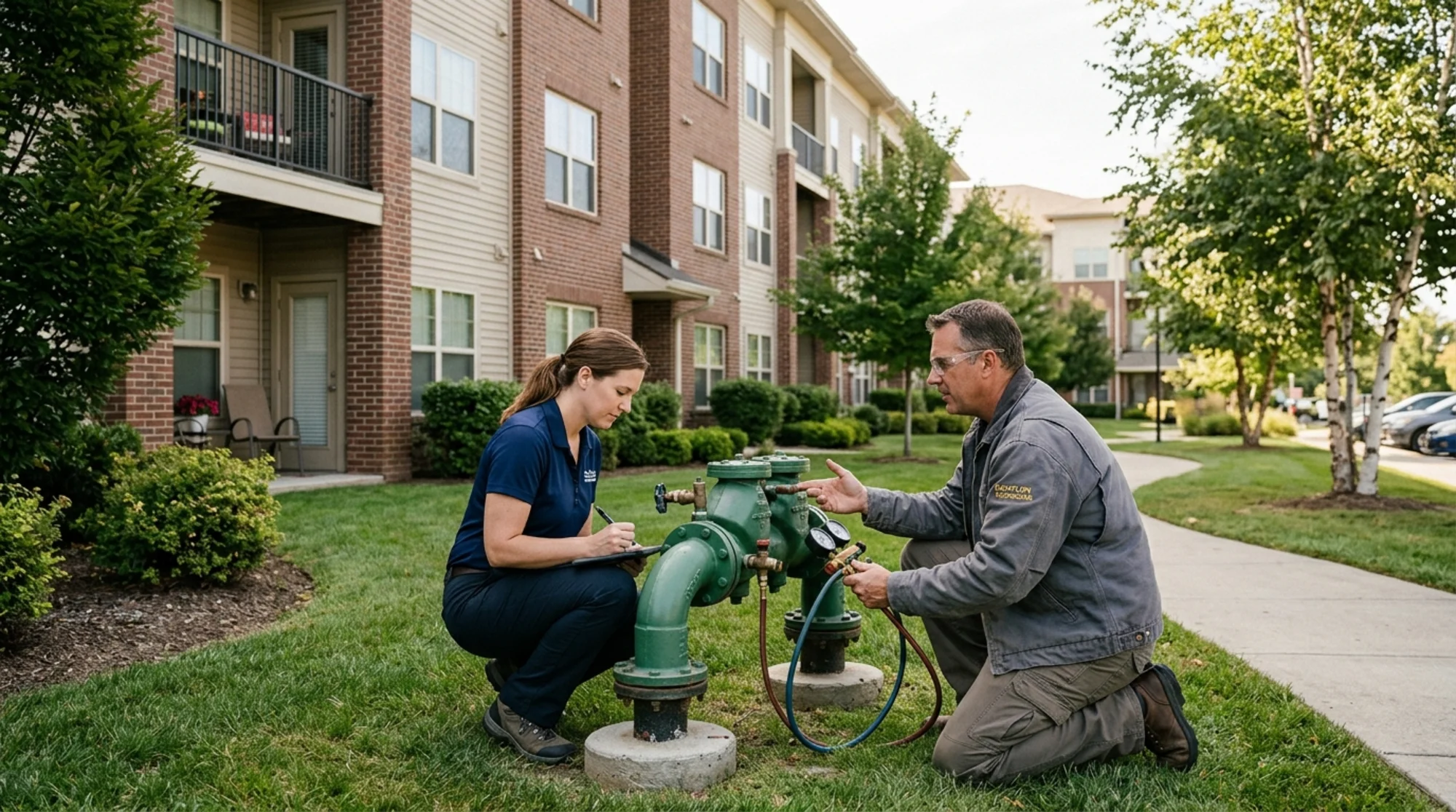
An apartment property manager and a certified backflow tester inspecting an exterior backflow prevention assembly beside a multi-family residential building with landscaped common areas, natural daylight, no text overlay, no visible logos
Why multi-family properties get flagged more often than owners expect
A single-family home may have one straightforward domestic water service and not much else. Multi-family properties often add shared irrigation, pools, boilers, fire sprinkler systems, roof tanks, elevated storage, treatment chemicals, multiple service lines, or more complicated mechanical rooms.
That is why utilities usually look at hazard and system configuration, not just whether the property is technically residential.
Seattle Public Utilities says the required backflow protection is determined by the hazard, and it lists low-hazard examples that include irrigation systems, fire systems, and buildings exceeding three stories or 30 feet in height.
New York City DEP shows another side of the same issue. Its FAQ says certain properties are required to install and operate backflow prevention devices, including properties with in-ground irrigation sprinklers, swimming pools, multiple water service lines, roof tanks and elevated storage lines, and large residential dwellings with treated water boilers.
The practical takeaway is simple: a multi-family property may need backflow protection not because it is “commercial,” but because shared residential infrastructure often creates risks utilities already regulate.
The systems on multi-family sites that most often change the answer
There is no single national apartment-building backflow template. Requirements usually change when one or more of the following systems are present.
Irrigation and common-area water use
Landscaped common areas are one of the biggest triggers. Seattle lists irrigation systems as a low-hazard example, and it separately lists premises with irrigation systems using the water supplier’s water together with chemical addition as high health hazards. That matters for apartment communities, condos, and HOA-managed sites where fertilizers or injected treatment products may be part of the irrigation setup.
Pools, spas, and water features
Pool equipment and shared amenities create another obvious risk point. Portland Water Bureau reminds residents to keep hose ends out of pools and other containers to avoid backflow, and NYC DEP specifically lists properties with swimming pools among those required to install and use backflow prevention devices unless exempted.
Boilers and water treatment chemicals
Large residential buildings often have central boilers or treated water systems. NYC DEP specifically calls out large residential dwellings with water boilers that use rust inhibitors or other water-treatment chemicals, as well as premises with large boilers or chemically treated boilers. That is one reason older apartment buildings and larger condo towers should not assume a normal residential label keeps them out of a backflow program.
Fire protection, building height, and service complexity
Seattle says fire systems and buildings exceeding three stories or 30 feet can fall into low-hazard backflow requirements. Once a property has dedicated fire lines, multiple risers, or unusual service arrangements, the answer usually gets more specific.
Multiple service lines, roof tanks, and elevated storage
These are especially relevant in denser urban buildings. NYC DEP explicitly lists multiple water service lines and roof tanks or elevated storage lines as triggers. Even when the domestic use sounds ordinary, those infrastructure details can change what protection the utility expects.
For local provider coverage, city pages like Austin, Texas, Philadelphia, Pennsylvania, and Seattle, Washington are a practical next step.
Backflow compliance on multi-family buildings is usually an owner or manager responsibility
One of the most common apartment-building mistakes is assuming a tenant, onsite maintenance person, pool contractor, or irrigation vendor is automatically handling the compliance side.
Sometimes they may handle part of it. But utilities usually want a clear responsible party.
NYC DEP states directly that property owners must hire a Licensed Master Plumber to install a backflow prevention device and that tenants are not responsible for managing installation or maintenance. That is New York-specific in the details, but the broader lesson travels well. On multi-family properties, the responsibility usually belongs to the ownership, association, landlord, or management structure, not to individual residents.
For condo associations and HOAs, this matters even more because the device may protect shared infrastructure rather than one unit.
That is also why recordkeeping matters so much. If management changes, a good handoff should include assembly locations, assembly type, the last passing test date, the next due date, the tester used, and proof of report submission.
If that documentation is weak, the first problem is often that nobody knows what was supposed to happen next.
 A certified backflow tester reviewing a completed field test report with an apartment maintenance manager beside a mechanical room entrance and shared building water equipment, natural lighting, no text overlay, no visible logos
What annual testing and paperwork usually involve
Once a testable assembly is required, the ongoing process tends to look familiar across many utilities even when the exact forms differ.
Seattle Public Utilities says all installed backflow assemblies must be tested annually by a State of Washington certified Backflow Assembly Tester. Its testing page also says failure to complete testing can lead to non-compliance charges and possibly water-service termination.
Washington DOH adds structure behind that workflow. It publishes Backflow Assembly Tester duties, field test report content requirements, certification verification tools, and public tester lists. That is a strong reminder that utilities care about both the mechanical result and whether the report meets the program’s standards.
NYC DEP uses a different administrative path, but the same basic model. After installation and initial testing, the property owner is required to have the device tested every 12 months by a certified tester, and failure to perform the annual test can result in fines or disconnection of water service.
For a multi-family property manager, the practical workflow usually includes:
- confirming which assemblies are actually on site,
- booking the right tester early enough to avoid deadline pressure,
- making sure the assembly is accessible on test day,
- confirming whether the tester submits the report or management does,
- saving the final report internally,
- and handling repair plus retest quickly if the assembly fails.
If you need a prep checklist before the visit, our guide on how to prepare your property for a backflow test is a good companion.
Questions apartment owners, condo boards, and property managers should ask
If you are not fully sure where your property stands, ask these questions before the next notice arrives:
- Which water systems on the property are creating the backflow requirement?
- Is the required assembly protecting the domestic service, irrigation, fire line, or another connection?
- Does the property have treated boilers, pools, roof tanks, irrigation chemical injection, or multiple service lines that raise the hazard level?
- Who is responsible for submitting reports and keeping proof on file?
- If the assembly fails, can the same provider handle repair and retest, or do we need multiple trades?
- If the property is a condominium or HOA, is the responsibility clearly assigned between the board, manager, and vendor?
Those questions help prevent the most common multi-family mess, everyone assumes someone else is handling it.
Utility-program pages can also help you compare how formal different local workflows are. The Philadelphia Water Department backflow testing program, Austin Water backflow testing program, and FAQs page are good starting points.
A simple multi-family backflow checklist
Before your next testing cycle, work through this list:
- confirm every shared assembly location on the property,
- note what each assembly protects,
- verify whether the property has irrigation, pools, boilers, roof tanks, multiple service lines, or fire systems,
- keep one clean file with the last passing report and next due date,
- make sure management changes do not break the record trail,
- schedule testing early enough to leave time for repair and retest,
- and confirm someone actually checks that the final report reached the utility.
For larger portfolios, our article on how utilities track backflow test compliance explains why good paperwork matters almost as much as a good field test.
 A condominium or apartment property manager reviewing a backflow compliance binder, utility notice, and service records at a desk with a shared-building water system file, natural office lighting, no logos or text overlay
Bottom line
Backflow prevention for multi-family residential buildings is usually driven by the systems the property operates, not by a simple label that says residential or commercial.
Shared irrigation, pools, treated boilers, fire systems, taller buildings, roof tanks, multiple service lines, and other common multi-family features can all bring a property into a utility backflow program. Once that happens, the safest move is to treat compliance as an operating responsibility, not a one-off plumbing task.
Know which assemblies are on site, know what hazards they are tied to, use the right tester, and keep the reporting trail clean. That is what keeps apartment and condo properties compliant and helps protect the drinking water supply residents depend on every day.
If you need help finding a provider, start by finding a certified backflow tester near you.
Sources
This article references guidance and regulations from authoritative sources including:
- U.S. Environmental Protection Agency (EPA) - Safe Drinking Water Act (SDWA)
- Centers for Disease Control and Prevention (CDC) - Preventing Drinking Water-Related Illnesses
- Washington State Department of Health - Cross-Connection Control and Backflow Prevention
- Seattle Public Utilities - Requirements & Types of Backflow Prevention
- Seattle Public Utilities - Backflow Assembly Testing
- New York City Department of Environmental Protection - Backflow Prevention Frequently Asked Questions
- Portland Water Bureau - How to choose and install a backflow prevention assembly
- American Water Works Association (AWWA) - Cross-Connection Control and Backflow Prevention Resources
Last updated: May 5, 2026