Who Submits the Backflow Test Report: Property Owner or Tester?
If you are new to backflow compliance, one of the most confusing parts is not the field test itself. It is the paperwork question that comes right after:
Who is actually supposed to submit the backflow test report — the property owner, the tester, or both?
The honest answer is: it depends on the utility’s program, but the owner is almost always still responsible for making sure the report gets accepted.
That is the key distinction.
A utility may require the tester to upload the form through a portal, email it to the cross-connection office, or file it through a utility-approved vendor system. But if that submission never happens, gets rejected, or cannot be matched to the right device, the overdue notice usually lands on the property owner or account holder.
This guide is a focused companion to our broader article on how to submit your backflow test report to your water utility. If you want the bigger public-health context first, keep why backflow testing is required and our FAQs nearby.
Short answer: the tester often files the report, but the owner still owns the outcome
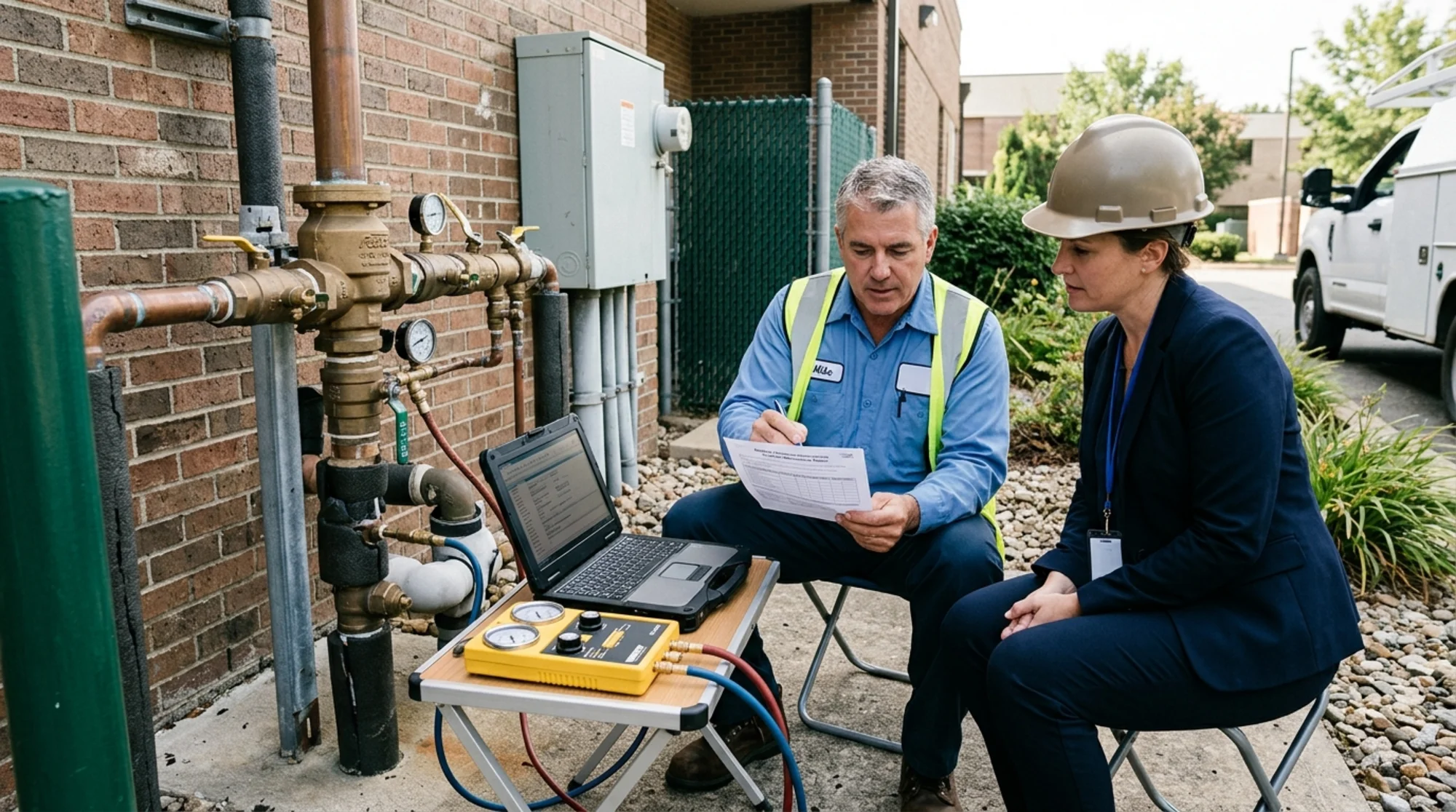
Certified backflow tester and property manager reviewing a completed test report beside a laptop and outdoor backflow assembly
EPA’s cross-connection control guidance frames this clearly: public water systems need enforceable programs, recordkeeping, and oversight, and customers need to understand their own responsibilities for testing and repairing backflow assemblies. In plain English, utilities care about the record being complete, traceable, and filed through the right channel.
That means two things can be true at once:
- the tester may be the person who actually submits the form, and
- the owner may still be the person held responsible if the record never closes.
That is why “the tester handles it” is not a complete compliance plan.
CDC’s drinking water guidance is also a useful reminder here: public water utilities are required to meet safety standards because drinking water failures can create real health risks. Backflow reporting is not just admin theater. It is part of how utilities prove assemblies protecting the potable system were tested, repaired if needed, and documented correctly.
If you have already run into paperwork trouble, read what to do if your utility says it never received your backflow test report and why your backflow test report was rejected. Those two problems are where this responsibility gap shows up most often.
What official utility programs actually require
The safest move is to stop looking for one universal national rule and instead ask: What does my utility’s program require in this jurisdiction?
A few official examples show how different the filing workflow can be.
Austin Water: tester submits online through WEIRS
Austin Water says each licensed Backflow Prevention Assembly Tester must submit a complete and legible Test and Maintenance Report within five calendar days of the test. It also says all reports must be submitted online through the WEIRS database and that paper copies are no longer accepted.
That is a strong signal that Austin does not want owners guessing with random email attachments or mailing in old forms. The utility expects a registered tester using the utility’s own workflow.
Dallas Water Utilities: mandatory SwiftComply participation
Dallas says high-hazard assemblies require annual testing by a licensed tester registered with the City of Dallas. It also says the city transitioned to online submission through SwiftComply and that participation in the program is mandatory.
Again, the practical takeaway is that the owner may hire the tester, but the accepted filing path runs through the utility’s approved tester system.
San Antonio Water System (SAWS): completed reports go to BSI Online
SAWS says annual testing must be coordinated between the customer and the tester, the tester completes a Test & Maintenance Report for each assembly, and completed reports should be submitted to BSI Online. SAWS also warns that submitting a failed report is considered a delinquency unless the assembly is repaired and retested.
That is important because it shows the customer and tester both have roles. The customer coordinates the work, but the tester-driven report workflow still matters.
Denver Water: reports must be sent to the cross-connection office
Denver Water says the water customer must have the assembly tested upon installation and annually thereafter by a certified tester, and that all testing must be reported to Denver Water’s Cross-Connection Control office. Denver also publishes the destination: test reports must be sent to the program email address.
That is a different workflow from Austin or Dallas, but the same principle applies: use the channel the utility names, not the one you assume should work.
State rules reinforce the recordkeeping side
TCEQ says its official backflow forms must be submitted to the responsible water system for recordkeeping. Colorado’s drinking-water program also published guidance work around annual backflow reporting templates after Regulation 11 updates. Regulators are not just asking whether the test happened. They care whether the result is documented in a format the utility program can track.
If you want local market context while comparing rules, our city pages for Austin, Texas, Denver, Colorado, and Philadelphia, Pennsylvania are a good starting point. Utility-specific overviews like Austin Water backflow testing and Philadelphia Water Department backflow testing are also helpful before you schedule anything.
What property owners should ask before test day
 Laptop showing a utility portal login beside a printed backflow test form, tester ID badge, and calibration certificate on a desk
If you only ask for price and availability, you are missing the compliance question that matters most.
Before the appointment, ask the tester:
- Who submits the report in this jurisdiction?
- Do you submit through a utility portal, by email, or another approved system?
- Are you already registered with this utility if registration is required?
- How long after the test do you usually submit the report?
- Will I receive a copy of the exact report that was filed?
- How should I confirm the utility marked the record compliant?
Then ask the utility, if anything is unclear:
- Do you require submission directly from the tester?
- Do you accept owner follow-up if the report needs correction?
- What form or portal applies to this assembly?
- How long does it normally take for the record to post?
Those questions can prevent a lot of avoidable trouble.
The goal is to leave the appointment knowing three things:
- who files,
- where it gets filed, and
- how you will verify acceptance.
If you manage multiple properties, turn those questions into a standard vendor checklist. That is much easier than reconstructing the process after an overdue notice arrives.
When the owner still needs to step in
Even if the tester is supposed to submit the report, there are several situations where the owner still needs to get involved fast.
1. The utility says nothing is on file
In that case, ask for proof of submission from the tester and confirm the exact assembly details used on the form.
2. The report was rejected
A rejected report often means missing fields, bad serial numbers, wrong forms, missing tester registration, or missing calibration information.
3. The assembly failed and needed repair
Some programs treat a failed report as an unresolved delinquency until the passing retest is submitted.
4. The device was replaced or removed
A replacement can create a record-matching problem if the old serial number is still on file. That is where how to update utility records after replacing a backflow preventer becomes relevant.
5. The property changed hands or staff changed
When ownership, property management, or maintenance vendors change, report-routing assumptions often break.
This is why owners should keep a basic compliance file with:
- the last accepted report
- assembly type, model, and serial number
- tester contact information
- proof of submission when available
- utility contact details
- next due date
EPA’s fact sheet specifically highlights recordkeeping for testing, repairs, and personnel certification. That is not overkill. It is what makes these handoffs survivable.
A clean workflow that prevents most submission problems
 Property manager filing a completed backflow report into a labeled compliance binder while checking an emailed utility confirmation on screen
A simple process works better than trying to remember what happened last year.
Before the test
- confirm which utility or jurisdiction governs the assembly
- confirm whether the tester must be licensed, registered, or utility-approved
- ask what submission channel will be used
On test day
- verify the service address and assembly serial number on the form
- request a copy of the completed report
- ask when the report will be filed
After the test
- save the report immediately
- wait the expected processing window
- confirm the utility marked the record compliant
- store any confirmation email, portal screenshot, or case number
If something looks off
- contact the tester and utility right away
- do not assume a missing or rejected report will fix itself
- keep the follow-up factual and tied to the exact assembly details
This workflow also makes it easier to compare providers. A qualified tester should be able to explain the reporting process just as clearly as the test procedure itself.
The bottom line
There is no single nationwide rule saying the property owner always submits the backflow test report or the tester always does.
What is consistent is this: the utility decides the accepted filing path, and the property owner is usually the one who feels the pain if that path is not followed correctly.
So the smartest answer is not “the tester handles it” or “I’ll just email the utility myself.” It is:
confirm the utility’s required channel, use a tester who knows that workflow, get a copy of the filed report, and verify the record actually closed.
That turns a vague responsibility question into a repeatable compliance process.
If you still need help lining up the right pro, start with your local city and utility program pages, then find a backflow tester near you before the deadline gets tight.
Sources
This article references guidance and regulations from authoritative sources including:
- U.S. Environmental Protection Agency (EPA) - Cross-Connection Control and Backflow Prevention Fact Sheet (PDF)
- American Water Works Association (AWWA) - Cross-Connection Control & Backflow Prevention resources
- Austin Water - Backflow Prevention Assembly Tester Information
- Dallas Water Utilities - Backflow Test Reports
- San Antonio Water System (SAWS) - Annual Testing of Backflow Prevention Assemblies
- Denver Water - Cross-Connection Control and Backflow Prevention Program
- Texas Commission on Environmental Quality (TCEQ) - Cross-Connection Control and Backflow Prevention
- Colorado Department of Public Health & Environment - Reg. 11 Guidance Updates for Storage Tank, Backflow Prevention and Cross-Connection Control
- Centers for Disease Control and Prevention (CDC) - About Drinking Water
Last updated: May 30, 2026