Testable vs Non-Testable Backflow Preventers: What You Actually Need
Why "Testable" vs "Non-Testable" Actually Matters
The EPA treats backflow as a public-health issue, not just a plumbing detail. Once a cross-connection exists between drinking water and a non-potable source, the real question becomes how much hazard is present and whether the protection can be verified in the field.
That is why two devices that both stop reverse flow can land in very different compliance categories. AWWA guidance and utility programs follow the same logic: match the protection method to the hazard and hydraulic conditions. This guide explains what that means in plain English, how to identify what you have, and when it is time to find a local tester.
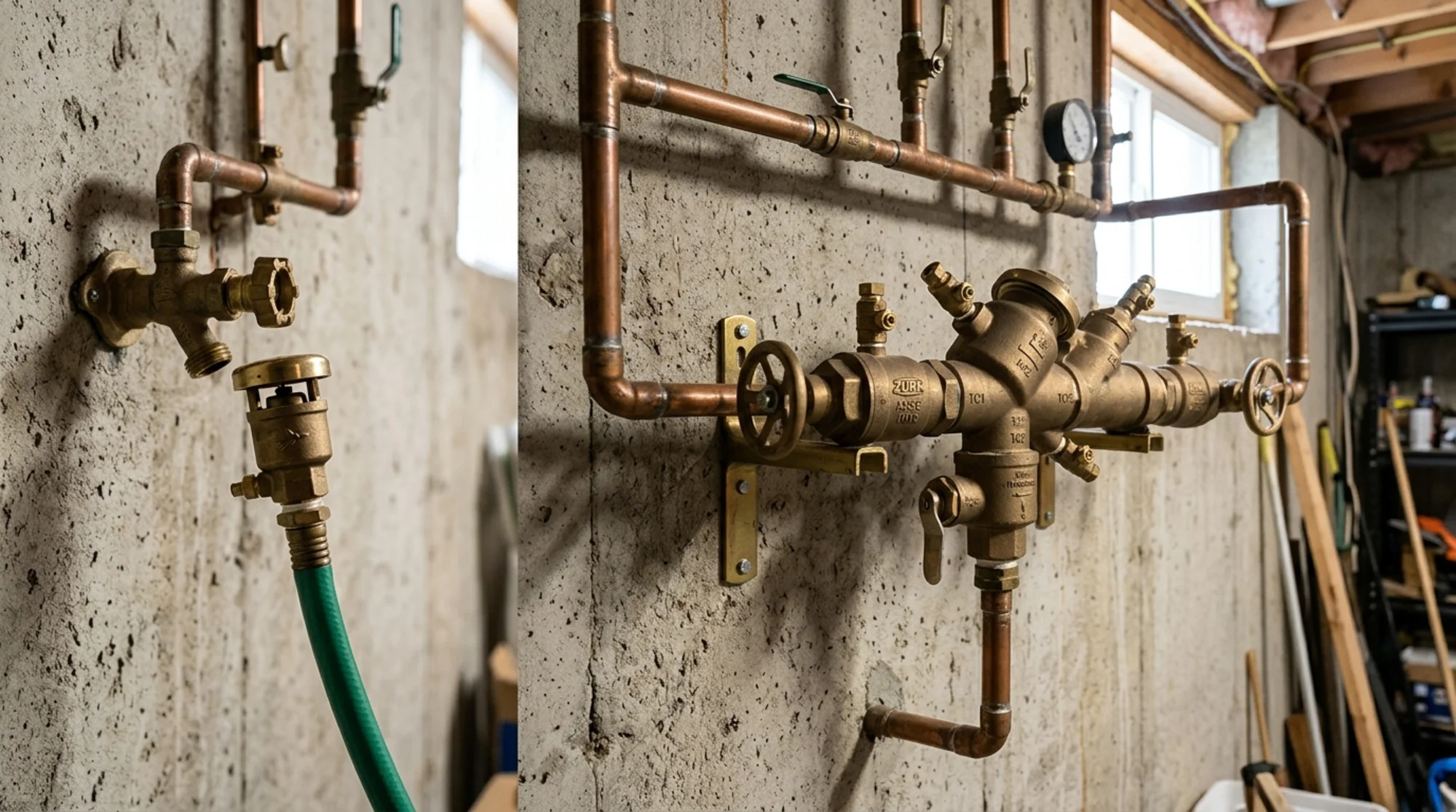
Side-by-side comparison of a small brass atmospheric vacuum breaker on a hose bib next to a large brass reduced-pressure backflow assembly with test cocks, mounted on a basement wall
What Makes a Backflow Preventer "Testable"
A testable backflow preventer is an assembly that a certified tester can evaluate with a differential pressure gauge and a documented field procedure. In practice, it has the hardware needed to isolate the assembly, connect a test kit, and verify that the internal checks or relief valve still work.
Common signs include:
- test cocks for connecting a gauge
- shutoff valves on the inlet and outlet
- a manufacturer model meant to be field-tested and repaired
That is why testable assemblies show up on irrigation systems, fire services, commercial domestic lines, boiler feeds, and other higher-risk connections. In Texas, for example, the TCEQ licenses Backflow Prevention Assembly Testers, and utilities like Austin Water require formal reporting from those licensed testers. Our Austin Water program guide and Charlotte Water program guide show how local programs explain that process.
What "Non-Testable" Means
A non-testable backflow preventer still provides real protection, but it is not designed for field verification with a differential gauge. It is usually simpler, cheaper, and tied to lower-risk fixture or hose connections.
That does not make it interchangeable with a testable assembly. A hose bib vacuum breaker and a reduced pressure assembly are both legitimate devices, but they solve very different compliance problems.
The Devices You Will Actually See
Atmospheric Vacuum Breaker (AVB) — Non-Testable
An AVB stops backsiphonage by letting air into the line when pressure drops. It is common on individual fixture connections and other simpler applications, but it is not the answer for every irrigation or commercial line.
Hose Bib Vacuum Breaker (HBVB) — Non-Testable
This is the small device on an outdoor spigot that protects against a hose sitting in a bucket, pool, or chemical sprayer. If it leaks or breaks, replacement is usually the practical fix.
Pressure Vacuum Breaker (PVB) — Testable
A PVB is common on irrigation systems because it is built for field testing and for lines that may remain pressurized.
Double Check Valve Assembly (DCVA) — Testable
A DCVA uses two independently acting check valves in series and is used where the utility or regulator allows a testable assembly for lower-hazard conditions. For more detail, see our related post on double check valve assemblies and when they are required.
Reduced Pressure Assembly (RP or RPZ) — Testable
An RP adds a relief valve between the checks so the assembly can discharge rather than quietly allow a higher-hazard backflow condition to develop. That is why it is commonly used for higher-risk connections such as chemical injection and certain commercial or industrial uses.
 Technician using a digital differential pressure gauge connected to the test cocks of a reduced-pressure backflow assembly, with a clipboard and test report on a nearby surface
How Utilities Decide Which Device You Need
The decision is usually based on two questions:
- What is the degree of hazard if water flows backward?
- What hydraulic conditions exist at the connection?
That hazard-based approach is consistent across EPA guidance, AWWA policy, state regulators, and local utility programs.
Here is the practical version:
- Outdoor hose connection: usually a non-testable hose bib vacuum breaker or similar fixture protection.
- Typical irrigation without chemical injection: often a testable assembly such as a PVB, and sometimes a DCVA where local rules allow it.
- Irrigation with fertilizer or chemical injection: often an RP because the hazard is higher.
- Commercial or mixed-use domestic service: depends on the building use and utility hazard classification.
- Boilers, medical equipment, industrial process connections, or other higher-risk plumbing: commonly require stronger protection and formal review.
That is why it is smart to check both your local city page and the utility program page instead of relying on a generic internet answer. If you need local context, start with Austin, TX, Charlotte, NC, or Los Angeles, CA, then compare that to the actual utility program instructions.
How to Tell What You Already Have
You can usually do a first-pass identification in a few minutes.
Look for these clues in order:
- Test cocks. If you can see small test ports meant for a gauge, you are probably looking at a testable assembly.
- Inlet and outlet shutoff valves. These are another strong sign that the device is meant for formal field testing.
- A relief valve body or discharge area. That often points to an RP-style assembly.
- A manufacturer tag or stamped model number. This is the fastest path to a reliable ID.
- Location and use. A hose connection, irrigation riser, boiler feed, or fire line all point to different device classes.
If you are not sure, photograph the device, the nameplate, and the surrounding piping. Then ask the utility whether that exact assembly is on file for your address. If the device is tied to a recurring compliance program, they can often tell you what type they expect and whether any report is due.
What Annual Testing Usually Involves
For a testable assembly, compliance is part plumbing check and part paperwork process:
- A certified tester isolates the assembly and connects a calibrated differential gauge.
- The tester checks whether the internal components meet the field criteria for that assembly type.
- If the device fails, it is repaired or replaced and then retested.
- The results are documented and submitted to the utility or local program.
- The owner keeps a copy for records.
That last step matters. Austin Water, for example, requires licensed testers to submit complete Test and Maintenance Reports online within five calendar days. Other utilities use different timelines, but the lesson is the same: do not assume the tester filed everything correctly until you confirm it.
For larger buildings, CDC water-management guidance reinforces the documentation side: keep a clean log for device type, model, serial number, last test date, repair history, and utility contact.
 Hand pointing to test cocks and relief valve on a wall-mounted reduced pressure backflow assembly in a mechanical room, with copper supply pipes visible
Common Mistakes That Cause Trouble
Assuming any backflow device satisfies any hazard. It does not. The utility may require a testable assembly even if a smaller device is physically preventing some reverse flow.
Using a non-testable device where the utility expects a testable assembly. This often shows up on irrigation, commercial remodels, and property upgrades where someone installs what is easy instead of what is approved.
Ignoring the paperwork side. A device can pass in the field and still leave you out of compliance if the report never reaches the utility.
Changing the downstream use without reevaluating the hazard. Adding fertilizer injection, treatment equipment, or other process changes can change the protection class you need.
Treating unknown devices as someone else’s problem. If you bought the property, inherited the maintenance file, or manage the site now, it is your problem now. Better to identify the device early than explain it during an enforcement notice.
What to Do Next
If you are a homeowner, locate the device, photograph the model tag, ask your utility whether it is on file, and confirm whether a tester must submit anything this year.
If you manage multiple properties, keep one spreadsheet with the utility contact, assembly type, model, serial number, last passing test, and next action date.
If you are still sorting out the basics, our FAQs cover the common owner questions, and our post on how long a backflow test takes can help you plan the appointment side. When you are ready to act, use FindBackflowTesters to find a local tester.
The Bottom Line
"Testable" and "non-testable" are shorthand for how much risk a connection presents and whether the protection can be proven in the field. If the connection serves irrigation, commercial plumbing, fire protection, or higher-hazard equipment, a utility may expect a testable assembly with regular reporting. The safest move is to identify the device, confirm the utility’s expectations, and treat the paperwork as part of the job.
Sources
This article references guidance and regulations from authoritative sources including:
- U.S. Environmental Protection Agency (EPA) - Cross-Connection Control and Backflow Prevention Fact Sheet (PDF)
- U.S. Environmental Protection Agency (EPA) - Cross-Connection Control Manual (PDF)
- American Water Works Association (AWWA) - Cross-Connection Policy Statement
- Texas Commission on Environmental Quality (TCEQ) - Occupational Licenses: Backflow Prevention Assembly Tester
- Austin Water - Backflow Prevention Assembly Tester Information
- Charlotte Water - Backflow Program Information
- Centers for Disease Control and Prevention (CDC) - Overview of Water Management Programs
Last updated: May 27, 2026