Tax Deductions for Backflow Testing and Maintenance Costs
Tax Deductions for Backflow Testing and Maintenance Costs
Backflow testing bills usually do not feel like a tax strategy. They feel like one more compliance expense you have to handle before a deadline gets missed.
But once you are paying for annual tests, maintenance, repairs, or even a full assembly replacement, the tax treatment starts to matter. The same property owner who wants the device compliant also wants to know whether the cost is an ordinary current-year deduction, a capital improvement, or part of a larger asset decision.
That is the real question. Not “Can I deduct backflow costs?” in the abstract, but which backflow costs are usually deductible now, and which ones may need to be capitalized and recovered over time?
IRS guidance for small businesses points taxpayers to the rules for deducting business expenses and to the separate rules for depreciation and capitalization. The IRS tangible property regulations explain the line in plain terms: ordinary and necessary business expenses, including certain repairs and maintenance, may be deductible under Section 162, while amounts paid to acquire, produce, or improve tangible property generally must be capitalized under Section 263(a).
Backflow work fits inside that same framework.
If you want the compliance background first, start with why backflow testing is required. If you are trying to budget these costs across a portfolio, our guide on annual backflow testing budgets for property managers is a helpful companion.
Why these costs exist in the first place
Backflow testing is not random maintenance somebody invented to annoy property owners. It sits inside drinking-water protection and utility compliance.
EPA says the Safe Drinking Water Act protects public health by regulating the nation’s public drinking water supply. State and local cross-connection control programs carry that responsibility into the field. Washington DOH publishes backflow assembly tester duties, field-test report requirements, and related cross-connection control guidance. Seattle Public Utilities says annual testing is required to make sure assemblies are functioning properly. Philadelphia Water Department publishes manuals, approved technician resources, and official testing forms for the same reason.
That context matters for taxes because it shows these costs are often tied to the normal operation of a business or income-producing property. If a shopping center, apartment building, HOA, restaurant, medical office, or irrigation-heavy commercial site has to schedule annual testing to stay compliant, that is usually an operating reality, not an optional upgrade.
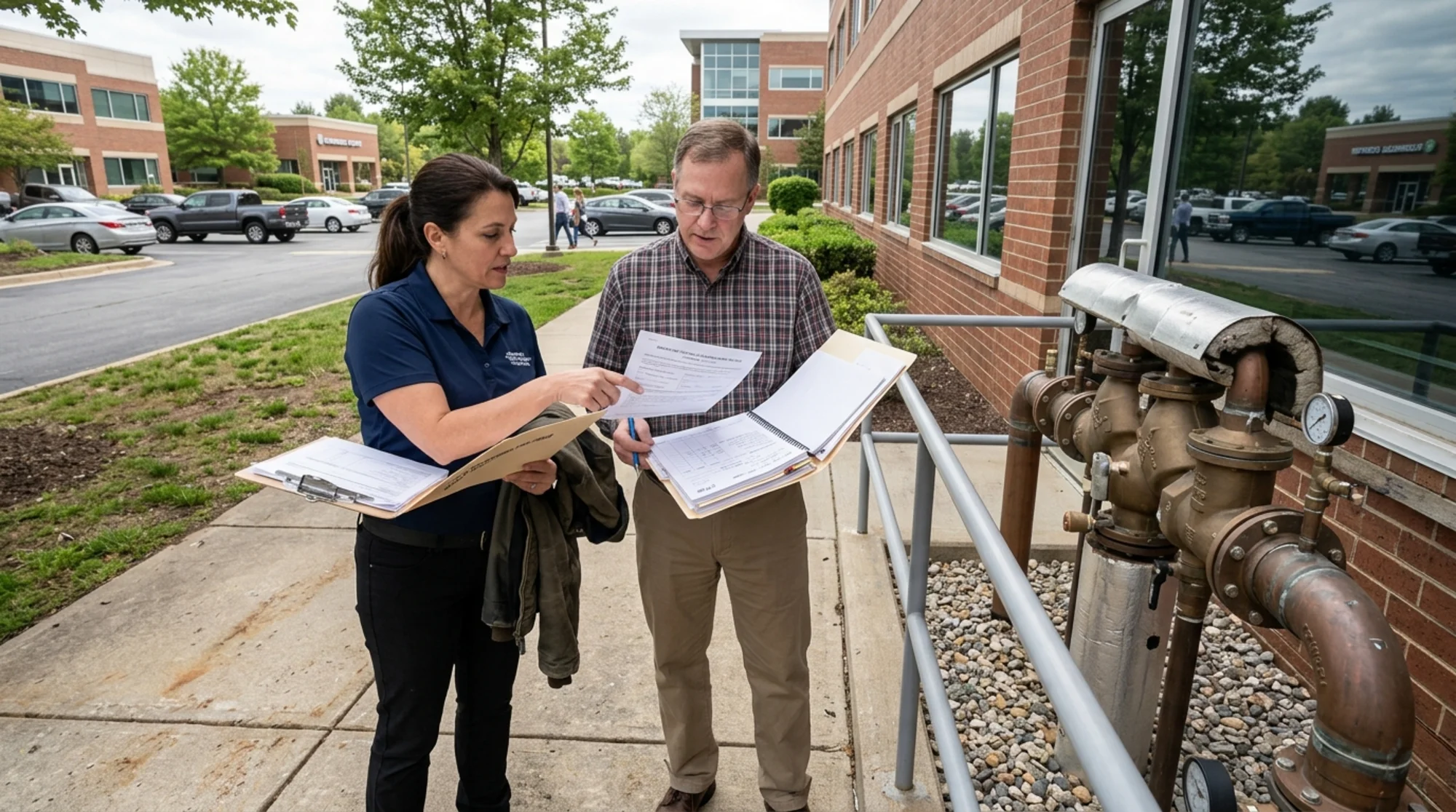
A property manager and bookkeeper reviewing backflow testing invoices, annual compliance notices, and maintenance records beside an exterior commercial backflow prevention assembly, natural daylight, realistic office park setting, no logos or text
Costs that are often treated as current business expenses
For many businesses and rental-property owners, the most straightforward category is the recurring compliance and maintenance work that keeps an existing assembly in service.
That commonly includes items like:
- annual backflow testing,
- routine inspection visits,
- standard maintenance,
- minor repair labor,
- replacement of small wear parts,
- report preparation and submission fees,
- and administrative follow-up tied to the annual compliance cycle.
Why are these usually the easiest costs to discuss with a tax preparer? Because they often look like the classic Section 162 pattern: ordinary, necessary, and connected to the ongoing operation of the property or business.
If you own or manage income-producing property, annual testing is usually not creating a new asset. It is helping you keep an existing system compliant and operational. A small repair that restores the assembly to working order also tends to look very different from a full system upgrade.
That does not mean every invoice is automatically deductible in the current year. Facts still matter. But as a practical starting point, recurring testing and routine maintenance usually belong in the “ask whether this is a current operating expense” bucket, not the “this is obviously a capital project” bucket.
If you are comparing pricing across markets before booking service, start with city pages like Seattle, Austin, and Philadelphia, then browse broader utility program pages and our FAQs for baseline questions.
Costs that may need capitalization instead of an immediate deduction
This is where property owners get into trouble by treating every plumbing invoice the same.
IRS guidance draws a line between deductible repairs and costs that improve, better, restore, or adapt property to a new or different use. When the backflow work moves beyond keeping the existing assembly running and starts looking like acquisition or improvement of tangible property, capitalization becomes a real issue.
Examples that may deserve a closer capitalization analysis include:
- first-time installation of a backflow prevention assembly,
- full replacement of an assembly rather than minor repair,
- major relocation tied to site redesign or construction,
- substantial upgrades to meet a new use or major renovation,
- and larger improvement projects bundled with other plumbing system work.
That does not mean every replacement is treated identically. The details matter, including how the work relates to the larger system, whether you are restoring a major component, and how your books and records treat the expenditure. But this is the category where a same-year deduction becomes less automatic.
If the cost is capitalized, the next question is usually whether it is recovered through depreciation, and whether elections such as Section 179 or other depreciation rules might be relevant for the asset and taxpayer involved. That is where IRS Publication 946 becomes useful, because it covers depreciation rules rather than just current-year deductions.
The simple rule is this: testing and routine upkeep are one conversation, new asset or major improvement costs are another.
Replacement versus repair is the big tax fork in the road
A failed annual test does not automatically mean you are facing the same tax treatment every time.
Sometimes the fix is modest. A repair tech replaces internal parts, retests the device, and the assembly goes back into service. That often looks much closer to repair and maintenance.
Other times the assembly is too damaged, too obsolete, or too far gone, and the answer is full replacement. Once you are buying and installing a new device, plus any related plumbing work, permits, or site changes, you may be crossing into capitalization territory.
That is why good invoice detail matters. “Backflow service, $2,400” is a weak record. A cleaner breakdown is much more useful:
- annual test,
- repair labor,
- rebuild kit,
- replacement assembly,
- permit,
- and retest.
The more the invoice separates recurring service from capital-type work, the easier it is for your bookkeeper or CPA to evaluate the right treatment.
This is also one reason rushed emergency work creates accounting messes. If you are trying to solve a compliance deadline and a failed assembly in the same 24-hour window, paperwork quality drops fast. Our post on finding emergency backflow testing when your deadline is tomorrow explains that operational side.
 A bookkeeper sorting a backflow testing invoice into line items for annual test, repair labor, rebuild parts, and full assembly replacement while a service report and calibrated gauge case sit nearby, natural indoor lighting, no visible logos or text overlay
Business property, rental property, and personal residence are not the same
Another common mistake is assuming the answer is the same for every type of owner.
Business-use property
If the property is used in a trade or business, recurring backflow testing and maintenance often fit naturally into the normal business-expense discussion. Think office buildings, warehouses, retail centers, restaurants, industrial sites, and owner-operated commercial facilities.
Rental or income-producing property
Rental properties can raise similar questions, but the reporting framework may be different depending on the owner structure and return. The core repair-versus-improvement distinction still matters.
Personal residence
A homeowner asking about a personal residence is in a different lane. Routine home maintenance on a personal residence is generally not treated like a business deduction just because the bill was necessary. If the property is partly rented, partly business use, or tied to another special fact pattern, that is where allocation and tax advice get more specific.
So before you even ask “Can I deduct this?” first ask, What kind of property is this on my return?
That one question avoids a lot of sloppy assumptions.
Recordkeeping is what makes the deduction defensible
Even when the tax treatment seems intuitive, weak records make everything harder.
Keep:
- the utility notice or annual test requirement,
- the completed field test report,
- the technician invoice,
- any parts and labor breakdown,
- proof of payment,
- notes showing which property or assembly the work applied to,
- and any replacement-versus-repair explanation from the vendor.
Seattle’s process is a good operational reminder here. The utility expects properly completed reports and supporting tester documentation. Philadelphia likewise publishes formal test and maintenance records. In other words, backflow work already produces a paper trail. Use that paper trail for your accounting too.
CDC’s drinking-water guidance also emphasizes maintaining water-related devices and understanding water-quality responsibilities. From a documentation standpoint, that supports the practical story behind the expense: this is part of responsible property operation, not an unrelated discretionary purchase.
If you manage multiple sites, maintain a simple assembly register with last test date, next due date, recent repairs, and invoice history. That helps operations, and it also gives your accountant a cleaner picture at year-end.
Questions to ask your CPA or tax preparer
Bring specifics, not just the invoice total.
Ask:
- Does this look like routine testing or maintenance, or like a capital improvement?
- Was this a repair that restored the existing assembly, or a full replacement?
- Should any part of this invoice be split between deductible repair and capitalized asset cost?
- If it is capitalized, what recovery method applies?
- Does the property have any personal-use component that changes the analysis?
- Do our books and records support the treatment we want to take?
That conversation goes much better when you provide the actual service report and invoice detail instead of only a credit-card statement line.
A practical workflow that keeps taxes and compliance aligned
The easiest way to stay sane is to treat backflow costs as both an operations workflow and an accounting workflow.
A simple version looks like this:
- schedule annual testing before the deadline,
- save the report when the job is done,
- classify the invoice as testing, repair, replacement, or mixed,
- flag any large replacement work for accounting review,
- and store everything by property and assembly.
That way you are not rebuilding the story months later during tax prep.
It also helps prevent content-free budgeting. If you want to tighten next year’s planning, compare this article with backflow testing requirements for commercial properties and your local market pages before the next annual cycle starts.
 A property operations manager updating an assembly register and tax records after a completed backflow test, with organized invoices, filed test reports, and a maintenance calendar on a desk, natural office lighting, no logos or text
Bottom line
Backflow testing and maintenance costs are often part of normal business or rental-property operations, which means many of those recurring costs may fit the current-expense side of the tax rules.
But that does not make every backflow invoice a simple same-year deduction. The big dividing line is usually whether you paid for routine testing and maintenance, or for acquisition, restoration, or improvement of tangible property.
If the work was annual testing, standard upkeep, or modest repair, the deduction conversation is usually more straightforward. If the work involved full replacement, first-time installation, or a broader system upgrade, capitalization and depreciation may become the better lens.
Use good records, keep repair and replacement costs separated, and run the final classification by your CPA or tax preparer before filing.
If you still need the operational side handled first, find a tester in your market and get clean documentation from the start.
Sources
This article references guidance and regulations from authoritative sources including:
- Internal Revenue Service (IRS) - Guide to business expense resources
- Internal Revenue Service (IRS) - Tangible property final regulations
- Internal Revenue Service (IRS) - Publication 946, How To Depreciate Property
- U.S. Environmental Protection Agency (EPA) - Overview of the Safe Drinking Water Act
- American Water Works Association (AWWA) - Cross-Connection Control and Backflow Prevention resources
- Washington State Department of Health - Cross-Connection Control and Backflow Prevention
- Seattle Public Utilities - Backflow Assembly Testing
- Philadelphia Water Department - Cross-Connection & Backflow Compliance
- Centers for Disease Control and Prevention (CDC) - Preventing Drinking Water-Related Illnesses
Last updated: May 2, 2026