RPZ vs DCVA: How to Choose the Right Backflow Preventer for Your Property
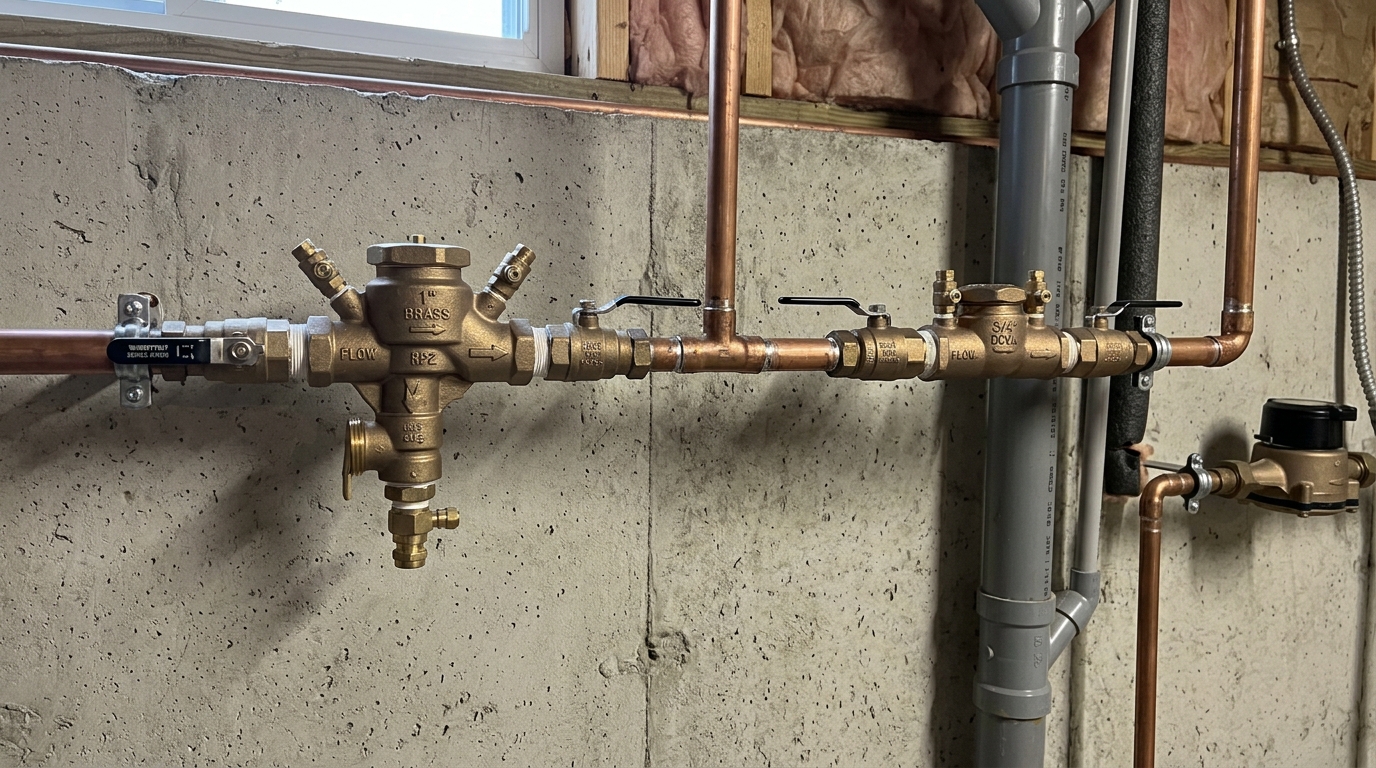
RPZ vs DCVA: The Practical Guide to Choosing the Right Backflow Device
If you've ever opened a notice from your water purveyor telling you to "install an approved backflow preventer," you've probably run into two acronyms that look almost interchangeable on paper: RPZ and DCVA. They protect drinking water in completely different ways, cost very different amounts to install and maintain, and pass or fail testing under different conditions.
Pick the wrong one and you'll either overspend for years on equipment you didn't need, or — far worse — install a device that won't legally protect the hazard on your property. This guide walks through what each device actually does, when each one is required, what they cost to live with, and how to make the right call before the plumber digs the trench.
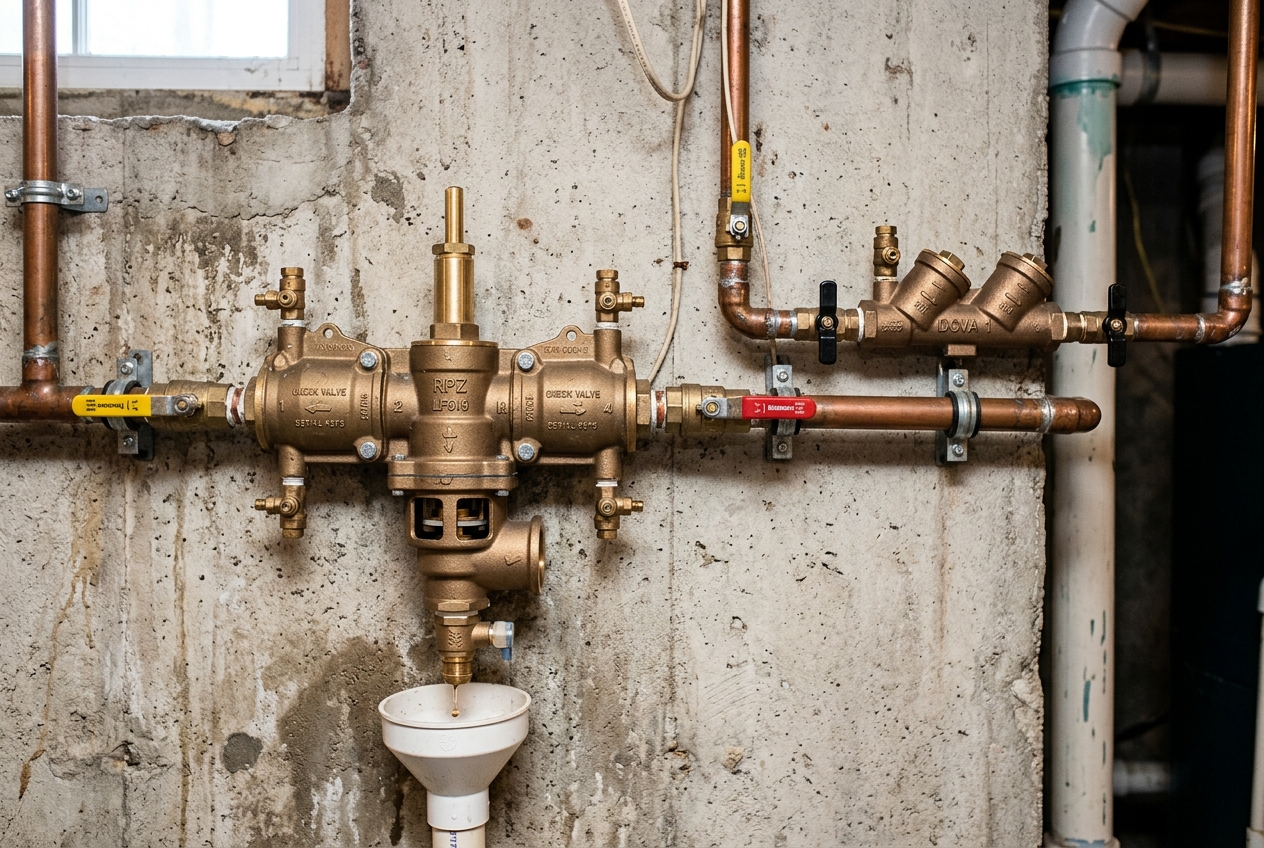 Side-by-side comparison of a brass RPZ assembly with a visible relief valve next to a smaller bronze DCVA assembly mounted on a basement wall
What "Backflow" Actually Means
Before comparing devices, it helps to be precise about the problem they solve. Backflow is any reversal of normal water flow inside a plumbing system. Instead of clean water flowing from the city main into your building, contaminated water flows back into the public supply.
It happens in two ways:
- Backsiphonage — Pressure in the city main drops (a hydrant opens for fire suppression, a main breaks, a pump fails). The vacuum pulls water — and whatever's mixed with it — back through your service line.
- Backpressure — Your building's internal pressure exceeds the city main pressure. Common culprits are boilers, irrigation booster pumps, elevated tanks, and high-rise plumbing.
Both RPZ and DCVA devices stop backflow. The difference is what kind of contamination they're rated to stop, and how reliably they do it.
Hazard Classes: The Reason Two Devices Exist
Water authorities classify cross-connection hazards into two practical buckets:
- High hazard (health hazard) — A backflow event could cause illness or death. Think: chemicals, sewage, irrigation systems with fertilizer injection, hospital equipment, processed food production, boilers with chemical treatment, car wash bays, mortuaries.
- Low hazard (non-health / aesthetic) — A backflow event could make water unpleasant — discolored, odd-tasting, foamy — but not dangerous. Think: fire sprinkler systems without chemical additives, food-grade equipment without injection systems, certain non-chemical cooling loops.
This single distinction is what determines whether you need an RPZ or a DCVA. Most codes won't let you substitute one for the other. The hazard class is fixed by the use, not by your preference.
The DCVA: How It Works
A Double Check Valve Assembly is mechanically simple. Water flowing in the correct direction pushes through two independent, spring-loaded check valves arranged in series. If flow reverses, both valves snap shut, and the second valve acts as a backup if the first one fails to seal completely (a piece of grit, a worn spring, a corroded seat).
Key characteristics:
- Sealed body. No vent to atmosphere. The device can be installed indoors, in a pit, or below grade with proper drainage and clearance.
- Two test ports. Annual testing checks that each check valve holds against differential pressure.
- Lower head loss. Typically 5 to 7 PSI of pressure drop, which matters if your incoming supply is marginal.
- Lower install cost. Smaller footprint, no relief drain to plumb, simpler enclosure requirements.
A DCVA is rated for low hazard, non-health cross-connections only. It's the standard device for fire sprinkler risers (wet-pipe systems without antifreeze or foam additives) and certain commercial domestic services where the only contamination risk is aesthetic.
The RPZ: How It Works
An RPZ — Reduced Pressure Zone assembly (sometimes called RPBA, Reduced Pressure Backflow Assembly) — is the heavyweight. It contains two independent check valves plus a hydraulically operated differential relief valve between them.
Here's why that relief valve changes everything. Between the two checks is a "zone" of water held at a pressure that's always lower than the incoming supply pressure. If either check valve starts to leak — even slightly — the relief valve dumps water from that zone out to atmosphere through a visible air gap. That dump is the proof that the device cannot, by physics, allow contaminated water to siphon backward into the supply line.
Key characteristics:
- Open relief port to atmosphere. Cannot be installed in a pit or anywhere it could submerge. Needs an air gap above the drain and adequate drainage capacity (an RPZ in failure mode can discharge a lot of water — gallons per minute, sometimes more).
- Four test ports. Annual testing is more involved: technicians check each check valve and the relief valve opening point.
- Higher head loss. Typically 8 to 14 PSI of pressure drop. On a marginal supply, this can require upsizing or a booster.
- Higher install cost. Larger footprint, freeze protection if outdoors, drainage infrastructure, often a heated enclosure in cold climates.
An RPZ is rated for high hazard / health hazard cross-connections. Irrigation with any kind of injection, boilers with glycol or treatment chemicals, lab and medical equipment, industrial process water, commercial kitchens with certain equipment — all RPZ territory.
Side-by-Side: The Honest Comparison
| Factor | DCVA | RPZ |
|---|---|---|
| Hazard rating | Low / non-health | High / health |
| Relief to atmosphere | No | Yes |
| Test ports | 2 | 4 |
| Pressure loss (typical) | 5–7 PSI | 8–14 PSI |
| Can install below grade | Yes (with conditions) | No |
| Freeze sensitivity | Moderate | High (relief valve exposed) |
| Annual test cost (typical) | $50–$120 | $90–$200 |
| Equipment cost (typical, 1") | $250–$500 | $450–$1,200 |
| Repair complexity | Lower | Higher |
| Discharge risk | None | Can dump water if it fails |
The numbers above are 2026 ballpark figures for residential and small-commercial sizes (3/4" to 1-1/2"). Larger commercial assemblies (2" and up) scale significantly, especially for RPZs.
When You Need an RPZ (Even If You Were Hoping for a DCVA)
A common cost-saving question is "Can I just install a DCVA instead?" The answer is almost always no when any of the following applies:
- Lawn irrigation. Most jurisdictions require an RPZ on any inground irrigation system, regardless of whether you currently inject fertilizer or weed killer. The assumption is that someone, someday, will hook up a fertilizer injector. A few jurisdictions allow a PVB (pressure vacuum breaker) instead, but DCVA is rarely accepted for irrigation in 2026.
- Boilers and hydronic heating. Glycol, rust inhibitors, and water treatment chemicals are health hazards.
- Commercial kitchens with pre-rinse sprayers below the flood rim, soda machines with carbonators, dish machines with detergent injection. These typically require RPZs at the equipment or service entrance.
- Car washes, laundromats, dental and medical offices, funeral homes, photo labs, plating shops, any chemical handling facility.
- Fire sprinkler systems with antifreeze, foam, or chemical additives. A plain wet-pipe system might qualify for a DCVA; anything chemically treated steps up to an RPZ.
If you're unsure, ask your water purveyor's cross-connection control department in writing. They classify the hazard, not the plumber, and not the property owner.
When a DCVA Is Genuinely the Right Choice
A DCVA is appropriate — and often required by code — when:
- Standard wet-pipe fire sprinkler systems with no chemical treatment.
- Commercial domestic service at facilities the authority has classified as low hazard (some office buildings, low-risk retail).
- Certain food service applications that don't involve chemical injection or below-rim connections.
The advantage is real: lower install cost, lower annual testing cost, no relief discharge to worry about, easier indoor placement, less pressure loss.
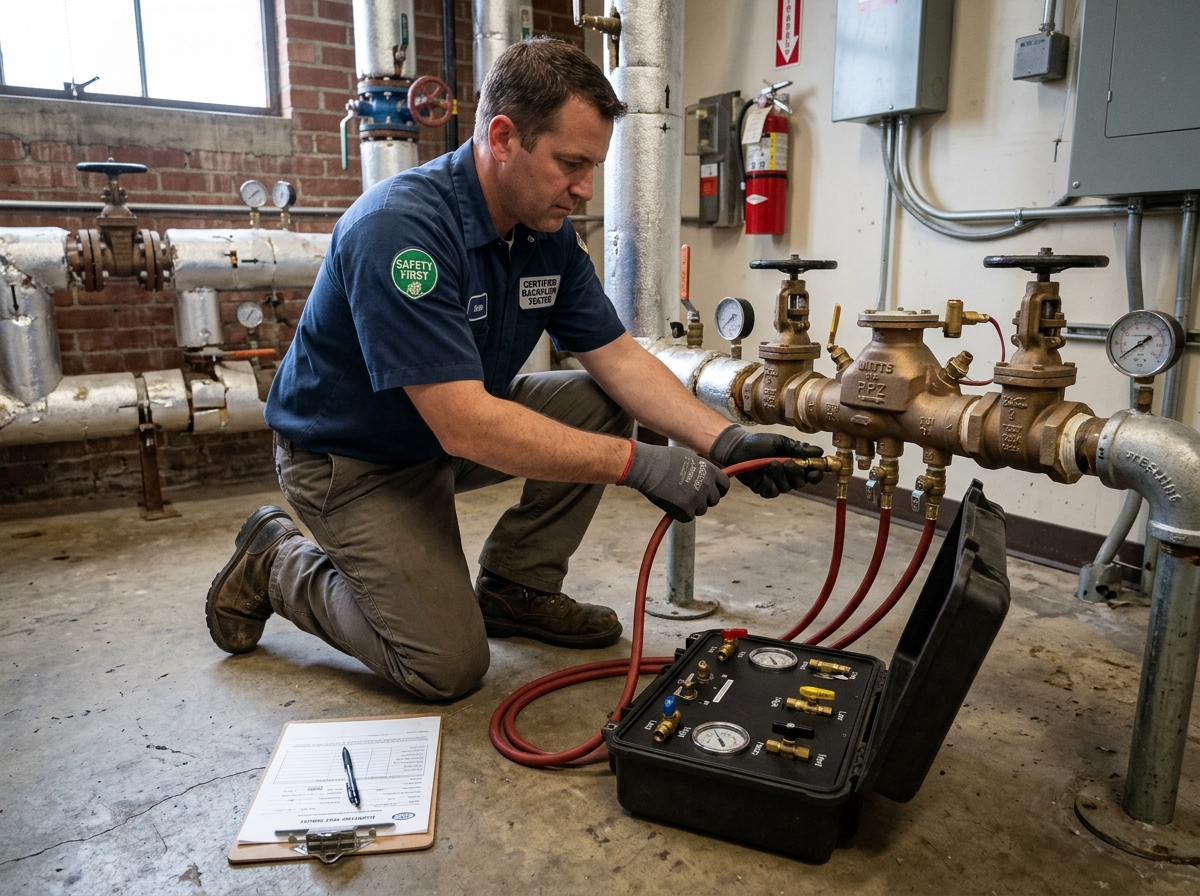 Certified backflow tester kneeling next to an RPZ in a mechanical room, connecting a calibrated test kit to the four test cocks with a clipboard nearby
Installation: What People Get Wrong
A device installed in the wrong place is a device that fails inspection, fails its annual test, or — quietly — fails to protect anything.
Orientation. Most assemblies are designed for horizontal installation with the relief valve (on RPZs) pointing down. Vertical installation is permitted only on models specifically approved for it. Check the manufacturer's listing.
Clearance. Codes typically require minimum clearance on all sides for testing and repair — usually 12 inches around and below the assembly, 30 inches in front. Buried in a tight crawlspace corner = guaranteed repair headaches and possible re-installation.
Drainage for RPZs. The relief valve can discharge a significant flow during failure. The drain receptor must have capacity. An RPZ dumping into an undersized floor drain has flooded more than a few mechanical rooms. Plan for the worst case, not the static drip.
Freeze protection. This is the most common premature failure cause in northern climates. An RPZ's relief valve is exposed to ambient air through its vent — freeze it once and the rubber seats deform permanently. Use a heated enclosure, drain seasonally if applicable (irrigation), or move the device indoors.
Backflow shutoffs and test cocks accessible. If the shutoff valves are seized or the test cocks corroded shut, the tester can't perform the annual test and you'll fail by default.
The Annual Testing Reality
Both DCVAs and RPZs require annual testing by a certified backflow tester in virtually every U.S. jurisdiction. Some require semi-annual testing for certain hazards. The water purveyor sends a notice; the property owner is responsible for finding a certified tester, getting the test performed, and submitting the report.
What testing actually involves:
- The tester closes the downstream shutoff.
- They attach a calibrated differential pressure gauge to the test cocks.
- For a DCVA: verify that each check valve holds at least 1 PSI of differential.
- For an RPZ: verify each check, and verify that the relief valve opens before differential drops below 2 PSI.
A test takes 15 to 30 minutes for a typical small assembly. If the device fails, you either have it rebuilt (rubber kit, $40 to $200 in parts plus labor) or replaced. Missed or failed tests can result in water shutoff in most jurisdictions — this isn't theoretical, it's enforced.
Budget for testing as a recurring annual line item. It's small, but missing it cascades into bigger problems.
Repair vs Replace: When to Stop Patching
Most backflow assemblies are designed for a 15 to 25 year service life when properly installed and maintained. The economics of repair vs replace usually break down like this:
- First failure or two, rubber kit (rebuild) — almost always worth it. Parts are cheap, labor is moderate, you reset the clock for several more years.
- Repeated failures within a couple of years, body or seat damage, or visible corrosion — replace. Throwing rubber kits at a corroded body is a slow leak of your money.
- Lead-containing brass (pre-2014 assemblies in some jurisdictions) — replacement may be required to meet current low-lead standards regardless of working condition.
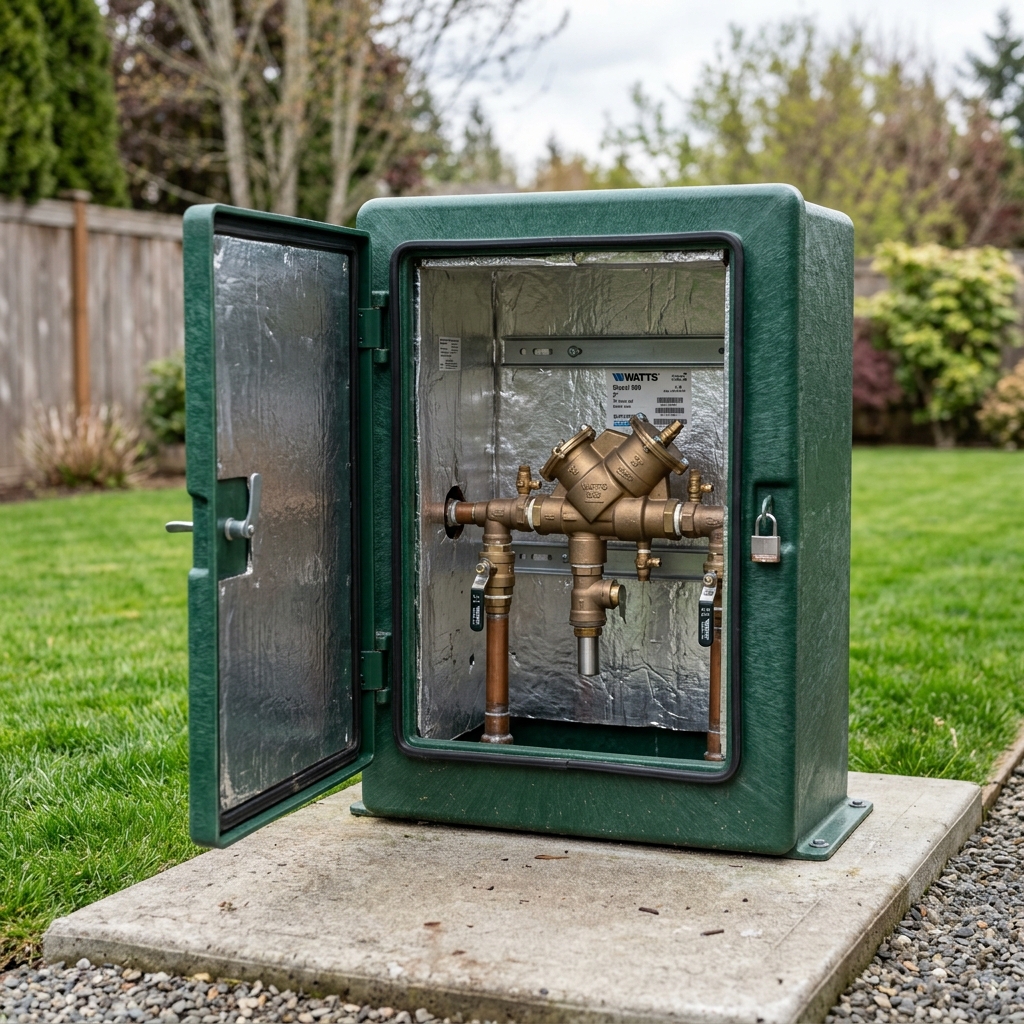 Outdoor RPZ assembly inside an insulated green fiberglass hot-box enclosure on a concrete pad next to a lawn, with the access door open showing the assembly inside
Cost of Ownership Over 10 Years
Here's a realistic 10-year cost picture for a small commercial property in 2026, comparing an irrigation RPZ to a fire sprinkler DCVA on the same site:
RPZ on irrigation (1"):
- Install: $1,200 – $2,000 (assembly, freeze enclosure, drainage)
- Annual testing × 10: $1,200 – $2,000
- Two rebuilds in 10 years: $400 – $800
- 10-year total: $2,800 – $4,800
DCVA on fire sprinkler (2"):
- Install: $1,800 – $2,800 (assembly, often required to be by sprinkler contractor)
- Annual testing × 10: $900 – $1,500
- One rebuild in 10 years: $250 – $500
- 10-year total: $2,950 – $4,800
The DCVA is cheaper to test annually, but the larger pipe size on a fire main usually equalizes the totals. The bigger cost driver is whether the device is correctly specified for the hazard — installing the wrong device leads to forced replacement, code violations, and sometimes fines.
Choosing: A Practical Decision Process
Before you call anyone, do this:
- Identify every cross-connection on the property. Irrigation, boilers, fire sprinklers, commercial equipment, secondary water sources (wells, cisterns), chemical feeders. List them.
- Look up your water purveyor's cross-connection control program. It's usually published online with hazard classifications and required device types per use case.
- Match each cross-connection to a hazard class. If any are high hazard, you need an RPZ for that connection.
- Decide on premise isolation vs fixture isolation. Sometimes one large RPZ at the service entrance protects the whole site. Sometimes smaller devices at each hazard point are cheaper and easier to maintain. The purveyor often dictates which is required.
- Get two written quotes — one from a plumber/backflow specialist and ideally one from a backflow-focused installer. The pricing variance on identical work is often 30 to 50%.
- Confirm the assembly model is on your state's approved list before installation. Devices must be USC FCCCHR-listed or equivalent in most jurisdictions. An unlisted device will fail final inspection.
Next Steps
If you're a homeowner getting a backflow notice for the first time, call your water department's cross-connection control office and ask: "What hazard class is my property, and what device type is required?" Then find a certified tester or installer in your area to walk the property and quote the work.
If you're a property manager juggling a portfolio, build an inventory: every device, its serial number, install date, last test date, and the responsible certified tester. Set calendar reminders 60 days before each annual test deadline. Missed tests are the single most preventable backflow compliance failure.
If you're a commercial operator adding new equipment — a new boiler, a new irrigation zone, a new dish machine — call the cross-connection office before installation. Adding a hazard to your premises can change your required device, and discovering that after the fact is the expensive way to learn.
The right device, correctly installed, tested every year, is one of the cheapest pieces of insurance you have on your plumbing system. The wrong device, or no device at all, is a problem that doesn't reveal itself until something is already wrong with the water supply — and by then, the cleanup costs are someone else's quote to write.