Fire Sprinkler Backflow Testing 2026: Complete Code & Compliance Guide
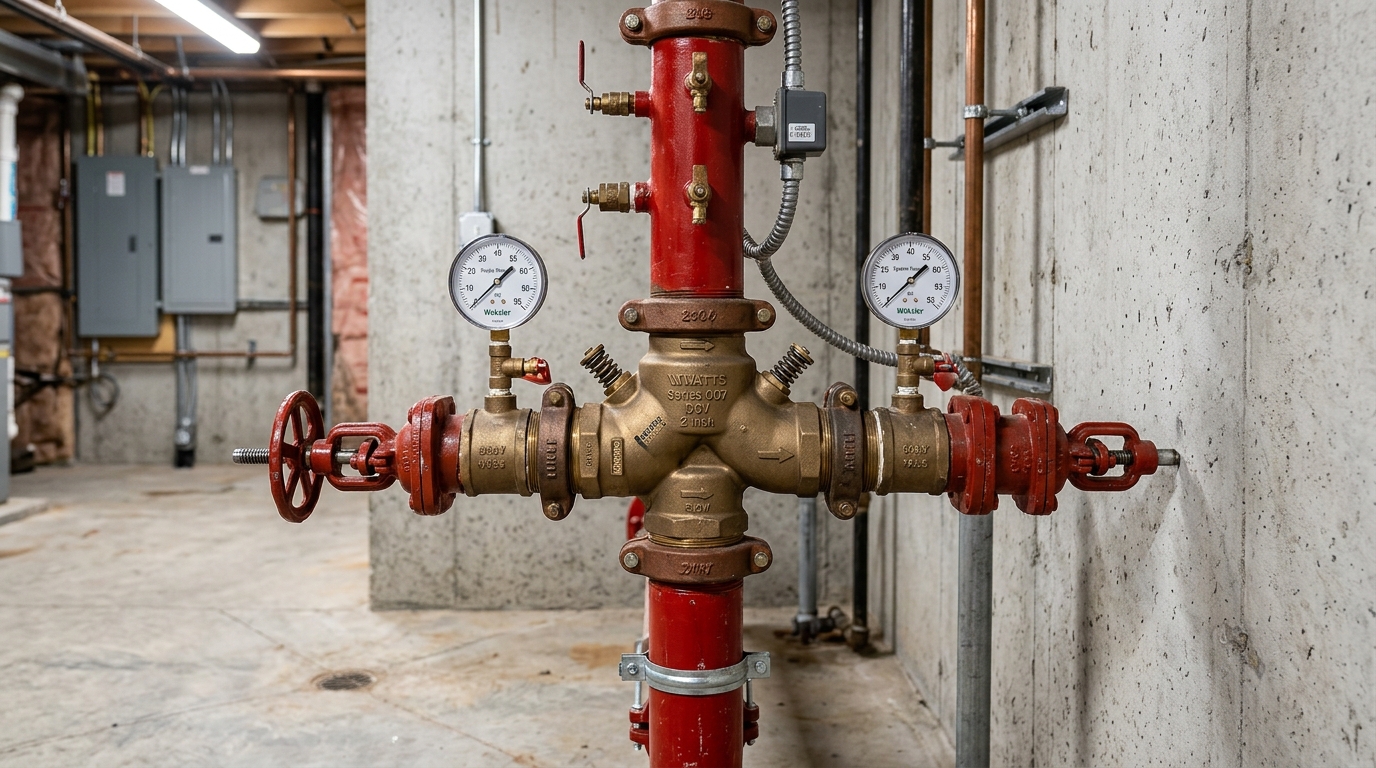
Why Fire Sprinkler Systems Need Backflow Prevention
Fire sprinkler systems sit quietly behind your walls and above your ceilings for years at a time, holding pressurized water that nobody drinks but everyone depends on in an emergency. That water is the problem. It stagnates inside steel pipes, picks up rust, sediment, antifreeze, and biological growth, and sits at higher pressure than the public water main on the other side of the connection. Without a properly tested backflow preventer, a single pressure drop in the city main — a hydrant flush, a water main break, a major fire draw down the street — can pull that contaminated sprinkler water back into the drinking supply.
This is not a theoretical risk. Water utilities across North America have documented backflow incidents tied to fire systems, including cases where black, oily water reached residential taps after a nearby main break reversed flow through an untested or failed assembly. That is why almost every jurisdiction in the United States and Canada now requires fire sprinkler systems to have a backflow preventer installed at the service connection and tested at least annually by a certified tester.
If you own, manage, or maintain a building with a fire sprinkler system, this guide walks you through what the law requires in 2026, what device you likely have, how testing actually works, what it costs, and what to do when the test fails.
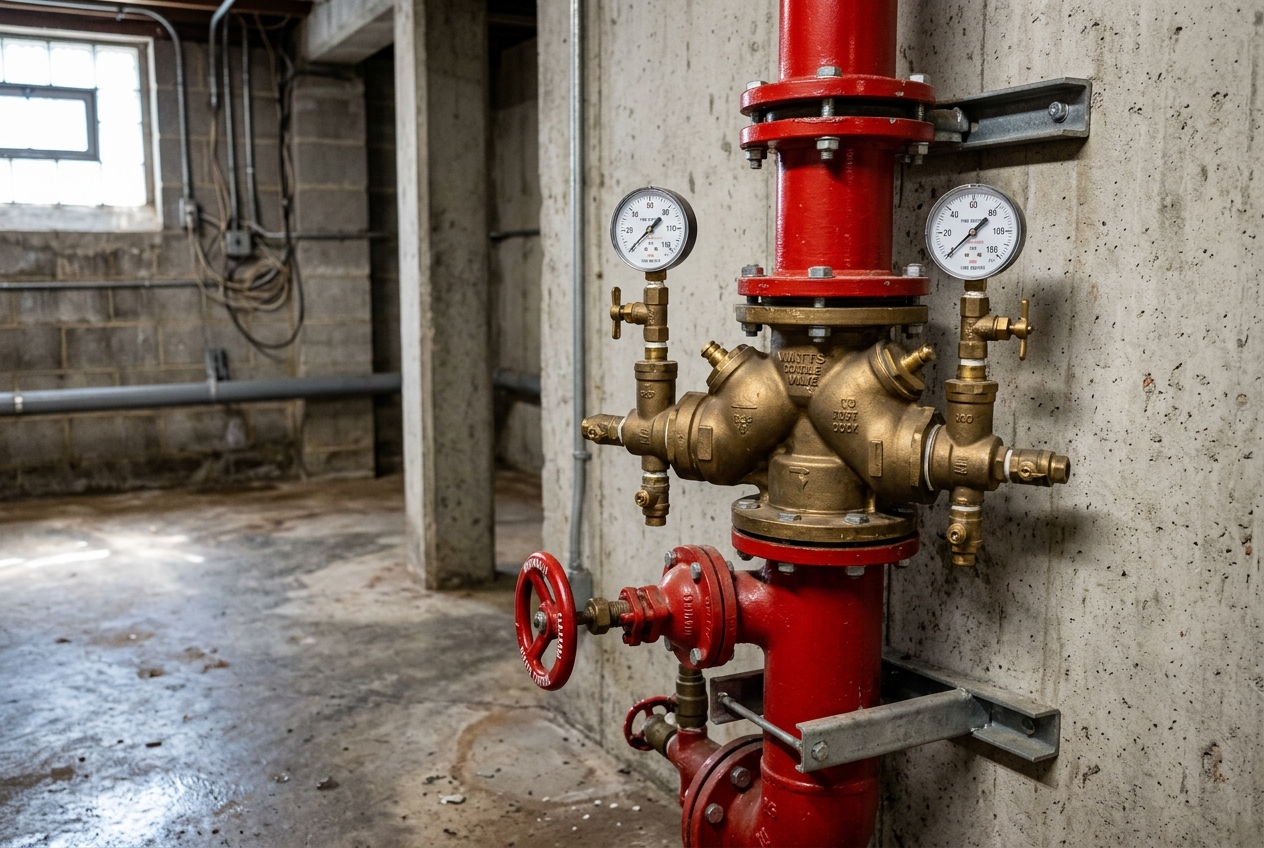 Red fire sprinkler riser in a basement mechanical room with a brass double check assembly and pressure gauges
What the 2026 Codes Actually Require
The two documents that drive fire sprinkler backflow requirements are NFPA 13 (Standard for the Installation of Sprinkler Systems) and the local cross-connection control program enforced by your water purveyor, usually built on AWWA M14 guidance and adopted into the state plumbing or health code. NFPA 25 covers the inspection and testing of the sprinkler system itself, but the backflow assembly testing is governed by the water utility.
For 2026, the practical rules are consistent across most jurisdictions:
- Every fire sprinkler system connected to a potable water supply must have an approved backflow prevention assembly at the point of connection.
- The assembly must be tested at installation, after any repair or relocation, and at least once every twelve months.
- Testing must be performed by a tester certified by the state, province, or AWWA-recognized body, using a calibrated differential pressure gauge.
- Test results must be submitted to the water purveyor, usually within 10 to 30 days of the test, on the form the utility specifies.
- A forward flow test of the assembly is required annually under NFPA 25 to confirm the assembly does not obstruct the system's design flow.
The level of protection required — meaning which type of assembly you need — depends on the hazard rating the water utility assigns to your sprinkler system. That hazard rating is where most confusion happens, so it is worth understanding before you call a tester.
Matching the Assembly to the Hazard
Water utilities classify fire sprinkler systems into hazard categories based on what is inside the pipes and how the system is configured. The 2026 categories used by most cross-connection programs follow the NFPA classification model:
Class 1 systems are pure wet-pipe systems with no auxiliary connections, no antifreeze, no chemical additives, and no fire department connection that could introduce non-potable water. These are rare in practice and usually only require a Double Check Valve Assembly (DCVA).
Class 2 systems are wet-pipe with a fire department connection (FDC) but no chemical additives. These are the most common configuration in light-hazard occupancies. A DCVA is typically acceptable.
Class 3 systems include a fire department connection plus non-potable water sources or auxiliary tanks. These require a Reduced Pressure Zone Assembly (RPZ or RPDA in the fire-rated version).
Class 4 systems contain antifreeze, foam concentrate, or other chemical additives. These are classified as high hazard and require an RPDA — a Reduced Pressure Detector Assembly that also includes a low-flow bypass meter to detect leaks or unauthorized water use.
Class 5 and 6 systems include direct connections to non-potable sources, gridded loops, or pumps drawing from tanks. These almost universally require an RPDA, and many jurisdictions also require an air gap separation at the supply.
The detector versions of these assemblies — DCDA and RPDA — are the standard choice for fire systems because the bypass meter lets the utility see unauthorized water use without forcing a high-flow meter on the main line, which would create unacceptable pressure loss during a fire event.
If you do not know your hazard class, your water utility's cross-connection control coordinator can tell you in about five minutes based on your service record. Do not guess. Installing a DCVA where an RPDA is required is one of the most expensive mistakes a building owner can make, because the replacement is on you, not the utility.
How an Annual Test Actually Works
A fire sprinkler backflow test is a short procedure when nothing is wrong, and a longer one when something is. A certified tester will arrive with a calibrated five-valve differential pressure gauge, hoses, fittings, and a paper or electronic test report form.
Before the test, the tester confirms the assembly is the one listed on the water utility's records — make, model, serial number, and size. They check the installation for code compliance: proper orientation, adequate clearance, drainage for the relief valve on an RPZ, and an accessible shutoff upstream and downstream.
The test itself isolates the assembly using its test cocks and shutoff valves, then measures the performance of each check valve and, on an RPZ, the relief valve. For a double check, the tester verifies that each check holds at least one pound of pressure differential in the direction of flow. For an RPZ, the tester confirms the relief valve opens before the pressure differential between the two checks drops below two pounds, and that each check holds tight against backpressure.
A forward flow test follows. The tester opens a downstream drain or test connection capable of flowing the system's design demand and confirms the assembly passes that flow without choking the supply. On larger fire mains this can require coordinating with the property to flow water to a drain, a yard, or a tank truck — it cannot be done into a small floor drain.
The entire procedure usually takes 30 to 60 minutes on a typical commercial sprinkler riser. Large campuses with multiple assemblies can take a full day.
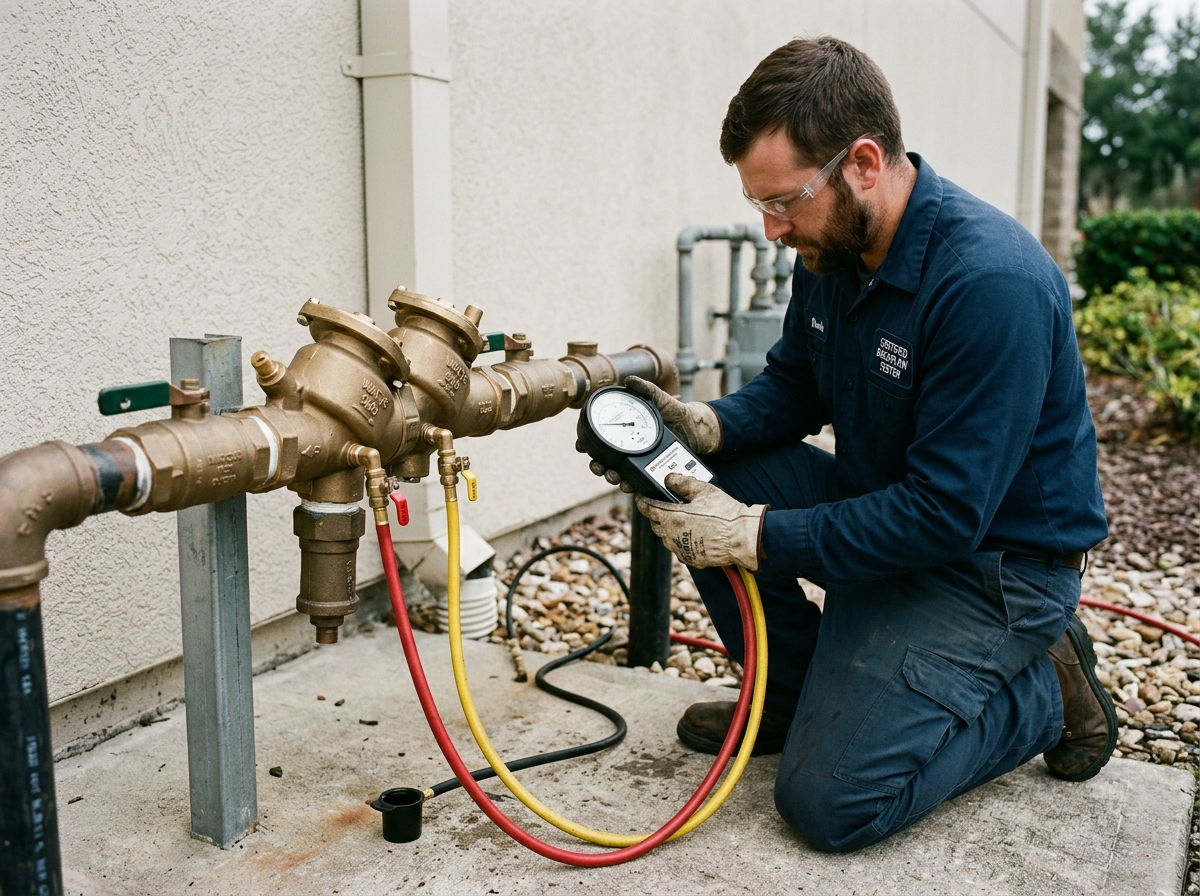 Certified tester kneeling next to a backflow assembly holding a calibrated differential pressure test kit with red and yellow hoses connected to test cocks
What It Costs in 2026
Pricing varies by region, but the 2026 market for fire sprinkler backflow testing has settled into a fairly predictable range:
- Single residential or small commercial DCVA (under 2"): $75 to $150
- Commercial DCVA or DCDA (2" to 4"): $150 to $300
- RPZ or RPDA (2" to 4"): $200 to $400
- Large fire main RPDA (6" to 10"): $400 to $800
- Multi-building campus or hospital with several assemblies: priced per assembly, often with a 10 to 20 percent multi-unit discount
A failed test that requires repair adds parts and labor. The most common repair on a fire system assembly is replacing rubber check seats and disc rubbers, which typically runs $150 to $400 depending on size. A failed relief valve on an RPZ can run $300 to $700 to rebuild. Full assembly replacement on a 4" RPDA can exceed $4,000 installed.
If you are managing a portfolio of properties, ask testers about annual contracts that bundle testing, paperwork submission to the water utility, and a discount on repairs. The administrative burden of tracking dozens of assemblies across multiple utilities is real, and a contractor who handles the submissions is worth the premium.
The Paperwork Problem
The single most common reason buildings get backflow violation notices is not a failed test — it is a passed test that never reached the water utility. Test reports get emailed to a property manager who forgets to forward them, faxed to a number that no longer works, or uploaded to a portal that the contractor was not aware of.
Most water utilities in 2026 use online submission portals, and many now require electronic submission with a tester's certification number and a digital signature. A few still accept paper. Almost all of them will issue a notice of non-compliance — and sometimes shut off water service — if the report does not arrive within the stated window.
Confirm with your tester, in writing, which of you is responsible for submitting the report to the water utility. Get a copy of the confirmation that the utility received it. Keep the test report on file at the property for at least three years, longer if your state requires it.
What to Do When a Test Fails
A failed test is not an emergency in most cases, but it is a problem on a clock. The water utility will typically give you 14 to 30 days to repair and re-test the assembly. Some utilities allow longer for fire systems because shutting down the assembly means impairing the sprinkler system, which triggers NFPA 25 impairment procedures.
When a fire sprinkler backflow fails:
- Notify the property's fire alarm monitoring company before any work begins, so the impairment does not trigger a false fire department response.
- Place the sprinkler system on impairment status per NFPA 25, including the yellow impairment tag and notification of the authority having jurisdiction if your jurisdiction requires it.
- Schedule the repair with a tester who is also licensed to repair the assembly — not every certified tester carries repair parts or is authorized to break the seals on the assembly.
- Once repaired, re-test the assembly and submit the passing report to the water utility.
- Restore the system, remove the impairment tag, and notify the monitoring company that the system is back in service.
Do not let a failed test sit. A sprinkler system with a failed backflow is still functional for fire protection in most cases, but you are now out of compliance with the water utility and potentially with your insurance carrier. Insurers have started asking for backflow test records on commercial property renewals in 2026, and a lapsed test can affect your premium or coverage.
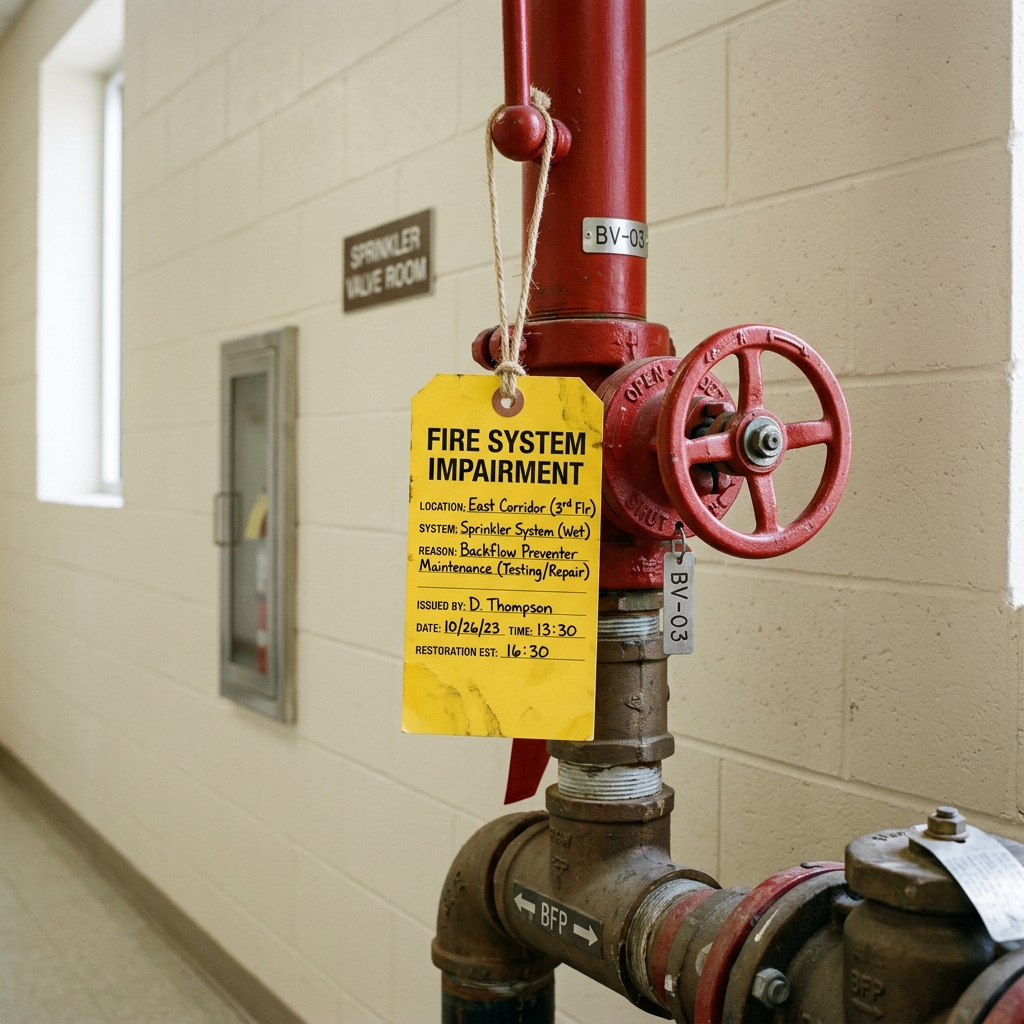 Yellow fire system impairment tag hanging from a sprinkler control valve in a building corridor
Special Cases Worth Knowing
Antifreeze loops in unheated areas — parking garages, attics, freezer rooms — push your system into Class 4 and require an RPDA. If your building still uses glycerin or propylene glycol antifreeze in sprinkler branches, confirm the main backflow is rated for that hazard. Many older buildings were grandfathered with a DCVA that is no longer code-compliant.
Fire pumps that draw from a tank or pond rather than the city main create a different cross-connection picture. The assembly protecting the potable supply must be sized for the makeup line, not the pump discharge, and it must handle the surge pressures the pump can create.
Standpipe systems without sprinklers — common in older high-rises and parking structures — still need backflow protection on the potable supply connection. The hazard class is usually lower than a full sprinkler system, but the assembly is still required.
Combined domestic and fire services — where one large meter feeds both the building's drinking water and the sprinkler system — require an assembly rated for the fire side, which means an RPDA in most cases. The domestic side may need additional protection downstream.
Next Steps for Your Property
If you do not have a current passing backflow test report for every fire sprinkler assembly on your property, do these things this week:
- Locate your last test report. Check the file the previous tester left, your property management software, and any wall-mounted log near the riser.
- Call your water utility's cross-connection control coordinator and ask for the list of assemblies on file for your address, with hazard classifications and last test dates.
- Schedule testing for any assembly more than eleven months past its last test. Do not wait for the violation notice.
- For multi-property portfolios, build a spreadsheet with assembly serial number, size, make, model, location, hazard class, last test date, next test due, and the water utility's submission portal. This is the lowest-effort, highest-return compliance tool you can build.
- If you are buying or leasing a commercial property, make backflow test history a due diligence item alongside the fire sprinkler 5-year internal inspection report.
Fire sprinkler backflow testing is one of the cheapest pieces of life safety compliance you will pay for in a year. The cost of skipping it — contaminated drinking water, a shut-off notice, an insurance complication, or a sprinkler system tagged out of service during a fire — is not worth the savings.
Find a certified tester in your area, get the test on the calendar, and keep the paperwork where you can find it. That is the entire job.