Why Fire Sprinkler Systems Need Backflow Prevention Testing
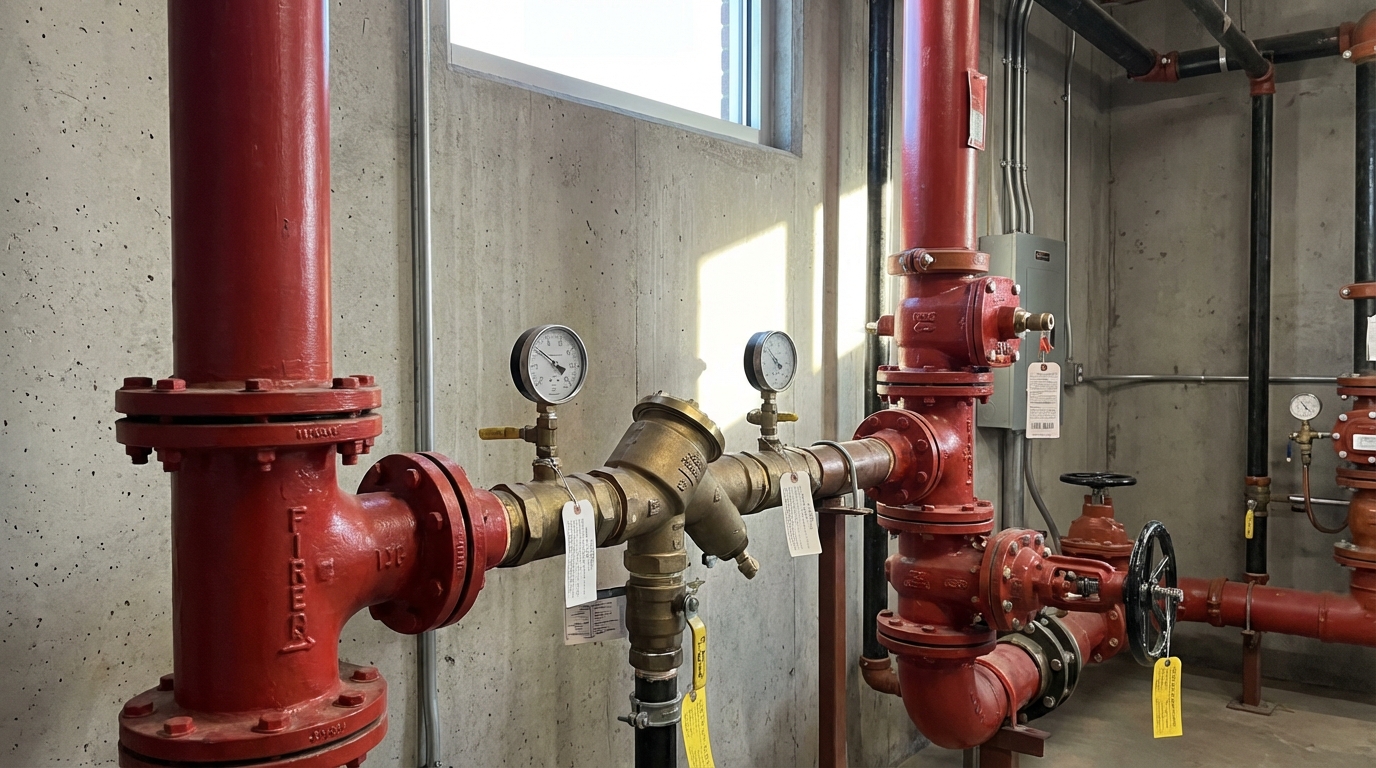
Why Fire Sprinkler Systems Need Backflow Prevention
Every commercial building, warehouse, and multi-family property with a fire sprinkler system has a direct connection to the public water supply. That connection exists so sprinklers can deliver enough water pressure to suppress a fire. But it also creates a serious cross-connection risk.
Fire sprinkler systems sit idle for months or years at a time. Water inside those pipes stagnates. Depending on the system type, that standing water can contain rust, sediment, bacterial growth, and in some cases residual antifreeze or chemical additives. Without a functioning backflow preventer, a pressure drop in the municipal supply — from a water main break, heavy firefighting demand, or routine maintenance — can siphon that contaminated water back into the drinking water system.
This is not a theoretical problem. The EPA and state health departments have documented backflow incidents traced to fire suppression systems, including cases where stagnant water and corrosion byproducts entered potable supply lines serving schools and hospitals.
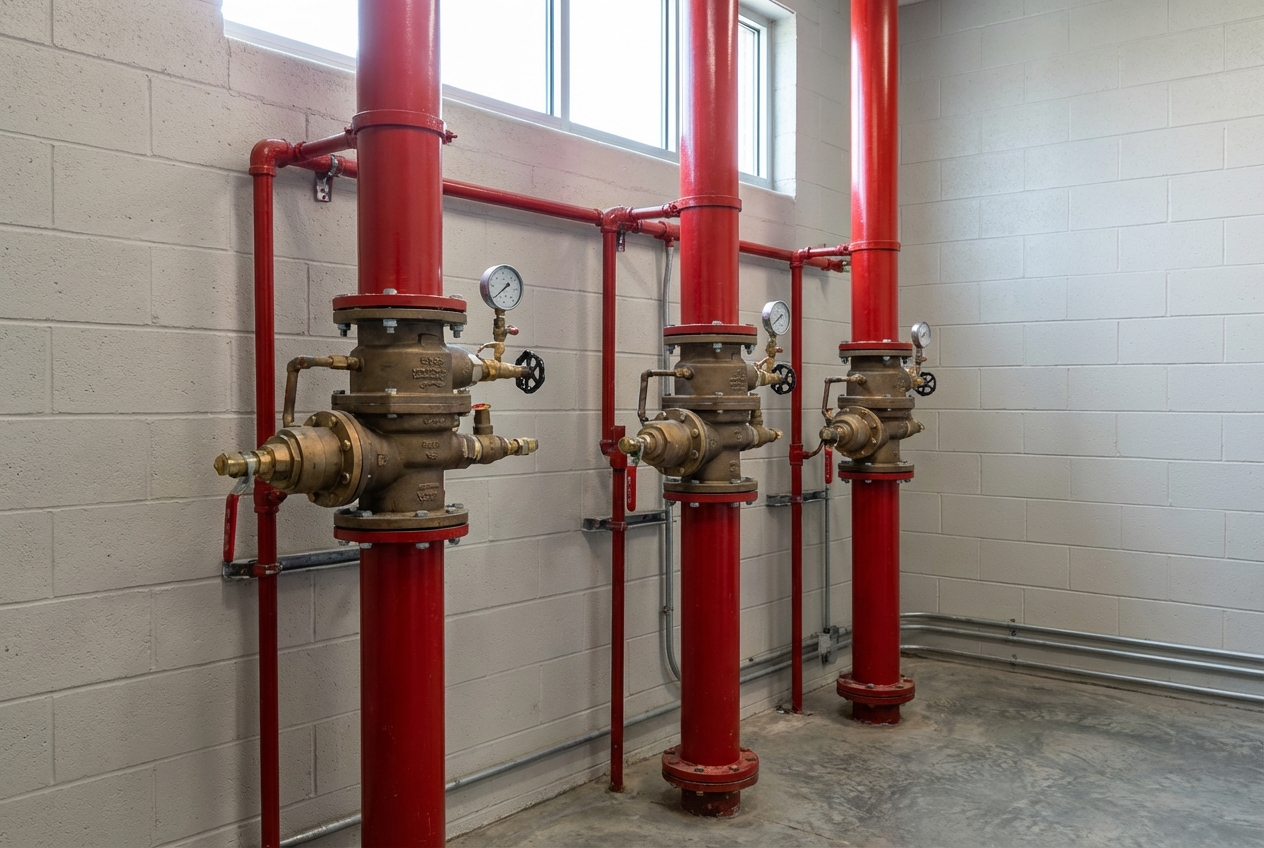 A row of large red fire sprinkler risers with backflow preventer assemblies and gauges in a commercial building mechanical room
What Types of Backflow Preventers Are Used on Fire Lines
Fire sprinkler connections typically require one of two assemblies, depending on the hazard classification your water authority assigns to the system.
Double Check Detector Assembly (DCDA)
A DCDA is used on fire sprinkler systems classified as a low hazard. This generally applies to wet systems that contain only potable water and have no chemical additives. The assembly consists of two independently acting check valves with a metered bypass line. The bypass meter detects unauthorized use or small leaks in the fire system.
Most residential fire sprinkler systems and basic commercial wet systems fall into this category. DCDAs are less expensive and create lower friction loss than RPZ assemblies, which matters when maintaining adequate flow for fire suppression.
Reduced Pressure Zone Detector Assembly (RPZDA)
An RPZDA is required for systems classified as a high hazard. This includes:
- Dry pipe systems where stagnant air and moisture promote bacterial growth
- Systems using antifreeze loops (glycol or glycerin-based solutions)
- Systems with chemical fire suppressants or foam additives
- Auxiliary connections to non-potable water sources (such as fire pump test headers connected to retention ponds)
- Any system where the water authority determines the building use creates an elevated contamination risk
The RPZDA adds a relief valve between the two check valves. If either check valve fails, the relief valve opens and dumps water rather than allowing backflow. This discharge can be significant — 30 to 200 gallons per minute in some failure modes — so RPZDAs on fire lines need adequate drainage provisions, which affects where and how they can be installed.
Which One Does Your Property Need?
Your local water purveyor or cross-connection control authority makes this determination, not your plumber or fire protection contractor. Many jurisdictions have moved toward requiring RPZDAs on all new fire line connections regardless of system type, reflecting a more conservative approach to public health protection. Check your water authority's cross-connection control manual for the current classification.
Annual Testing Requirements
Backflow preventer assemblies on fire sprinkler lines must be tested at least annually by a certified backflow tester. This requirement comes from multiple overlapping authorities:
State plumbing and health codes — Most states adopt some version of the USC Foundation for Cross-Connection Control and Hydraulic Research guidelines or the AWWA M14 manual, both of which mandate annual testing.
Local water authority regulations — Your water purveyor likely has a cross-connection control program that requires annual test reports. Failure to submit reports on time can result in fines, mandatory retesting, or water service termination notices.
NFPA 25 (Standard for the Inspection, Testing, and Maintenance of Water-Based Fire Protection Systems) — Section 13.7 specifically addresses backflow prevention devices and requires annual forward flow testing. NFPA 25 also requires a five-year internal inspection of check valves, which goes beyond what many cross-connection programs require.
Fire marshal and insurance requirements — Many jurisdictions tie certificate of occupancy renewals and fire inspection approvals to proof of current backflow testing. Commercial property insurers increasingly ask for test documentation as part of underwriting.
The practical result is that you need testing done every 12 months, and you need to keep the documentation organized because multiple agencies may request it independently.
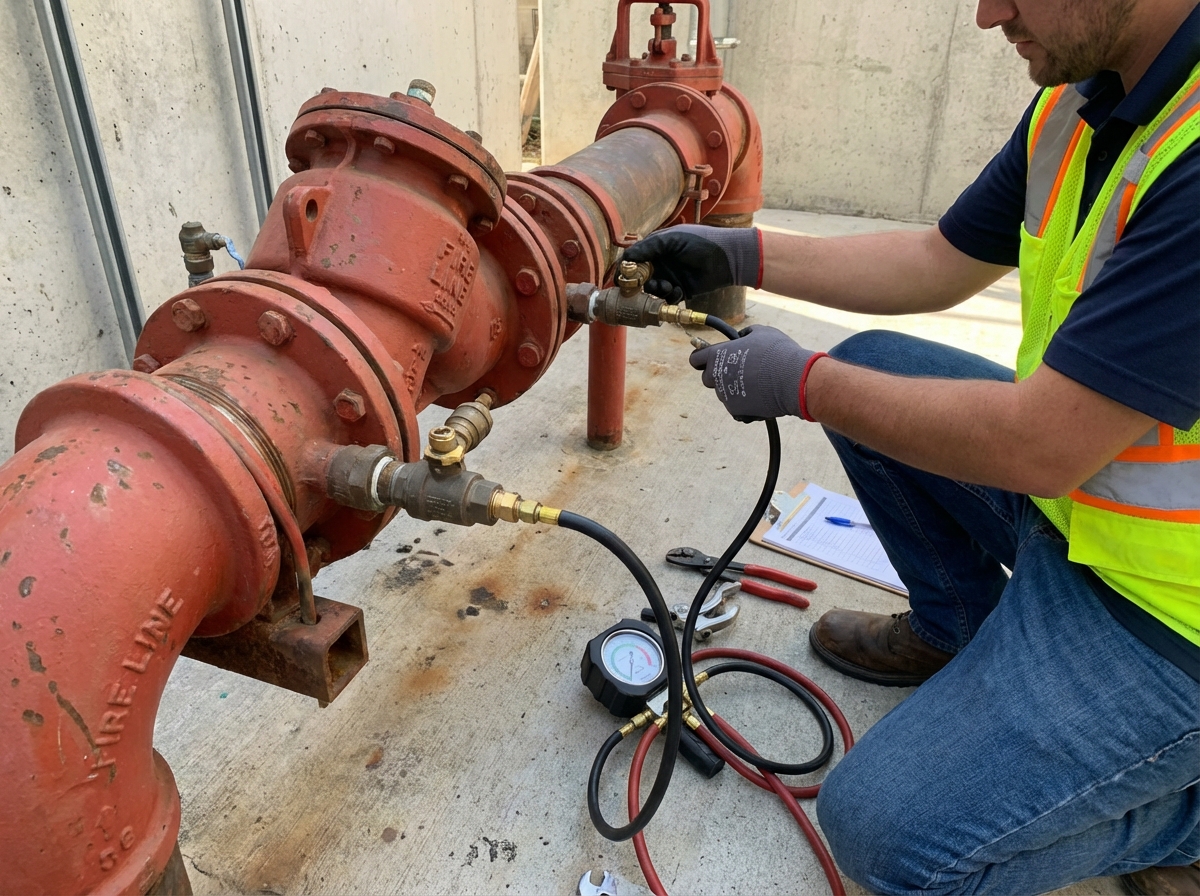 A certified backflow tester attaching differential pressure gauge test kit to a large fire line backflow preventer assembly with test cocks open
What Happens During a Fire Line Backflow Test
The testing procedure for a fire line assembly follows the same general protocol as any backflow preventer test, but with some important differences in logistics and coordination.
Pre-Test Coordination
Testing a fire line backflow preventer means temporarily shutting down the fire sprinkler system or at least isolating sections of it. This requires advance coordination:
Notify the fire alarm monitoring company — The building's fire alarm panel will register a supervisory signal or trouble condition when the sprinkler system loses pressure. Your alarm company needs to know this is a planned test, not an emergency.
Notify the building owner or property manager — Someone with authority needs to approve the temporary impairment of the fire protection system.
Notify the local fire department (when required) — Some jurisdictions require a fire watch or formal impairment notification for any planned sprinkler shutdown exceeding a set duration, often 4 to 10 hours depending on occupancy type.
Coordinate with the fire sprinkler contractor — If the backflow preventer fails the test and needs repair, the fire line may be out of service longer than planned. Having a fire protection contractor aware of the scheduled test prevents delays.
The Test Itself
A certified tester connects a differential pressure gauge to the test cocks on the assembly and runs a series of checks:
- First check valve test — Verifies the downstream check holds pressure. Minimum holding pressure varies by assembly type but is typically 1.0 PSI for a double check and 2.0 PSI for an RPZ.
- Second check valve test — Verifies the upstream check holds independently.
- Relief valve test (RPZ only) — Confirms the relief valve opens before backflow can occur, typically verified by showing it opens when differential pressure drops to approximately 2.0 PSI.
On large fire line assemblies (4-inch, 6-inch, 8-inch, and larger), the test takes longer because of the volume of water that must move through the system. Expect 30 to 90 minutes of actual testing time, not counting setup, coordination, and documentation.
Common Failures
Fire line backflow assemblies fail tests more often than domestic water assemblies for several reasons:
- Infrequent use — Fire systems rarely flow water, so check valve discs and seats can develop deposits, corrosion, or debris fouling that goes unnoticed between annual tests.
- Sediment accumulation — Municipal water carries trace sediment that settles in low-flow conditions. Fire line assemblies accumulate this sediment more aggressively than assemblies on active domestic water lines.
- Relief valve fouling (RPZ) — The relief valve diaphragm can degrade, stick open, or fail to seat properly, especially in assemblies exposed to temperature extremes.
- Age — Many commercial fire line assemblies have been in service for 15 to 30 years. Rubber components deteriorate on a timeline independent of use.
When a test fails, the tester will typically note which component failed and whether it can be repaired in the field. Most failures involving check valve discs, seats, or relief valve diaphragms can be addressed with a rebuild kit specific to that assembly's make and model.
Cost Considerations for Fire Line Backflow Testing
Fire line backflow testing typically costs more than testing a standard residential or small commercial assembly. Several factors drive the higher price:
- Larger assemblies require more time — A 6-inch RPZDA takes significantly longer to test than a 3/4-inch residential device.
- Coordination overhead — The alarm company notification, fire watch arrangements, and scheduling around building operations add time that testers factor into pricing.
- Certification requirements — Some jurisdictions require testers working on fire line assemblies to hold both backflow testing certification and fire protection system credentials.
Typical ranges in 2026 for fire line backflow testing run from $150 to $400 for the test alone, depending on assembly size and location. Repairs, if needed, are additional. Replacement of a large fire line assembly can run several thousand dollars, so staying on top of annual testing and catching problems early saves money over the life of the system.
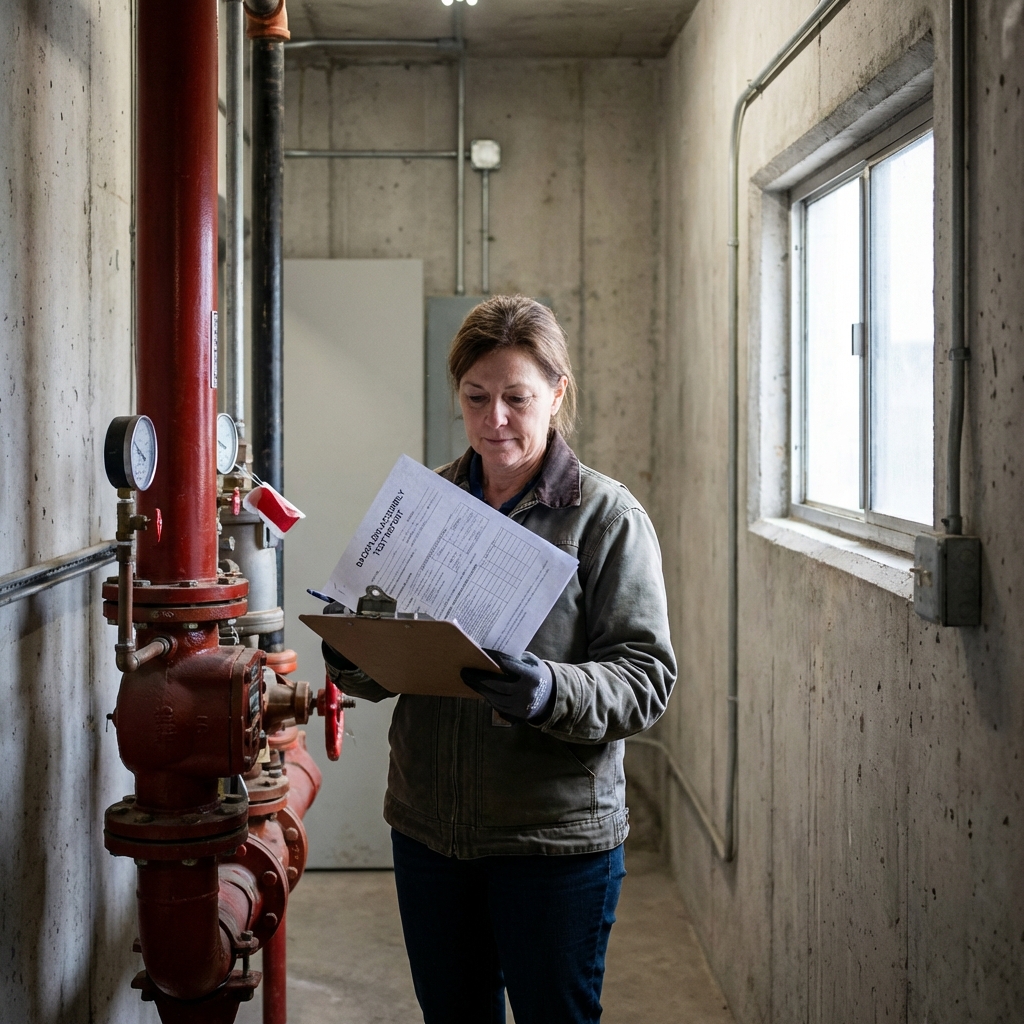 A property manager reviewing backflow test report paperwork next to a fire sprinkler riser in a building utility corridor
Compliance Tracking and Record-Keeping
Managing fire line backflow compliance requires more organization than a single residential device. For commercial properties and multi-building portfolios, keep track of these items:
- Test report copies — Your certified tester submits one copy to the water authority, but you should keep your own copy. Many jurisdictions now accept or require electronic submissions through platforms like the USC online reporting system or state-specific portals.
- NFPA 25 records — If your property is subject to NFPA 25, maintain a log that includes the annual backflow test alongside other required inspections (quarterly valve inspections, annual flow tests, five-year internal inspections).
- Repair documentation — Any time a backflow preventer is repaired or rebuilt, document the date, what was replaced, and the passing retest results.
- Replacement records — When an assembly is replaced entirely, record the new make, model, serial number, and size. Update your records with the water authority, as they track assemblies by serial number.
Properties with multiple buildings or multiple fire risers should maintain a spreadsheet or database that tracks each assembly's location, last test date, next due date, and current status. Letting one assembly lapse can trigger a compliance action that affects the entire property.
What to Do Next
If you manage a property with fire sprinkler systems, here is a practical checklist:
- Confirm you have a backflow preventer on every fire line connection. Older buildings sometimes have fire connections that predate current cross-connection requirements. Your water authority can tell you if your connections are on file.
- Check your last test date. If it has been more than 12 months, schedule testing now. Many water authorities issue violation notices without a second reminder.
- Verify your tester's credentials. Fire line assemblies should be tested by someone who holds a current backflow prevention assembly tester certification recognized by your state or water authority.
- Coordinate the alarm company before the test date. This is the step most often forgotten, and it results in false alarms, unnecessary fire department responses, and fines.
- Budget for repairs. Assume that any assembly over 10 years old may need a rebuild kit during testing. Having that expectation set with your maintenance budget avoids surprise costs.
Finding a certified tester who handles fire line assemblies is the first step. Not every backflow tester works on large commercial fire systems, so confirm experience with your assembly size and type when scheduling. Use the FindBackflowTesters.com directory to locate certified professionals in your area who specialize in fire sprinkler backflow testing and can handle the coordination your property requires.