How to Dispute a Failed Backflow Test Result
How to Dispute a Failed Backflow Test Result
A failed backflow test can trigger panic fast. You may be looking at repair costs, a utility deadline, and the possibility of fines or service interruption if the device stays out of compliance. But “dispute” in this context usually does not mean arguing with your water utility and hoping they throw out the result. In most cases, it means verifying the report carefully, confirming the assembly and tester information are correct, and deciding whether you need a repair, a second certified test, or a formal follow-up with the utility.
EPA guidance treats cross-connections and backflow as public-health risks, so utilities are under pressure to act when an assembly fails. That is why official programs from Austin Water, Denver Water, Philadelphia Water Department, Washington State Department of Health, and local districts such as Woodinville focus heavily on documentation, repair, retesting, and submission. The practical takeaway: if you think a failed result is wrong, move quickly — but move in a documented, utility-friendly way.
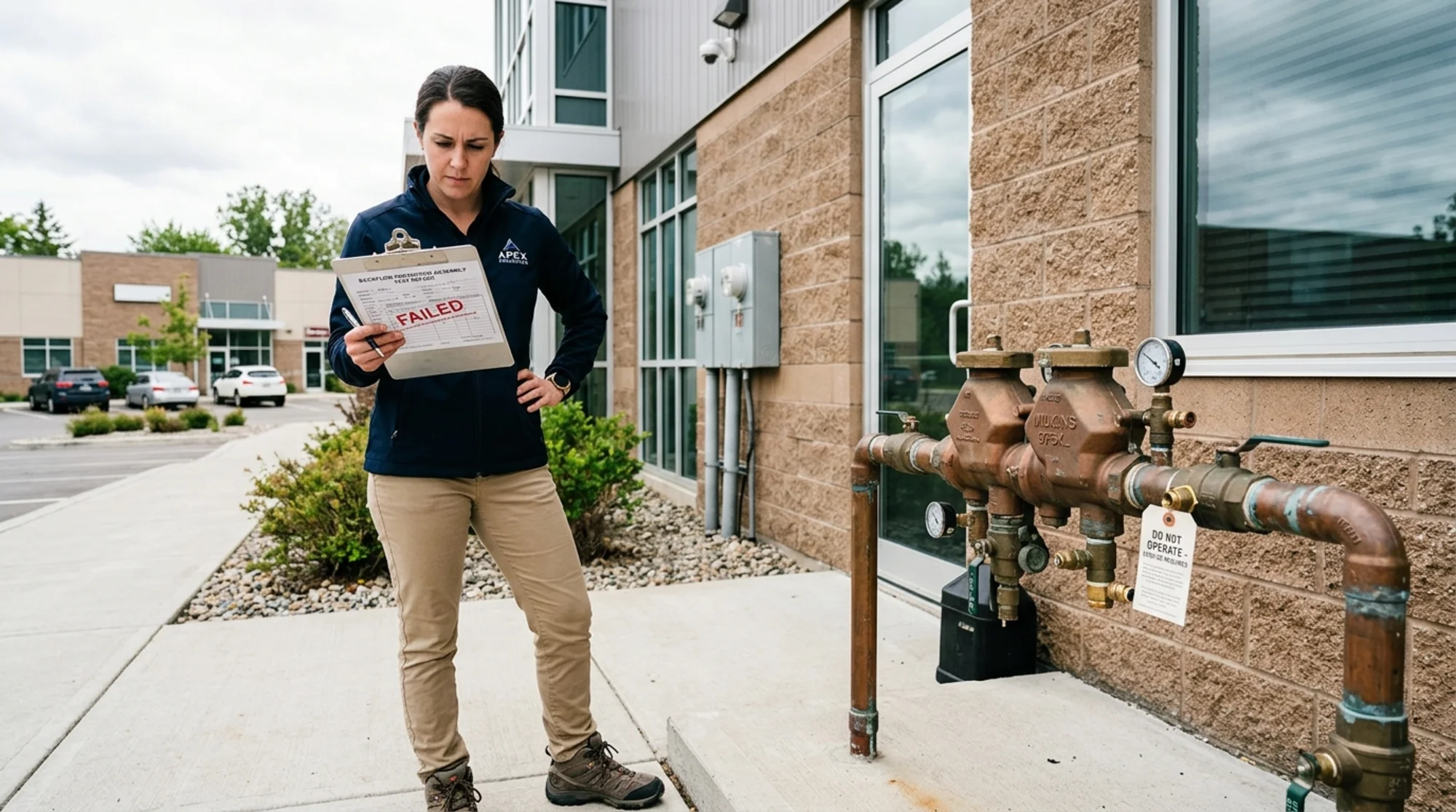
A property manager reviewing a failed backflow test report on a clipboard beside an outdoor reduced pressure zone assembly outside a commercial building
Start by separating a failed test from a violation notice
These are related, but they are not the same thing.
A failed test result means the certified tester recorded readings showing the assembly did not meet pass criteria. A violation notice means the utility has already treated your property as out of compliance because of a failed test, a missed deadline, or missing paperwork.
That distinction matters because many official utility documents do not describe a formal “appeal” process for the failed field test itself. They describe what happens next: repair, replacement if needed, retest, and report submission. For example:
- Philadelphia requires failed assemblies to be repaired or replaced and retested within 14 days, with reports submitted within 48 hours of completion.
- Woodinville Water District says a failed assembly must be cleaned, repaired, or replaced, followed by a successful retest submitted to the district.
- Denver Water requires installation testing and annual testing thereafter, with all test reports sent to its cross-connection office.
So if you are disputing the result itself, the goal is usually to verify whether the test was accurate before the failed result turns into a bigger compliance problem.
Review the report before approving any major work
The first thing to ask for is the complete test report, not just a verbal summary that the device “failed.” Washington State’s operator certification rule specifically emphasizes field test report content requirements, and that is a good standard to follow everywhere.
Check the report for:
- correct service address
- correct assembly type and size
- manufacturer, model, and serial number
- tester name and certification information
- test date
- actual readings or notes for each failed check valve or relief valve component
- comments about debris, leaking shutoffs, missing parts, or inaccessible installation conditions
This sounds basic, but paperwork mistakes happen. A wrong serial number, a transposed address, or a report tied to the wrong device can create a false compliance problem. If something obvious is wrong, contact both the tester and the utility’s cross-connection or backflow office immediately and ask how to correct the record.
If you need help understanding the paperwork path, our guide on how to submit your backflow test report to your water utility walks through the reporting side.
Ask the tester exactly what failed and why
Not every failed test means the whole assembly is done for.
Official utility guidance and district documents commonly point to practical causes such as debris, worn internal parts, relief valve problems, or check valves that do not hold pressure. Woodinville’s utility guidance explicitly says some failed devices can be cleaned, repaired, or rebuilt before retesting. That is very different from immediately authorizing a full replacement.
Ask the tester these questions:
- Which component failed — first check, second check, relief valve, or shutoff issue?
- Is this typically a cleaning/rebuild issue or a likely replacement issue?
- Were there any testing-condition problems, such as leaking shutoff valves or unstable water pressure?
- Do you have photos of the assembly and failed condition?
- Can you provide the raw readings on the report?
A credible tester should be able to explain the failure in plain English. If the explanation is vague — “it just failed” — that is a reasonable moment to slow down and verify before spending more money.
 Close-up of a certified backflow tester connecting differential pressure gauges to a brass backflow preventer while pointing to the test report readings
Know when a second certified test makes sense
A second opinion is usually the most practical way to challenge a failed result.
That is especially true when:
- the first tester’s notes are incomplete
- the device failed for a borderline reading
- the assembly was tested under awkward field conditions
- the recommended repair seems excessive compared with the reported defect
- the tester’s certification, gauge calibration, or reporting details are unclear
If you go this route, do not hide the first report. Share it with the second certified tester and say you want an independent verification before deciding on repair or replacement. That gives the second tester the full context and helps avoid repeating obvious setup mistakes.
Use a qualified local tester who understands your utility’s process. Our city pages for Austin, Texas, Philadelphia, Pennsylvania, and Denver, Colorado can help you start local research, and utility-specific guidance is easier to compare on pages like Austin Water backflow testing requirements and Philadelphia Water Department backflow testing.
One caution: a second test does not pause your deadline automatically. If your utility has already logged a failed result, contact the utility while the second opinion is being arranged and ask what documentation they want during the review.
Contact the utility early if the issue looks administrative or technical
Utilities care most about protecting the public water supply and maintaining a clean compliance record. If your dispute is really about bad paperwork, wrong device identification, or a test submission error, contact the utility’s cross-connection office right away.
A calm message should include:
- service address
- account or reference number
- assembly serial number
- copy of the failed report
- short description of what appears incorrect
- expected date of second test or corrective action
Keep the tone factual. You are not arguing that backflow rules should not apply to you. You are asking the utility to review a specific reporting or technical issue while you act in good faith.
This is also the moment to ask whether the utility requires:
- same-day or short-window notification of failed tests
- a specific retest deadline
- a utility-specific test form
- submission directly from the tester
- proof of repair before retesting
For many owners, the real risk is not the failed reading itself. It is silence. If the utility sees no movement, the situation can escalate into a notice that is better handled under our separate guide on appealing a backflow compliance violation.
Do not let the dispute delay compliance work
This is the biggest mistake property owners make.
Philadelphia’s official FAQ is blunt: failed assemblies must be repaired or replaced and retested quickly. Woodinville also centers the successful retest as the resolution. EPA’s fact sheet similarly treats testing, repair, replacement, and recordkeeping as core parts of cross-connection control.
In other words, disputing a failed result is not a reason to ignore the device.
A safe practical sequence looks like this:
- Get the failed report immediately.
- Review it for obvious errors.
- Ask the tester for a clear failure explanation.
- Schedule a second certified test if the result seems questionable.
- Notify the utility if there is a reporting discrepancy or active review.
- Repair or replace promptly if the second result confirms failure.
- Submit the passing retest and keep copies.
If you manage multiple properties, build this into your standard compliance checklist and keep your annual deadline tracking in one place. Our FAQs page is a useful quick reference for recurring owner questions.
 Property owner and certified backflow tester reviewing a passing retest form after repair beside a commercial backflow assembly with utility paperwork on a clipboard
The bottom line
If you think a backflow test failed in error, the smart move is not to argue from the sidelines. It is to verify the report, confirm the device details, get a second certified opinion when appropriate, and keep the utility informed while you work the problem.
Most official water-utility guidance does not offer a dramatic appeal path for failed gauge readings. It offers a compliance path: document the issue, correct the device if needed, retest, and submit the result. That may feel less satisfying than a formal dispute, but it is usually the fastest way to protect both your water service and your budget.
If you need help lining up a qualified tester quickly, start with your local city pages and utility program requirements so you can compare options without guessing.
Sources
This article references guidance and regulations from authoritative sources including:
- U.S. Environmental Protection Agency - Cross-Connection Control Fact Sheet (PDF)
- U.S. Environmental Protection Agency - Cross-Connection Control Manual (PDF)
- American Water Works Association - Cross-Connection Control & Backflow Prevention resources
- Austin Water - Backflow Prevention Overview
- Denver Water - Cross-Connection Control and Backflow Prevention Program
- Philadelphia Water Department - Cross-Connection Control FAQ (PDF)
- Washington State Department of Health - Cross-Connection Control and Backflow Prevention
- Woodinville Water District - If Your Backflow Test Fails (PDF)
- Centers for Disease Control and Prevention - Preventing Drinking Water-Related Illnesses
Last updated: May 28, 2026