Why Commercial Kitchens Face Strict Backflow Prevention Requirements
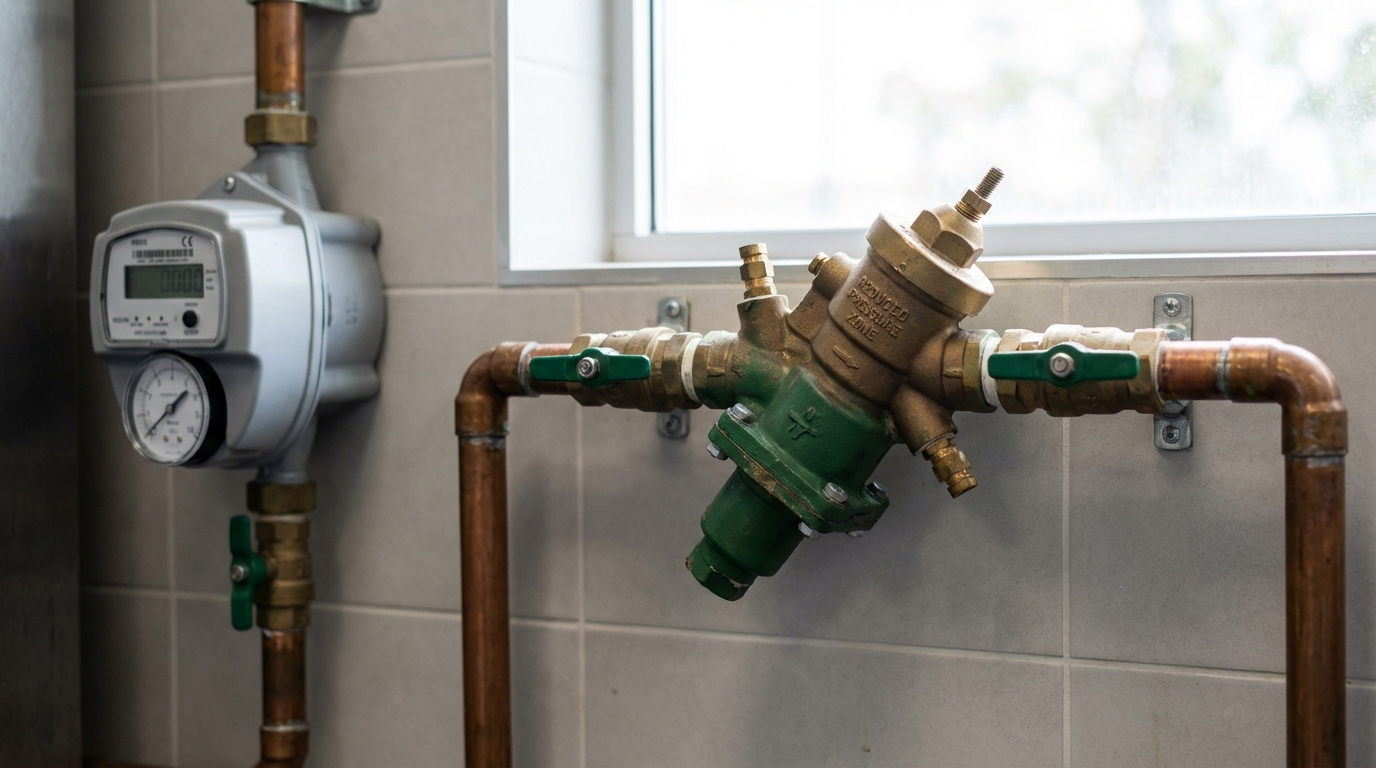
Why Commercial Kitchens Face Strict Backflow Prevention Requirements
Commercial kitchens pose one of the highest cross-connection risks in any building. Grease, chemical sanitizers, food waste, and industrial cleaning agents all flow through the same plumbing that connects to the municipal water supply. Without proper backflow prevention, a sudden pressure drop in the city main — from a water main break, heavy fire hydrant use, or routine maintenance — can siphon contaminated water back into the public drinking supply.
Health departments and water utilities treat this risk seriously. If you own, manage, or operate a commercial kitchen, understanding your backflow prevention obligations is not optional. Violations carry fines, forced shutdowns, and liability exposure that can dwarf the cost of compliance.
This guide breaks down what devices you need, where they go, how often they must be tested, and what happens when you fall behind.
What Makes Commercial Kitchens a High-Hazard Cross-Connection
Water utilities classify cross-connections by hazard level. Commercial kitchens almost always fall into the high-hazard category because of what flows through their drains and equipment:
- Chemical sanitizers and degreasers used in three-compartment sinks and dishwashers
- Grease and animal fats that accumulate in drain lines
- Submerged inlets on equipment like steam kettles, soup warmers, and wok stations where hoses or fill lines sit below the flood rim
- Carbonation systems that connect pressurized CO2 directly to water supply lines
- Lawn and pest-control chemicals at facilities with outdoor prep or loading dock wash-down hoses
A single backpressure or backsiphonage event at any of these points could introduce hazardous substances into the potable water system. That is why most jurisdictions require reduced pressure zone (RPZ) assemblies — not just double check valves — at the service entrance and at individual high-risk fixtures.
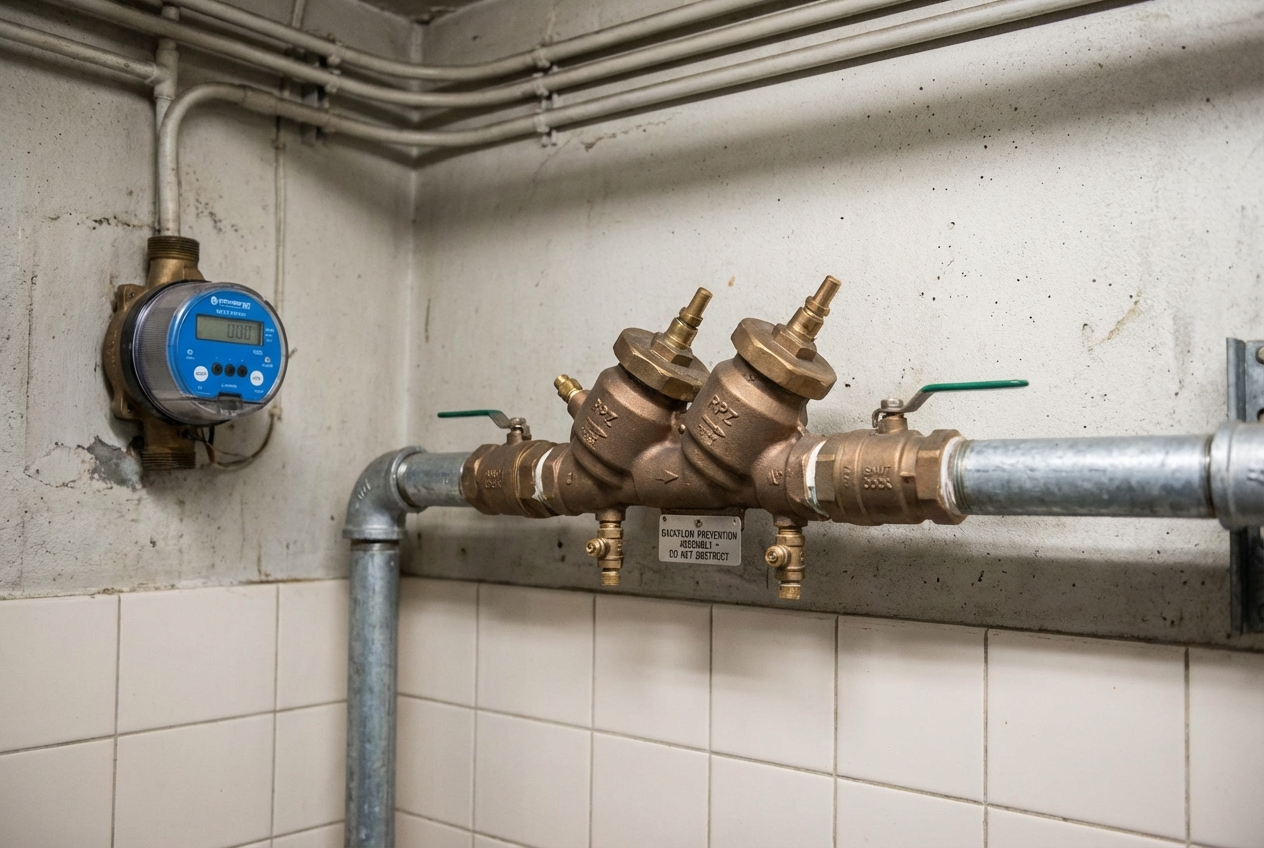 RPZ backflow preventer assembly installed on a commercial kitchen water supply line near a wall-mounted meter
Required Backflow Devices for Commercial Kitchens
The specific devices your kitchen needs depend on your local water utility, state plumbing code, and the equipment you operate. That said, the requirements below apply in most U.S. jurisdictions and represent the baseline expectation.
Premise Isolation (Service Entrance)
Nearly every commercial kitchen must have an RPZ assembly installed at the water service entrance. This device protects the public water main from anything happening inside your building. It is the single most important backflow preventer on the property.
Key requirements for premise isolation RPZs:
- Must be an ASSE 1013-rated reduced pressure zone assembly
- Must be installed by a licensed plumber
- Must be accessible for annual testing (no locked closets, no ceiling installations without access panels)
- Must have adequate drainage since RPZs discharge water during normal operation and failure relief
- Must be tested annually by a certified backflow tester and results reported to the water utility
Individual Equipment Protection
Beyond premise isolation, most codes require point-of-use protection at specific fixtures:
| Equipment | Typical Device Required | Why |
|---|---|---|
| Commercial dishwashers | RPZ or air gap | Chemical sanitizer injection creates high hazard |
| Steam kettles / tilt skillets | RPZ or vacuum breaker | Submerged inlets during filling |
| Carbonation systems (soda fountains) | RPZ or dual check with atmospheric vent | CO2 backpressure can force carbonated water into supply |
| Three-compartment sinks | Air gap preferred, or RPZ | Chemical sanitizers and submerged hose connections |
| Hose bibbs / wash-down stations | Atmospheric vacuum breaker (AVB) minimum | Hoses left in mop sinks or floor drains |
| Ice machines with drain connections | Air gap or RPZ | Standing water and drain proximity |
| Wok stations with deck-mounted faucets | Vacuum breaker | Submerged fill lines in wok bowls |
Air gaps are the simplest and most reliable form of backflow protection. Where physically possible, health inspectors and plumbing inspectors prefer them over mechanical devices because they have no moving parts and cannot fail mechanically. An air gap simply means there is a visible, unobstructed vertical space between the water outlet and the flood rim of the fixture — typically at least twice the diameter of the supply pipe, with a one-inch minimum.
Fire Suppression Systems
Commercial kitchens with wet-chemical fire suppression systems (Ansul, Kidde, etc.) connected to the water supply require their own backflow protection. These systems often contain antifreeze or chemical agents that constitute a high hazard. A separate RPZ or double check detector assembly (DCDA) is typically required on the fire line, depending on whether it is a combined or dedicated fire service.
Testing and Reporting Requirements
Backflow prevention assemblies with moving parts — RPZs, double check valves, and pressure vacuum breakers — must be tested regularly. Here is what commercial kitchen operators need to know about the testing cycle.
Annual testing is the minimum. Most water utilities require testing once per year. Some jurisdictions require testing twice per year for high-hazard facilities. Your water utility will send notices, but compliance is your responsibility regardless of whether you receive a reminder.
Only certified testers can perform the work. Backflow assembly testers must hold a valid certification, typically through ABPA, ASSE, or a state-specific program. Your plumber may or may not be certified — always ask before scheduling.
Test reports must be filed with the water utility. After each test, the certified tester completes a report documenting whether each assembly passed or failed, its serial number, location, and the test gauge used. Most utilities now accept electronic submissions, and many certified testers file reports directly on your behalf.
Failed assemblies must be repaired and retested. If an RPZ or double check fails its annual test, you must have it repaired by a licensed plumber and retested within a deadline set by your utility — commonly 30 days. Operating with a failed assembly puts you at risk of a boil-water notice for your facility or disconnection from the water supply.
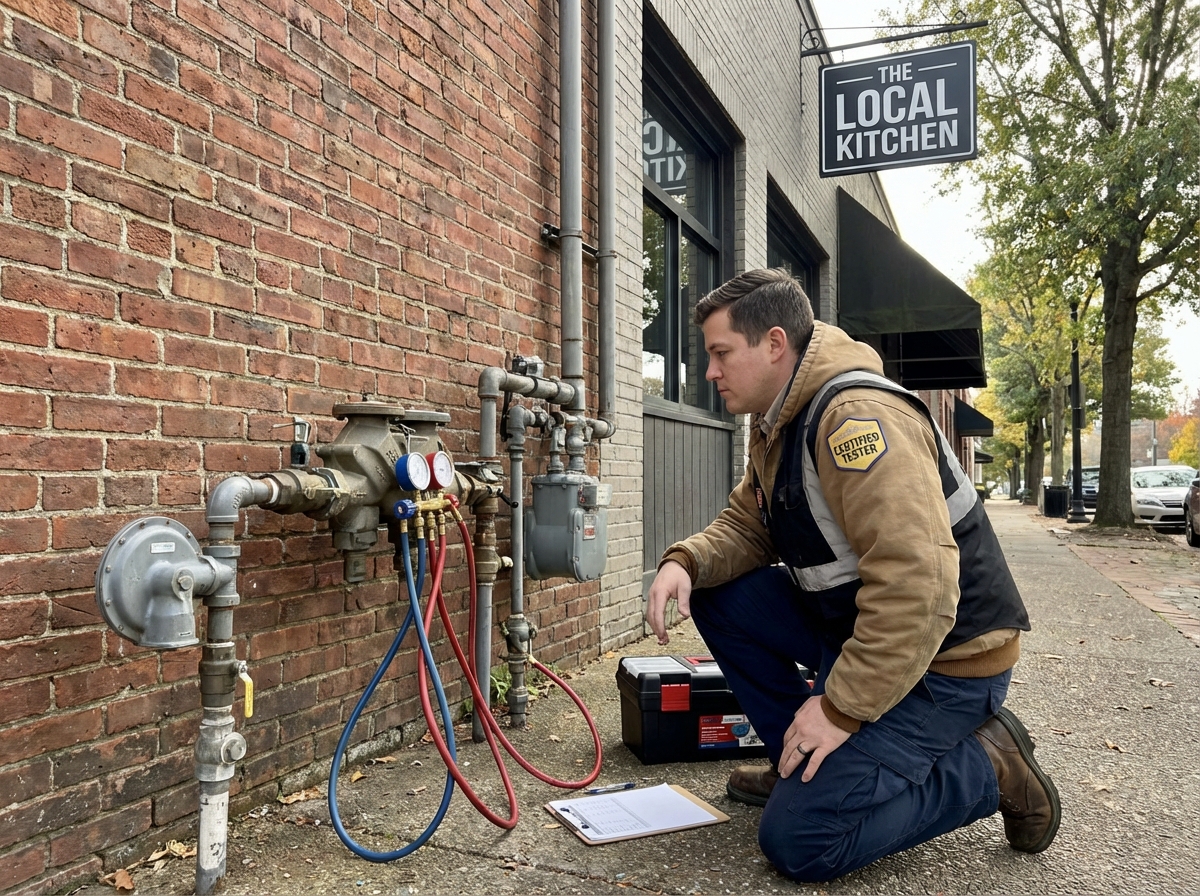 Certified backflow tester using a differential pressure test kit on an RPZ assembly outside a restaurant
Common Compliance Problems in Commercial Kitchens
After years of working with restaurants, catering operations, and institutional kitchens, these are the compliance issues that come up again and again.
Inaccessible Assemblies
RPZ assemblies installed behind walk-in coolers, above drop ceilings without access panels, or in locked mechanical rooms that kitchen staff cannot access create problems during inspections and testing. If a tester cannot reach the device, they cannot test it, and you will be flagged as non-compliant.
Fix: Ensure every assembly has at least 12 inches of clearance on all sides and is reachable without moving heavy equipment. If your RPZ is in a pit, make sure the pit is not flooded or filled with debris.
Missing Point-of-Use Protection
Premise isolation alone does not satisfy code requirements. Inspectors routinely flag commercial kitchens for missing vacuum breakers on hose bibbs, missing air gaps on dishwashers, and unprotected carbonation systems. These individual protections exist to prevent cross-contamination within your own building, not just to protect the public main.
Unauthorized Equipment Modifications
Kitchen equipment gets swapped, moved, and re-plumbed constantly. Each change can create a new cross-connection that was not there during the last inspection. Adding a new prep sink, relocating a dishwasher, or installing a new espresso machine all require a review of backflow protection at that fixture.
Expired or Lapsed Testing
Some operators assume that once a backflow device is installed, the job is done. It is not. Mechanical assemblies degrade. Check valves wear out. Relief valves get clogged with mineral deposits. Annual testing is how you verify the device still works. Skipping it does not save money — it delays a problem until it becomes an emergency.
What Happens When You Are Not in Compliance
Water utilities and health departments have enforcement tools, and they use them:
- Warning letters and compliance notices with deadlines (typically 30 to 90 days)
- Fines that range from $100 to $1,000 per day depending on jurisdiction
- Water service disconnection — utilities can and do shut off water to non-compliant commercial properties
- Health department violations that can affect your operating permit and appear on public inspection records
- Civil liability if contamination occurs and is traced to your facility
The cost of compliance — installing the right devices, keeping them maintained, and testing them annually — is a fraction of any single enforcement action. For most commercial kitchens, you are looking at a few hundred dollars per year in testing fees and occasional repair costs.
Steps to Get Your Commercial Kitchen Into Compliance
If you are not sure where your kitchen stands, here is a practical path forward.
1. Request your backflow inventory from the water utility. Most utilities maintain records of registered assemblies on your property. Compare this to what is actually installed. Discrepancies are common, especially if you took over an existing restaurant space.
2. Have a certified backflow tester perform a site survey. A good tester will walk your kitchen, identify every cross-connection, assess whether existing devices are appropriate, and flag gaps. This is often done as part of a scheduled annual test or for a modest additional fee.
3. Address gaps with a licensed plumber. Install missing devices, relocate inaccessible ones, and replace aging assemblies that are past their useful life. RPZ assemblies typically last 15 to 25 years with proper maintenance, but internal components need rebuilding every 5 to 8 years in hard-water areas.
4. Set up an annual testing schedule. Do not wait for the utility to remind you. Schedule your annual test proactively and keep records of every test report. Many property managers use calendar reminders tied to their lease renewal cycle to make sure testing does not slip.
5. Train kitchen staff on cross-connection basics. Your team does not need to be plumbing experts, but they should know not to leave hoses submerged in sinks, not to bypass vacuum breakers, and to report any plumbing modifications to management before making them.
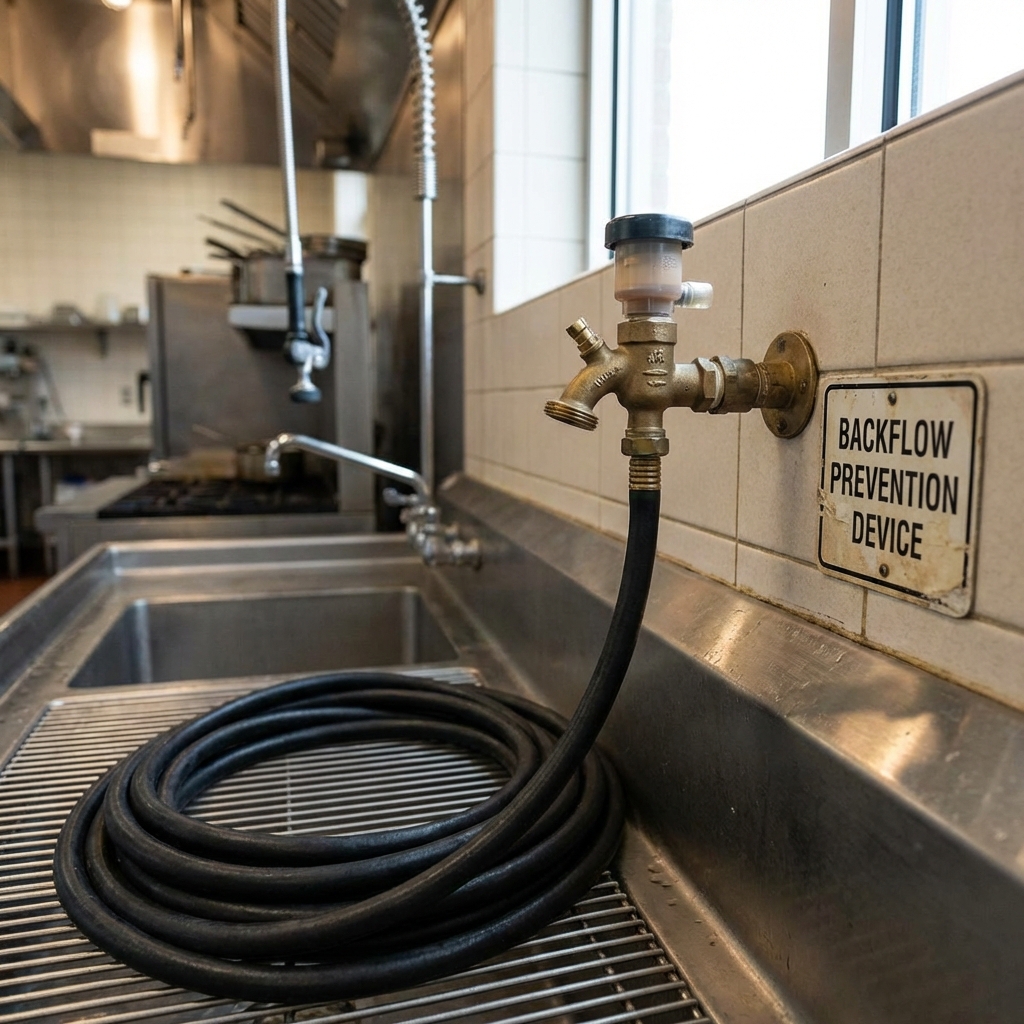 Wall-mounted hose bibb with atmospheric vacuum breaker installed at a commercial kitchen wash-down station
Choosing a Backflow Tester for Your Commercial Kitchen
Not all backflow testers have experience with commercial kitchen environments. When selecting a tester, ask these questions:
- Are you certified in my state? Certification requirements vary. Verify that their credential is current and accepted by your water utility.
- Do you file test reports directly with the utility? This saves you administrative work and ensures reports are submitted on time.
- Can you perform repairs on-site if a device fails? Some testers are also licensed plumbers who can handle repairs immediately rather than requiring a second visit.
- Do you have experience with restaurant and food-service facilities? A tester familiar with commercial kitchen layouts will identify point-of-use issues that a general tester might overlook.
Finding a qualified tester in your area does not have to be difficult. Use a directory like FindBackflowTesters.com to search by zip code and connect with certified professionals who handle commercial kitchen accounts regularly.
Staying Ahead of Requirements
Backflow prevention codes are tightening, not loosening. Several states have expanded their cross-connection control programs in recent years, and the EPA continues to push for stronger enforcement at the local level. Commercial kitchen operators who build compliance into their standard operating procedures — rather than treating it as an afterthought — avoid disruptions, protect their customers, and keep their doors open.
The bottom line: know what devices you need, keep them tested, fix problems immediately, and work with certified professionals who understand the specific risks in food-service plumbing. Your water utility and health department will notice the difference.