Commercial Backflow Testing Requirements: 2026 Compliance Guide for Property Owners
Why Commercial Buildings Face Stricter Backflow Rules Than Homes
Commercial properties carry water risk that residential structures simply don't. A restaurant connects municipal water to grease traps, carbonation systems, and dish sanitizers. A medical office has dental chairs, sterilizers, and lab sinks. A warehouse may feed irrigation, fire suppression, and a chemical wash bay off the same meter. Each of these is a potential pathway for contaminated water to siphon backward into the public supply during a pressure drop.
That's why nearly every U.S. jurisdiction treats commercial water service as a higher hazard class than residential. Under the federal Safe Drinking Water Act and EPA cross-connection control guidance, your local water purveyor is legally responsible for protecting the distribution system. They push that obligation downstream to you, the property owner, in the form of mandatory backflow assembly installation, annual testing, and documented repairs.
If you own, manage, or operate a commercial building in 2026, the compliance bar has risen. Many municipalities tightened reporting after the EPA's 2024 update to the Cross-Connection Control Manual, and several states now levy daily fines for missed annual tests. This guide walks through what's actually required, how to verify your building is compliant, and what to do if you've inherited a property with unclear records.
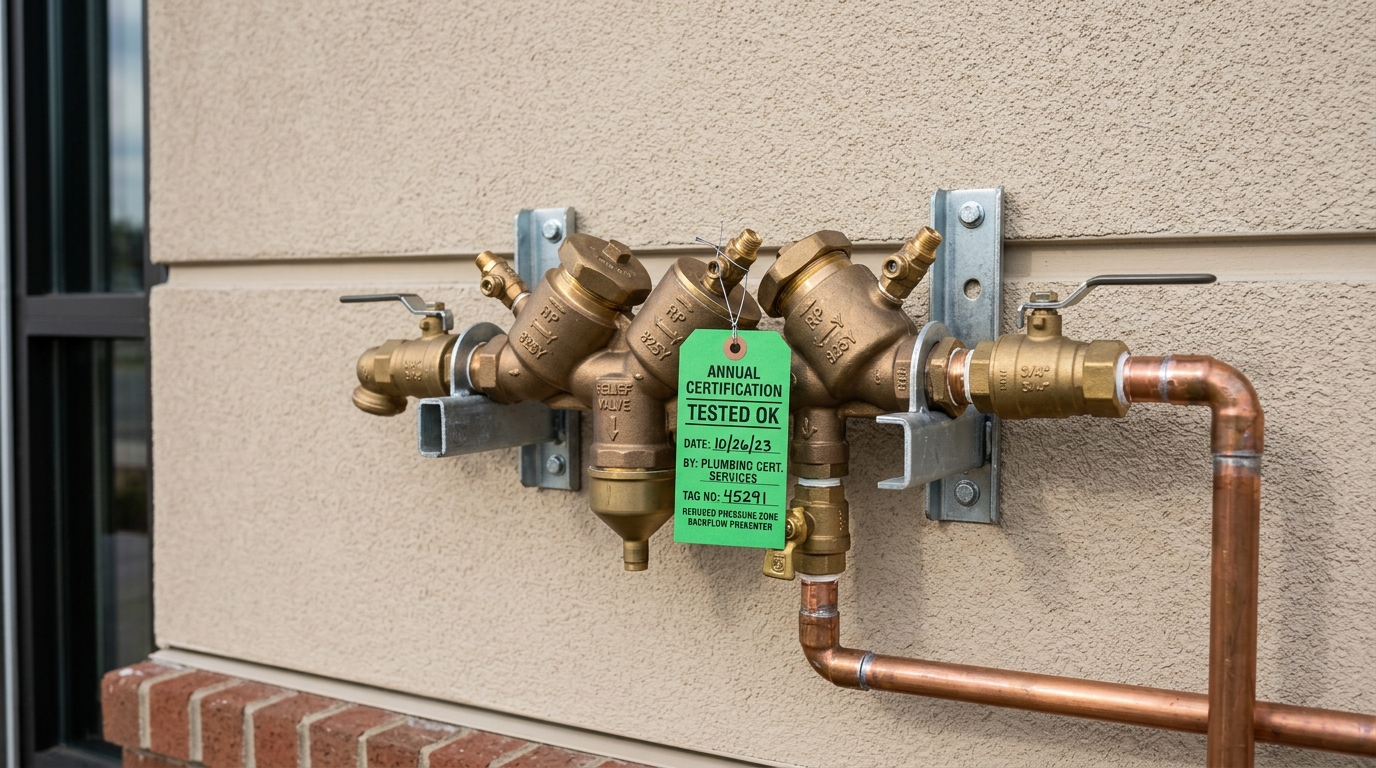
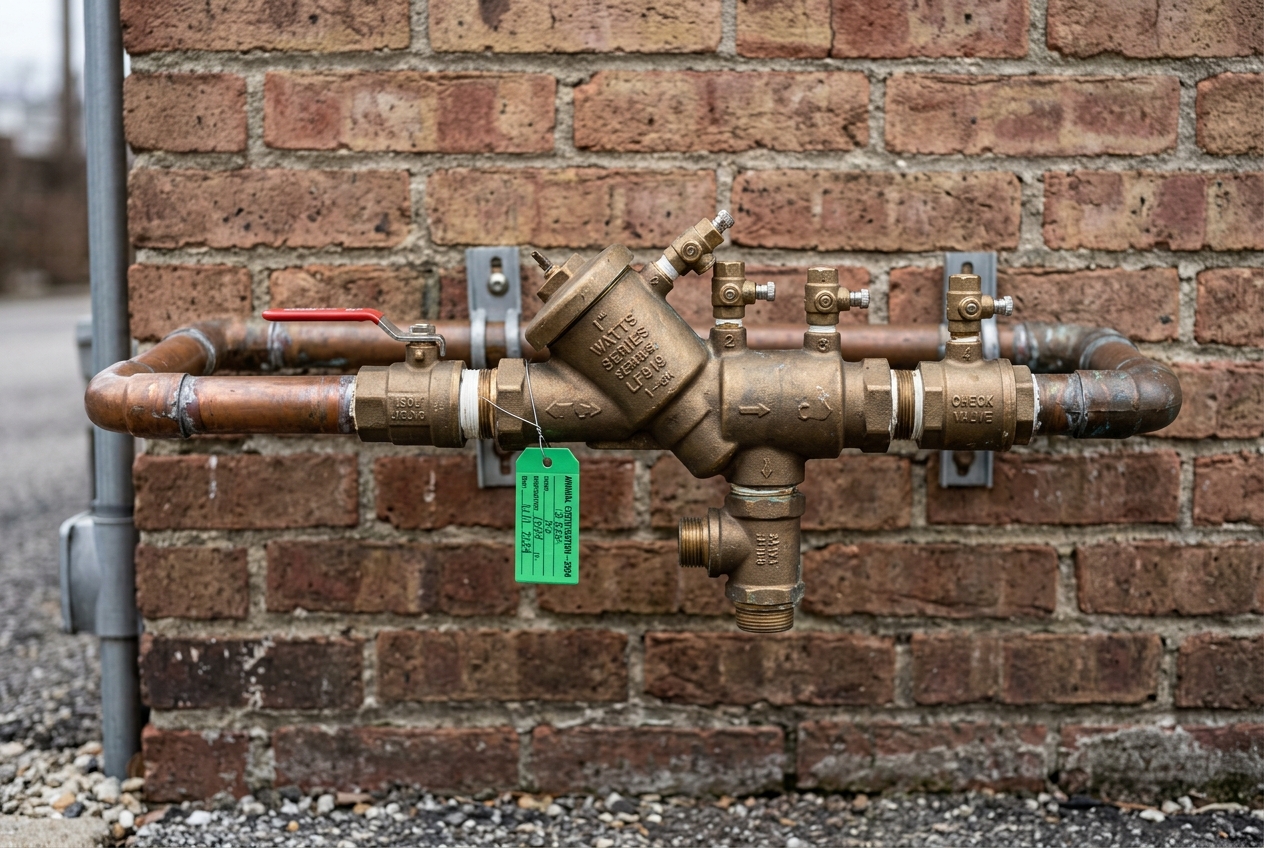 A reduced pressure zone assembly mounted above ground on the exterior wall of a commercial building, with brass test cocks and a small green tag wired to the body
The Three Hazard Classifications That Determine What You Need
Before you can know what assembly your building requires, you need to understand how water authorities classify cross-connection risk. There are three tiers, and they map directly to the device you'll be required to install.
Low hazard (non-health) covers situations where backflow would be aesthetically unpleasant but not dangerous. Think of an office building with nothing more than bathroom fixtures and a break room sink. Most jurisdictions require a double check valve assembly (DCVA) on the service line for these, though smaller offices may get by with a pressure vacuum breaker on specific fixtures.
High hazard (health) is anything where backflow could introduce pathogens, chemicals, or toxic substances. This is where most commercial buildings actually land. Restaurants, medical and dental practices, auto shops, salons, laundromats, manufacturing, agricultural processing, mortuaries, and any property with irrigation that uses fertilizer injection all require a reduced pressure zone assembly (RPZ or RPZA). The RPZ is the gold standard because it physically dumps water out of a relief valve if either of its check valves fails, making contaminated backflow nearly impossible.
Fire suppression systems get their own classification because they hold stagnant water for long periods and may contain antifreeze or foam additives. A wet-pipe sprinkler system using only potable water typically needs a double check detector assembly (DCDA). A system with chemical additives or one connected to a non-potable source requires a reduced pressure zone detector assembly (RPDA). The "detector" version adds a bypass meter so the utility can spot leaks or unauthorized use.
The classification isn't your choice. Your water purveyor assigns it based on your business type, the fixtures inside, and any auxiliary water sources on site. If you change use, you may trigger a reclassification.
What "Required" Actually Means in 2026
The word "required" gets tossed around loosely. Here is what is genuinely mandatory for a commercial property in nearly every U.S. jurisdiction this year.
Installation at the service connection. Your primary backflow assembly must be installed immediately downstream of the meter, before any branch line. For RPZ assemblies, it must be above ground, indoors or in a heated enclosure if your climate freezes, with the relief port positioned to drain safely without flooding. Below-ground installation of an RPZ is prohibited everywhere because the relief port cannot function submerged.
Annual testing by a certified tester. Every assembly must be tested at least once every twelve months by a person holding a state or county-issued backflow prevention assembly tester (BPAT) certification. Some jurisdictions require more frequent testing for highest-hazard sites such as hospitals and chemical plants. The tester uses a calibrated differential pressure gauge to verify each check valve holds against pressure, that the relief valve opens at the correct differential, and that no internal seals are leaking.
Submission of the test report. This is where many property owners get caught. Testing the assembly is not the same as being compliant. The signed test report must be filed with the water purveyor within the timeframe they specify, typically 10 to 30 days. Late or missing reports trigger violation notices, and after a grace period your water service can legally be shut off.
Repairs and replacements documented. If the assembly fails its test, you have a narrow window — often 10 business days — to repair or replace it and submit a passing test. The tester cannot simply "pass" a marginal assembly. Failed assemblies must be physically rebuilt or swapped.
Reclassification on change of use. If your tenant mix changes, if a unit becomes a kitchen, if you add irrigation, or if you install any equipment that introduces chemicals to your plumbing, you owe your water purveyor a heads-up. They may upgrade your assembly requirement.
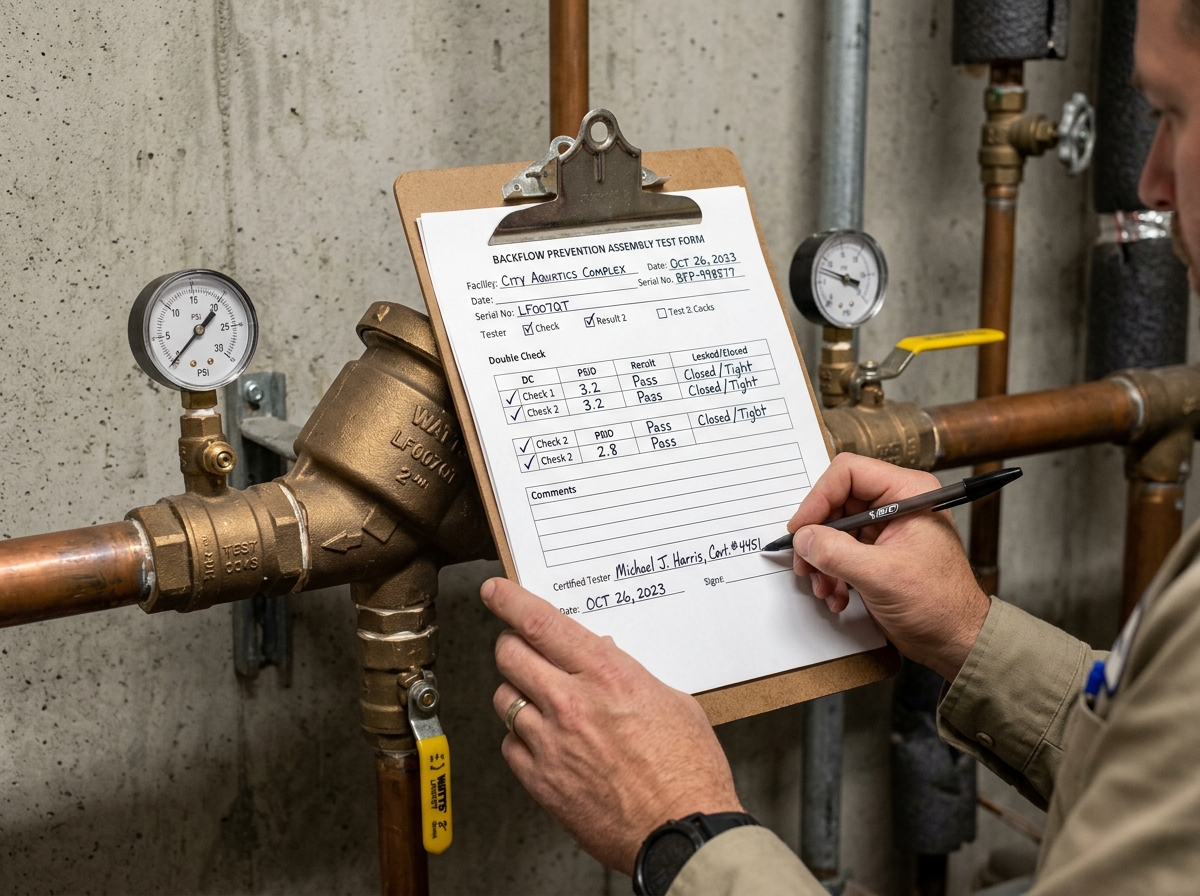 A clipboard resting on top of a backflow assembly showing a completed test form with gauge readings, signatures, and a hand holding a pen
The Specific Devices and Where Each One Belongs
It helps to think about backflow protection at two levels: the containment assembly that protects the public water supply at your meter, and the isolation devices that protect drinking water within your building from specific hazards inside.
The containment assembly is the one the water purveyor cares most about because it sits at the boundary of their system and yours. Whatever that device is — DCVA, RPZ, DCDA — it is the one that triggers your annual test bill.
Isolation devices are required by the plumbing code and matter to your building inspector. Common examples include:
- Atmospheric vacuum breakers (AVB) on hose bibs and any sink with a threaded faucet, since a hose left submerged in a mop bucket is a textbook backflow scenario
- Pressure vacuum breakers (PVB) on irrigation zones
- Dual check valves on individual coffee, ice, or carbonation equipment
- Air gaps at every dishwasher discharge, lab sink, and ice machine drain — a physical break of at least twice the supply pipe diameter
Isolation devices are not always on the test schedule, but they are inspected during code reviews and after fixture replacement. A missing air gap on a new dish machine is the single most common violation cited in restaurant inspections.
What Annual Testing Actually Costs and What It Buys You
Commercial backflow testing prices vary by region and assembly size, but typical 2026 ranges in the U.S. look like this:
- 3/4" to 1" DCVA: $35 to $90 per device
- 3/4" to 2" RPZ: $50 to $150 per device
- 2.5" to 4" RPZ: $150 to $400 per device
- 6" and larger fire line assemblies: $250 to $700 per device
If repair is needed, expect $150 to $600 in parts for small assemblies and $400 to $1,500 for large ones, plus labor. Complete replacement on a large RPZ can run $3,000 to $8,000 installed.
What you're actually buying with the annual test is documentation. A failed assembly discovered in October is much cheaper than a contamination event in November. More importantly, the signed report is your legal defense if something does go wrong on your property — proof that you exercised the duty of care your jurisdiction requires.
How to Tell If Your Building Is Currently Compliant
If you've just purchased a commercial property, taken over management, or simply aren't sure, here is the fastest way to find out where you stand.
Step one: pull your water purveyor's record. Call the cross-connection control office at your water utility (not customer service for billing — they're separate) and ask for your property's backflow history. They will tell you what assemblies are on file, when each was last tested, the result, and whether you have any open violations. This call costs nothing and resolves the question in five minutes.
Step two: physically inspect every assembly. Walk the property and find each backflow device. Take photos including the serial number, manufacturer, model, and size stamped on the body. Compare to the utility's record. Mismatches are common — an assembly may have been replaced years ago without updating records, or a new wing may have added a service line nobody registered.
Step three: check the tag. Certified testers leave a tag, sticker, or wire label after each annual test showing the test date and the tester's certification number. If the most recent tag is more than a year old, you're already non-compliant.
Step four: verify isolation devices on a fixture walk. Every hose bib should have a vacuum breaker, every dish machine and ice maker should discharge to an air gap, and every irrigation zone should have a PVB. Note any missing or damaged devices.
Step five: schedule a current test if any date is uncertain. If you can't confirm a passing test within the last twelve months, schedule one immediately. The cost of a test is trivial compared to a shutoff notice.
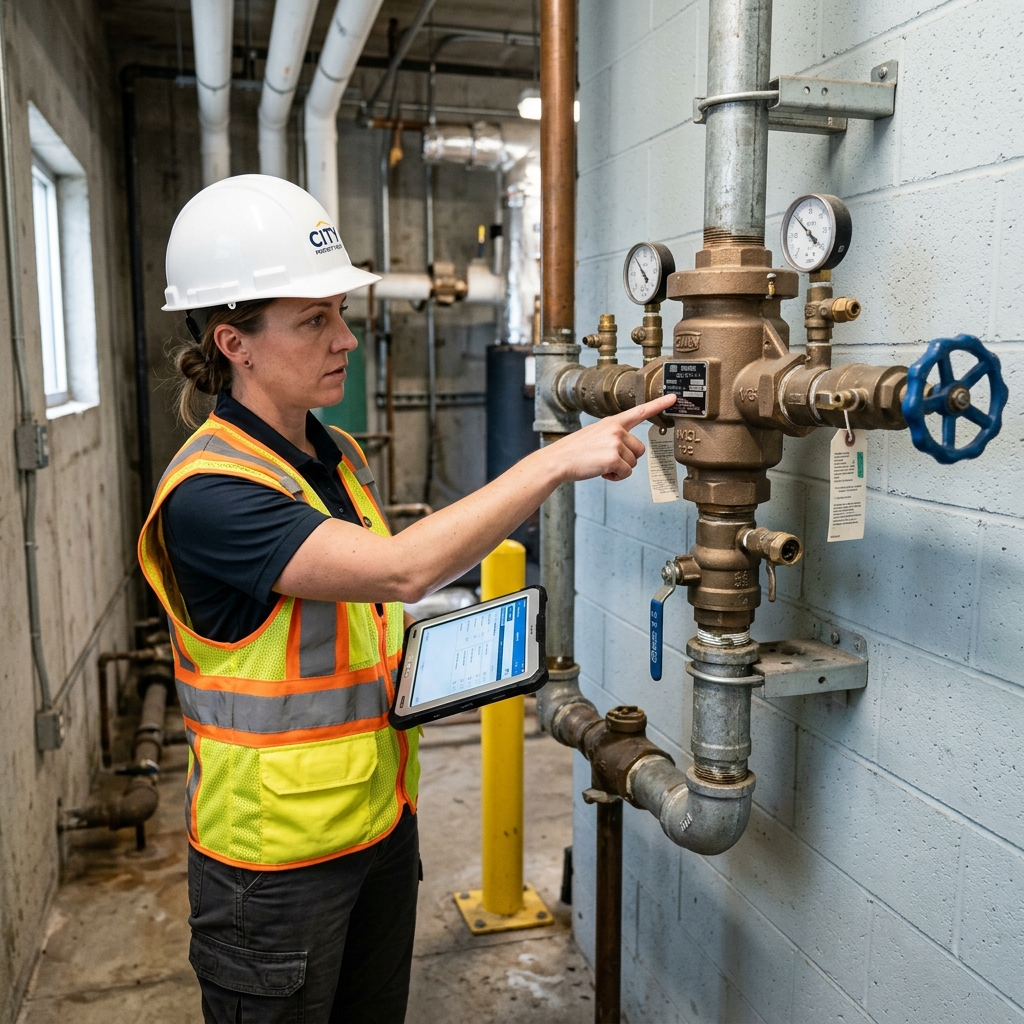 A property manager in a hard hat standing next to a wall-mounted backflow assembly inside a mechanical room, holding a tablet and pointing at the device's data plate
Common Mistakes That Cost Commercial Owners Money
A handful of errors come up repeatedly when properties fail compliance reviews. Avoid these and you'll stay ahead of nearly every preventable issue.
Treating the test as the obligation. The test is half the job. Filing the report on time is the other half. Many testers will file on your behalf, but confirm this in writing. If your tester sends you a paper copy and expects you to forward it, build a calendar reminder.
Ignoring the freeze risk. An RPZ that freezes will burst and may flood your mechanical room. In any climate where temperatures drop below freezing, the assembly must be in a heated enclosure or insulated cabinet with a thermostatically controlled heater. Insurance claims for frozen backflow assemblies are common and largely preventable.
Hiring an uncertified tester. Certification is jurisdiction-specific. A tester certified in one state may not be valid in the next. Always confirm certification number and expiration before the work begins, and verify it on your state or county's online roster.
Forgetting fire-line assemblies. Property owners often remember the domestic water assembly and forget the fire suppression connection has its own DCDA or RPDA. Both are required, both must be tested annually, and the fire marshal will cite missing tests independently of the water utility.
Locking the assembly inside an inaccessible space. Testers need physical access. If the assembly is behind a tenant's locked door, in a ceiling, or buried in storage, every annual test becomes a coordination headache. Plan for clear, year-round access when locating or relocating equipment.
Your Next Steps Depending on Where You Are Today
If you're not sure whether you have working assemblies, call your water utility's cross-connection office tomorrow morning and pull your record. Then physically inspect what's on site.
If you know you have assemblies but can't confirm the last test date, hire a certified tester now and ask them to file the report directly with the utility. Get a copy for your records.
If you have an open violation, do not wait. Most jurisdictions will work with you if you respond promptly with a scheduled test date. They will shut off water if you ignore them.
If you're planning a tenant build-out, addition, or change of use, contact the water purveyor before construction begins. Building a kitchen where there was an office may require upgrading from a DCVA to an RPZ, and that's much cheaper to plan for at rough-in than to retrofit after drywall.
Compliance is not glamorous and it does not generate revenue, but for commercial buildings it is one of the cheapest forms of risk management you'll ever buy. A single contamination event can end a business. A $100 annual test, filed on time, makes that scenario nearly impossible.