Backflow Prevention for Churches and Houses of Worship
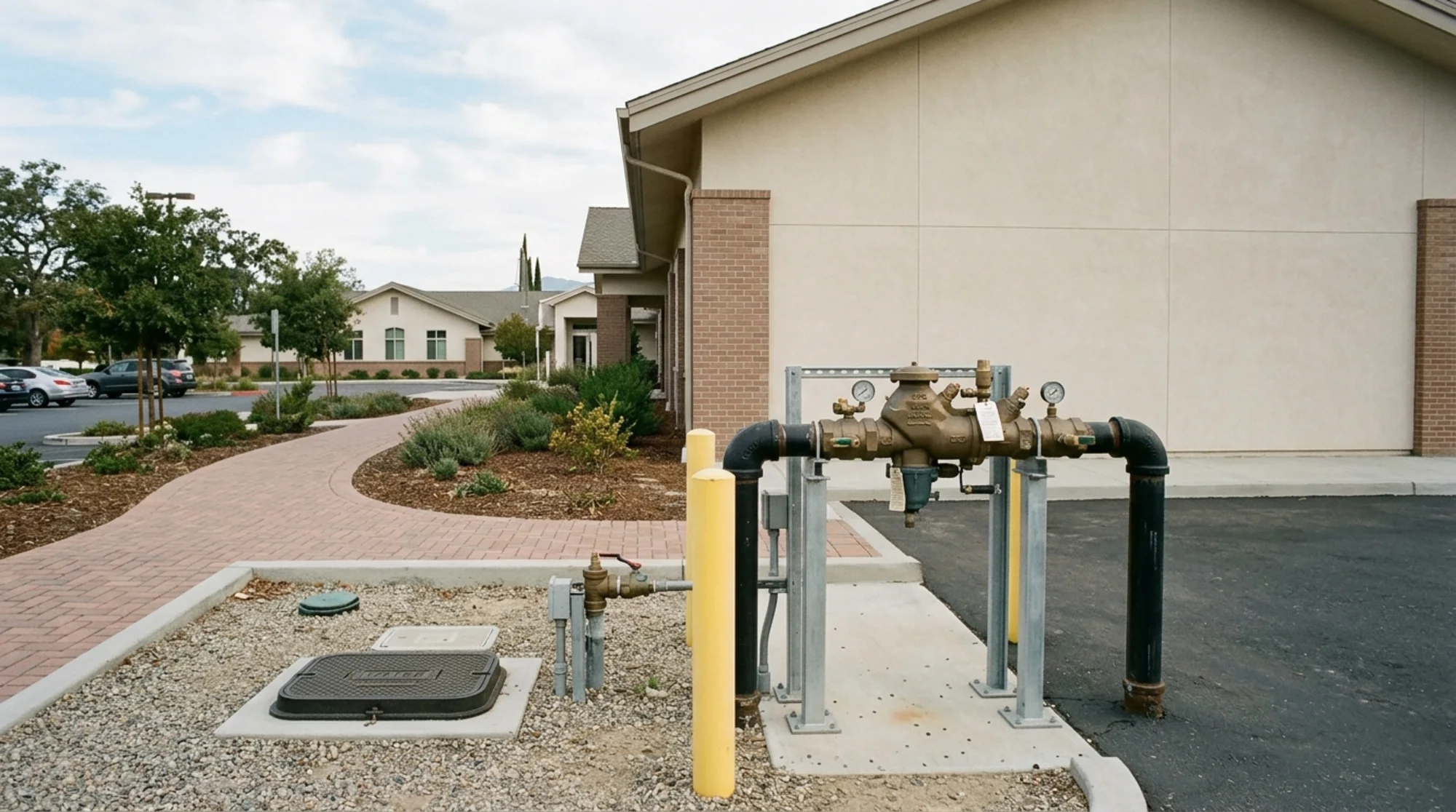
Churches and houses of worship are often more complex than they look from the parking lot. A site may include a sanctuary, fellowship hall, public-style kitchen, irrigated landscaping, fire sprinklers, classrooms, a daycare, a gym, a rectory, or multiple buildings on separate service lines. Some campuses also have pools, boilers, memorial gardens, or auxiliary water uses tied to landscaping or maintenance.
That matters because utilities usually do not classify backflow risk by the building’s religious use. They classify it by the plumbing conditions and hazard profile on the property.
So the right question is usually not, “Do churches need backflow prevention?” The better question is, “What systems on this campus create a cross-connection risk, and what protection does the utility require for those conditions?”
If you want the public-health background first, start with why backflow testing is required. This guide focuses on the practical side for church administrators, facilities teams, and property committees.
Why churches can fall under backflow requirements
Exterior of a church campus with a visible backflow prevention assembly near the water service entrance, realistic utility infrastructure, morning light, no denominational branding, no text overlay
EPA explains that the Safe Drinking Water Act protects public health by regulating the nation’s public drinking water supply, with EPA, states, and water systems working together to keep standards in place. Local backflow programs are one of the practical ways utilities protect that water once it reaches private property.
Seattle Public Utilities puts the rule plainly: any actual or potential cross-connection must be eliminated or properly protected, and the hazard determines the protection type. That is the key principle to keep in mind for worship properties. A simple sanctuary with restrooms and no irrigation may be treated very differently from a large church campus with kitchens, schools, fire systems, and specialized equipment.
In other words, a church is not usually a special compliance category by itself. The utility is looking at the risk created by connected systems, not the religious mission of the building.
The most common risk drivers on a worship campus
Several property features tend to come up again and again when utilities evaluate churches and similar campuses.
- Irrigation systems. In-ground irrigation is one of the most common triggers in utility guidance. NYC DEP specifically lists in-ground irrigation sprinklers among the property conditions that require devices. Seattle treats ordinary irrigation as a low-hazard example, but separately notes that irrigation systems using chemical addition can be treated as high hazard.
- Public or commercial-style kitchens. Fellowship halls, event kitchens, and food-prep spaces matter because utilities often focus on the actual kitchen use, not whether the building is commercial in the usual sense. NYC DEP lists commercial or public kitchens among the property conditions that require devices.
- Multiple water service lines. Larger campuses may have separate feeds for the sanctuary, school wing, irrigation, rectory, or fire service. NYC DEP lists multiple water service lines as a trigger condition.
- Fire sprinkler systems. Portland Water Bureau explains that a DCDA is used to protect fire sprinkler systems from stagnant water, booster pumps, FDC connections, and similar issues. It also notes that an RPDA is intended for fire sprinkler systems with chemicals or additives, or with auxiliary water sources, storage tanks, or high-rise supply conditions.
- Chemically treated boilers. Older worship buildings often have boiler systems, and chemically treated boiler water is a common utility concern. NYC DEP specifically calls out treated boilers.
- Schools, preschools, and daycare. Many churches operate school or childcare programs on the same property. NYC DEP lists schools and colleges among the property conditions that require devices. If that is part of your campus, it is worth also reading Backflow Prevention for Schools and Educational Facilities.
- Pools or baptismal-related support systems. A full swimming pool is a clearly cited trigger in NYC DEP guidance. Baptismal setups vary, so the plumbing arrangement matters more than the religious purpose.
- Reused or auxiliary water. Seattle includes premises where reclaimed water and potable water are both provided among high-hazard examples. NYC DEP also lists premises that reuse or recycle water.
- Water-cooled equipment or chillers. Larger campuses with extensive HVAC or support equipment can run into this issue too.
The important thing is not to jump from that list to a one-size-fits-all conclusion. A church may need only straightforward low-hazard protection, or it may need more formal premises isolation and tighter review. The actual requirement depends on the site.
If you are still comparing local providers and utility context, the city pages for Austin, Philadelphia, and Seattle are useful starting points.
How utilities decide what assembly is required
Utilities usually make the decision based on hazard level, service layout, and the specific system being protected.
Portland’s guidance is a good example because it states the rule directly: the location of the assembly, service size, and hazard level determine which assembly should be used. Portland also explains that an RPBA may be installed on either low- or high-hazard connections, while a DCVA is commonly used where the hazard does not pose a health risk.
Seattle frames the issue similarly. High hazards require premises isolation with an RPBA or RPDA. Low-hazard examples in Seattle’s published guidance include irrigation systems, fire systems, and buildings exceeding three stories or 30 feet in height.
That means church facilities teams should be careful about assumptions such as:
- Assuming one assembly type fits the entire campus.
- Assuming a domestic line, irrigation line, and fire line will all be treated the same way.
- Assuming a new kitchen, daycare, or irrigation upgrade will not affect the utility’s risk determination.
For local context, it helps to keep utility program pages handy, especially the Austin Water backflow testing program and the Philadelphia Water Department backflow testing program.
Annual testing, qualified testers, and why the paperwork matters
 Church facilities manager and certified backflow tester reviewing an annual test report beside an irrigation and fire service backflow setup, realistic documentary style, natural lighting, no logos or text overlay
Once the right assembly is in place, the next risk is usually administrative rather than theoretical. Many properties fall out of compliance not because the device is missing, but because annual testing, report submission, or repair follow-up breaks down.
Seattle requires all installed backflow assemblies to be tested annually by a State of Washington Certified Backflow Assembly Tester. Seattle also says reports must meet WAC 246-292-036 content requirements, and Washington DOH publishes supporting resources for tester duties, report content, and certification verification.
NYC DEP says required devices must be tested every 12 months after installation and notes that failure to perform the annual test could result in fines or water disconnection. Seattle likewise warns that missed testing can lead to non-compliance charges and possible water-service termination.
The practical lesson is simple: the job is not finished when the technician leaves. It is finished when the test is completed by the right person, the report is submitted correctly, and your records show the cycle is closed.
If you need help choosing a provider, choose the right provider and the main FAQs page are good next stops.
A practical checklist for church facilities teams
A simple process prevents most avoidable misses.
1. Build an assembly register
Track each assembly by location, type, size, serial information, system served, last passing test, next expected due date, and where the report is stored.
2. Map the hazard drivers
Note which buildings or systems have irrigation, kitchens, schools or daycare, boilers, fire systems, pools, or any reused or auxiliary water source.
3. Confirm the utility’s current view
Do not rely only on what was true years ago. A renovation, kitchen upgrade, or landscape project can change what the utility expects.
4. Verify the tester before booking
Use a tester who meets the state or utility program requirements for your jurisdiction and assembly type.
5. Schedule early enough for failures
Leave time for repairs and retesting instead of booking right at the deadline.
6. Treat report submission as part of the task
Do not mark the job complete until the report has been submitted correctly and saved internally.
7. Re-check requirements when the campus changes
New irrigation zones, a remodeled fellowship kitchen, a preschool expansion, or a modified fire system can all justify a new review.
8. Keep a local action list
For quick planning, keep links to your relevant city and utility pages, including Austin, Philadelphia, Seattle, and your utility program pages.
 Administrative staff at a church office using a compliance checklist with assembly inventory, due dates, and utility submission records, realistic office environment, natural daylight, no logos or text overlay
Bottom line
Churches and houses of worship are usually judged by the same principle as any other property: what cross-connection risk exists on the site, and what protection does the utility require for that risk.
For many worship campuses, the biggest questions are not theological or even architectural. They are practical:
- Is there irrigation?
- Is there a public kitchen?
- Is there a school or daycare wing?
- Are there multiple service lines or a fire system?
- Is annual testing being completed and documented properly?
If your team can answer those questions clearly, keep current records, and work with qualified testers, backflow compliance becomes much more manageable. And if you still need local help, compare providers through the city pages and utility program guides before the next due date turns into a scramble.
Sources
This article references guidance and regulations from authoritative sources including:
- U.S. Environmental Protection Agency (EPA) - Overview of the Safe Drinking Water Act
- American Water Works Association (AWWA) - Cross-Connection Control and Backflow Prevention resources
- Washington State Department of Health - Cross-Connection Control and Backflow Prevention
- Seattle Public Utilities - Requirements & Types of Backflow Prevention
- Seattle Public Utilities - Backflow Assembly Testing
- Portland Water Bureau - How to choose and install a backflow prevention assembly
- Philadelphia Water Department - Cross-Connection & Backflow Compliance
- New York City Department of Environmental Protection - Backflow Prevention Frequently Asked Questions
- Centers for Disease Control and Prevention (CDC) - Preventing Drinking Water-Related Illnesses
Last updated: May 20, 2026