Backflow Preventer Types Explained: AVB, PVB, DCVA, and RPZ Guide
What a Backflow Preventer Actually Does
Before getting into the different types, it helps to understand the problem these devices solve. Water in a building's plumbing is supposed to flow in one direction: from the municipal supply, through your fixtures, and out as wastewater. Backflow is what happens when that flow reverses. A pressure drop in the city main, a burst pipe down the street, or a high-pressure source inside the building can pull contaminated water back into the clean supply line.
The consequences range from unpleasant to serious. Lawn chemicals, boiler treatment additives, soapy water from a utility sink, or pesticides from an irrigation system can all end up in drinking water if a property doesn't have the right protection. Backflow preventers are mechanical barriers that stop this reversal. The type you need depends on what hazard you're protecting against and how the device fits into your plumbing.
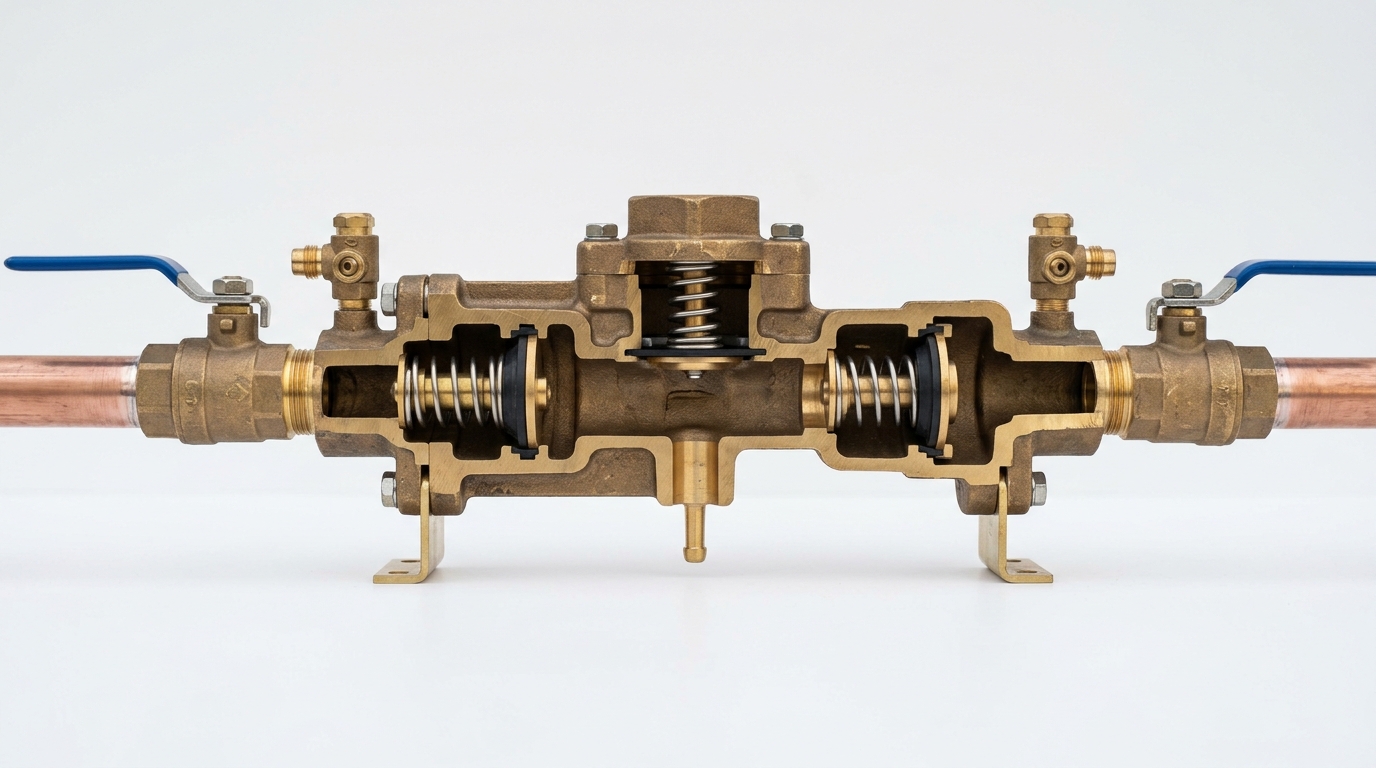
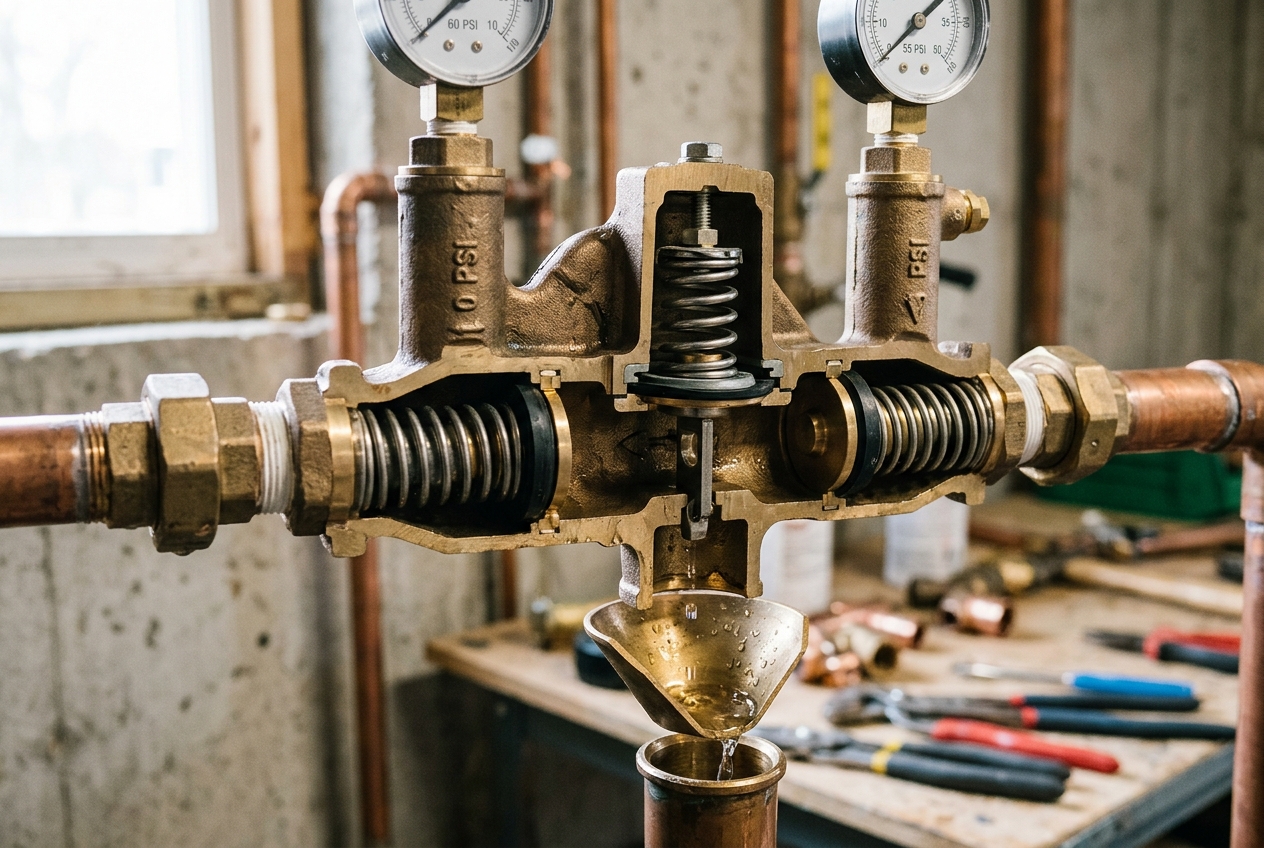 Cutaway diagram of a brass backflow preventer showing internal check valves and relief port
Choosing the wrong device is more common than you'd think. A homeowner who installs an inexpensive hose-bib vacuum breaker on a system that legally requires a reduced pressure zone assembly isn't just out of code. They're leaving their family and neighbors exposed to whatever contaminants the system was meant to block. Picking the right device starts with knowing what each one does and where it belongs.
The Two Categories of Backflow
Every backflow event falls into one of two categories, and the device you choose has to match.
Back-siphonage happens when pressure on the supply side drops below the pressure on the downstream side. Imagine drinking through a straw. If a water main breaks nearby and the city has to shut down a section, pressure in your pipes can briefly go negative, sucking water from your hose, irrigation lines, or fixtures back toward the main.
Back-pressure happens when the downstream pressure rises above the supply pressure and pushes water backward. This is common in commercial settings with boilers, pressure washers, fire suppression systems, or any equipment with its own pump.
Some devices protect against only back-siphonage. Others protect against both. Knowing which scenario applies to your property is the first filter when selecting a device.
Atmospheric Vacuum Breakers (AVB)
The atmospheric vacuum breaker is the simplest and cheapest option in the family. It uses a float and a vent that opens to the atmosphere whenever the supply pressure drops, breaking any siphon before contaminated water can move backward.
You'll typically find AVBs on irrigation systems, janitorial sinks, and process equipment where the device sits above the fixture it serves. They have to be installed at least six inches above the highest downstream outlet, and they cannot be under continuous pressure. If a valve downstream of the AVB stays open for more than twelve hours at a time, the device's seals will eventually fail.
AVBs protect against back-siphonage only. They do nothing for back-pressure. They are also non-testable. There's no test cock to verify performance, so when one fails, you replace it rather than repair it. For low-hazard applications with intermittent use, they remain a cost-effective choice.
Pressure Vacuum Breakers (PVB)
The pressure vacuum breaker is the AVB's more capable sibling. It's testable, can sit under continuous pressure, and is the workhorse of residential irrigation systems across most of the country.
A PVB consists of a spring-loaded check valve and an air inlet valve that opens when supply pressure drops. Because the device is testable, it has shut-off valves on either side and two test cocks that a certified tester uses to verify the check and air inlet are working. PVBs must be installed twelve inches above the highest downstream point, which is why you see them sticking up out of the ground next to lawn sprinkler systems.
Spill-resistant pressure vacuum breakers, or SVBs, are a variation designed for indoor installation. They use a different air inlet design that doesn't spit water during normal operation, so they're acceptable in places where a standard PVB's occasional discharge would cause damage.
PVBs handle back-siphonage but not back-pressure. If your irrigation system has any kind of pump that could push water back into the supply, a PVB isn't enough.
Double Check Valve Assemblies (DCVA)
A double check valve assembly is exactly what it sounds like: two independent check valves in series, with shut-offs and test cocks on either end. The redundancy is the whole point. If one check fails, the other still holds.
DCVAs protect against both back-siphonage and back-pressure, which makes them suitable for a much wider range of applications than vacuum breakers. They're commonly used on fire sprinkler systems without chemical additives, food-grade water lines, and low-to-medium hazard commercial connections. Because they can be installed below grade in a vault or above ground in a heated enclosure, they're more flexible than vacuum breakers in terms of placement.
The limitation is hazard rating. DCVAs are approved for non-health hazards only. They handle aesthetic contamination, like discolored water from a fire line that's been sitting stagnant, but they're not rated for situations where the contaminant could make someone sick. If there's any possibility of toxic chemicals, sewage, or biological hazards entering the protected system, a DCVA isn't the right choice.
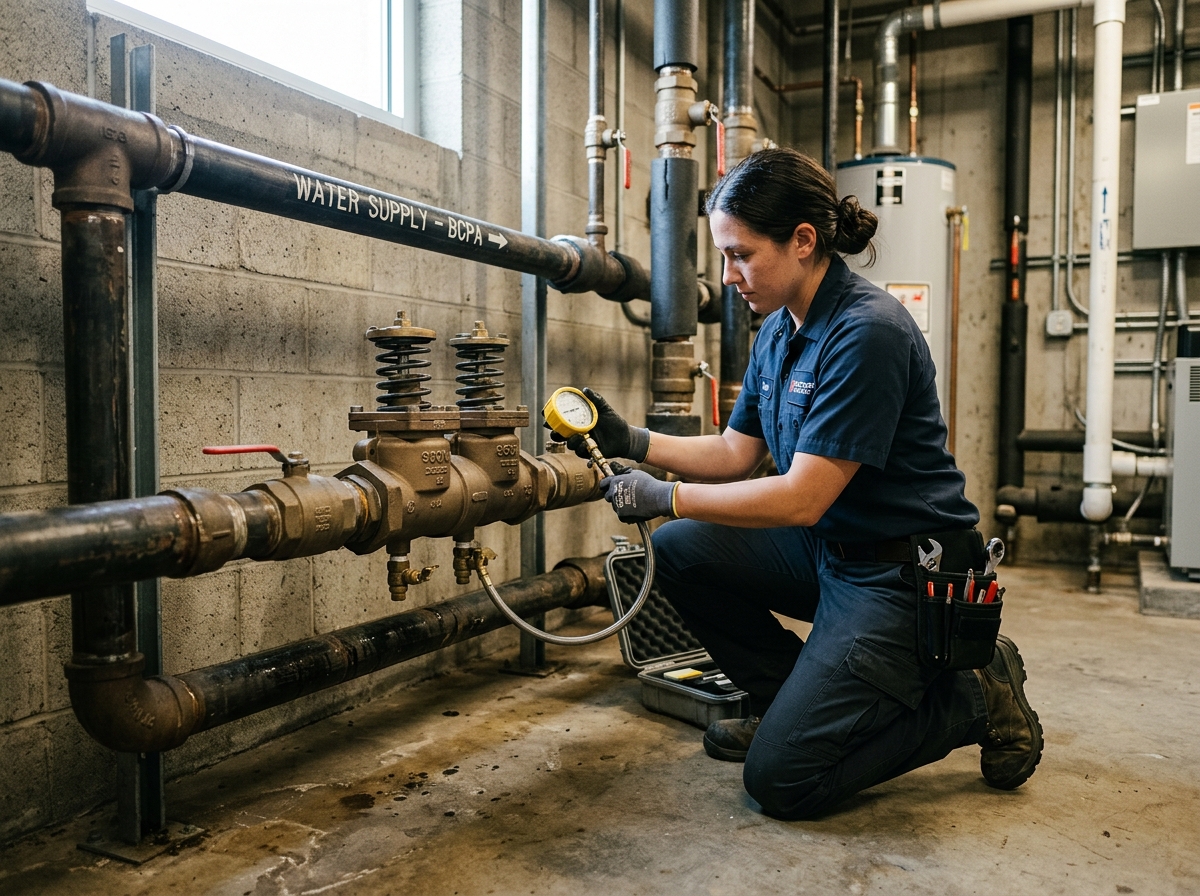 Technician kneeling beside an above-ground double check valve assembly in a mechanical room, attaching test gauge
Reduced Pressure Zone Assemblies (RPZ or RP)
The reduced pressure zone assembly is the most protective device in standard commercial and residential use, and the most expensive to buy, install, and maintain. An RPZ uses two spring-loaded check valves like a DCVA, but adds a relief valve between them that opens to the atmosphere whenever the zone between the checks loses pressure differential.
This relief mechanism is what makes the RPZ rated for high-hazard applications. If both check valves fail simultaneously, the relief valve dumps the contaminated water out of the device before it can reach the supply. You'll see an RPZ discharging from time to time. A small, brief spit during a pressure fluctuation is normal. A continuous stream means something is wrong, usually a fouled check valve or fluctuating supply pressure.
RPZs are required on most commercial buildings, medical facilities, irrigation systems that use fertilizer injection, boiler feed lines, and any connection where toxic or biological contamination is possible. They cannot be installed below grade because the relief port has to drain freely, and they cannot be installed where flooding would submerge the device. In cold climates, this usually means a heated mechanical room or an insulated above-ground enclosure with a heat trace.
Annual testing is mandatory in every jurisdiction I'm aware of, and most municipalities require the test to be performed by a certified tester whose results are filed with the local water authority.
Air Gaps
The air gap isn't a mechanical device. It's a physical separation between the end of a supply pipe and the flood-rim of the receiving fixture. If the gap is at least twice the diameter of the supply pipe, with a minimum of one inch, it provides absolute protection against backflow. There's no mechanical part to fail because there's no closed connection at all.
You see air gaps on dishwasher drain lines, commercial sinks, water softener drain connections, and emergency eyewash stations. The catch is that air gaps only work where the supply discharges into an open receiver. You can't use one in a pressurized line, which rules out most plumbing fixtures and all irrigation systems.
When an air gap is feasible, it's almost always the right answer. It's the only backflow protection method that doesn't require testing or maintenance.
Hose Bib Vacuum Breakers
The little brass cap you see threaded onto an outdoor faucet is a hose bib vacuum breaker. It's the lowest tier of protection, designed to keep garden chemicals, pool water, or whatever's at the end of a hose from being siphoned back into the house during a pressure drop.
Most plumbing codes now require these on all exterior hose bibs and on any threaded interior faucet, like a utility sink or laundry tub. They're cheap, non-testable, and meant to be replaced when they wear out. The set screw on the side is meant to break off after installation, so removing one without a tool is intentionally difficult.
These devices protect against back-siphonage on a single low-hazard fixture. They don't replace the larger device protecting the whole property.
Matching the Device to the Application
The right device depends on three questions. What's the hazard level? Is back-pressure possible? Does the device need to be testable?
For a residential lawn irrigation system without fertilizer injection, a PVB is usually sufficient. Add a fertilizer injector or any kind of booster pump, and you need an RPZ. For a fire sprinkler line with no chemical additives, a DCVA is the standard. For a commercial building's main water service in a jurisdiction that classifies the connection as high-hazard, expect to install an RPZ at the meter. For a residential dishwasher, an air gap or air gap fitting on the drain hose is required by most codes.
When in doubt, your local water purveyor or a certified backflow tester can review the cross-connection survey for your property and tell you which device is required. Don't rely on what was there before. Codes change, and a building that was grandfathered in under old rules may need an upgrade when the device fails or the use of the property changes.
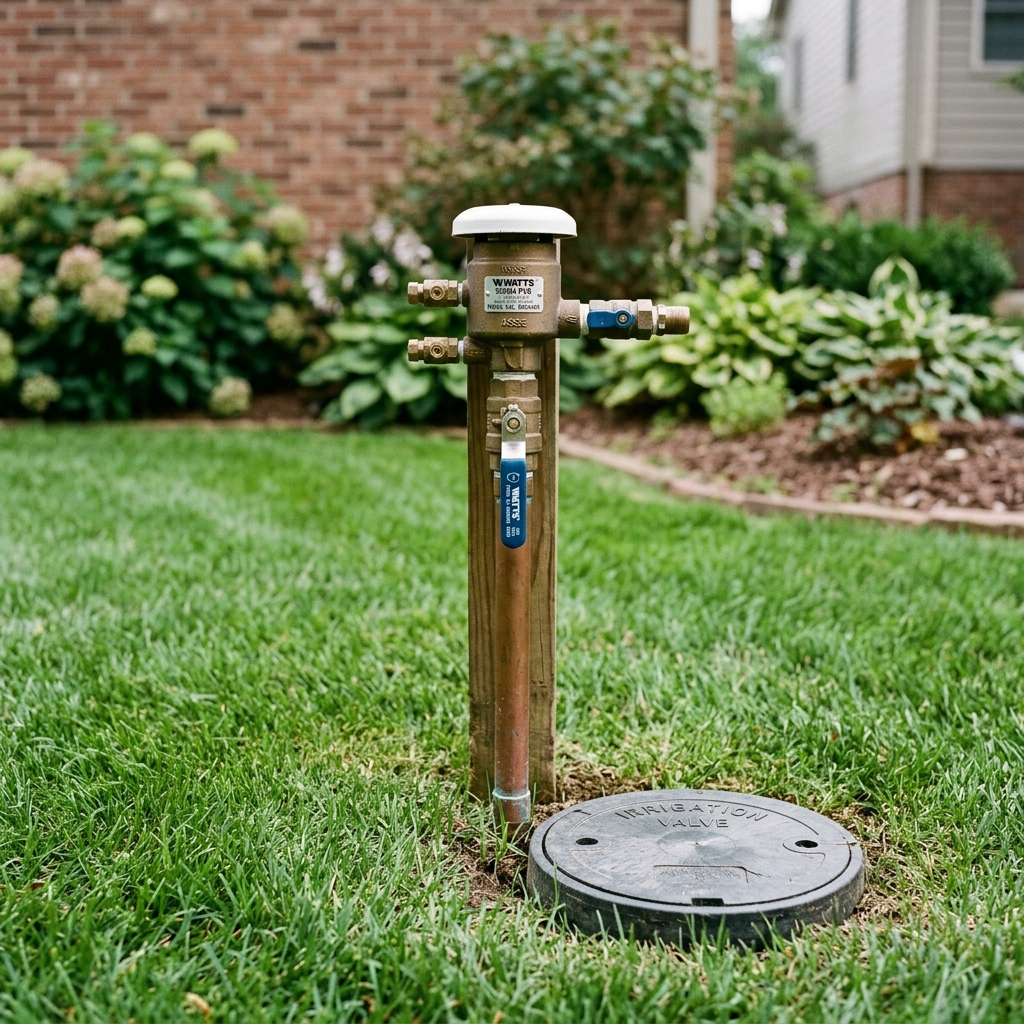 Outdoor pressure vacuum breaker mounted vertically next to a residential irrigation valve box on a green lawn
Testing, Maintenance, and Replacement
Every testable device has to be tested at installation, after any repair, and at least annually. The test verifies that the check valves hold pressure, that the air inlet or relief valve opens at the correct differential, and that the device is performing within manufacturer specifications.
A tester uses a calibrated differential pressure gauge connected to the test cocks in a specific sequence. The whole process takes fifteen to thirty minutes per device for someone who knows what they're doing. Test reports go to the local water authority, and most jurisdictions will issue a notice and eventually shut off water service if a required test isn't filed.
Failed devices usually need rebuilding rather than replacement. Manufacturers like Watts, Febco, Wilkins, and Apollo all sell rebuild kits with the springs, seats, and elastomeric parts that wear out. A device installed in clean municipal water with stable pressure can run twenty years between major rebuilds. A device on a well system with sediment or in an area with frequent water hammer might need attention every few years.
Next Steps for Property Owners
If you own a single-family home with irrigation, find out what kind of device is on your system and when it was last tested. The shut-off and test cocks are usually obvious if you know what to look for. If you can't find a device at all and your jurisdiction requires one, contact a certified tester now rather than waiting for a notice from the water utility.
If you manage a commercial property, pull your last annual test reports and confirm every device on the site is accounted for. Buildings often have devices installed years ago that nobody remembers, and missing one on the annual test can result in fines or a service interruption.
If you're planning a new installation or a renovation, have the cross-connection survey done before the plumbing rough-in is finalized. Adding a required RPZ after the fact is much more expensive than designing it into the project from the start. The right device at the right location, installed once and tested every year, is the cheapest path to keeping your water supply safe.